The Alhambra's Hidden Secrets: How the Last Muslim Rulers of Spain Built a Palace That Still Defies Time
Few monuments in the world combine architecture, political history, mathematics, poetry, water engineering, and artistic imagination as completely as the Alhambra.
Rising above Granada in southern Spain, the complex was developed primarily under the Nasrid dynasty, the last major Muslim ruling house of al-Andalus.
To describe the Alhambra simply as a palace is inadequate.
It was a royal city.
A fortress.
An administrative center.
A collection of gardens.
A symbolic representation of power.
And, after the Christian conquest of Granada in 1492, a monument that continued to acquire new architectural layers.
The Nasrid Kingdom of Granada
By the thirteenth century, Islamic political control in much of the Iberian Peninsula had been reduced dramatically.
The Nasrid Emirate of Granada survived as the final major Muslim state on the peninsula.
Its rulers faced powerful Christian kingdoms.
Diplomacy, tribute, military strategy, and political alliances became essential to survival.
The Alhambra emerged as the architectural heart of this kingdom.
From Fortress to Palace City
The name Alhambra derives from the Arabic al-Qal'a al-Hamra, often translated as “the Red Fortress.”
The site had earlier fortifications, but the Nasrid rulers transformed the hill into a major royal complex.
Its development included:
Defensive walls.
Towers.
Palaces.
Administrative spaces.
Gardens.
Water systems.
Mosques and later churches.
Residential areas.
Water: The Secret Engineering of the Alhambra
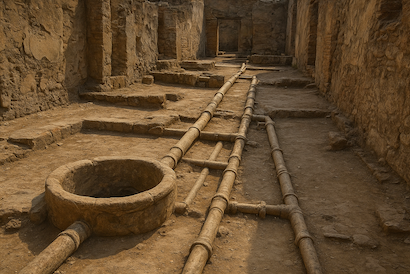
One of the most remarkable features of the complex is water.
Water flows through channels.
It fills pools.
It reflects architecture.
It cools courtyards.
It creates sound.
But its presence required sophisticated engineering.
Water had to be transported uphill and distributed throughout the complex.
The resulting system was both practical and symbolic.
In Islamic garden traditions, flowing water could evoke images of paradise.
The Geometry of Islamic Decoration
The Alhambra's walls appear covered with endlessly repeating patterns.
These designs are not random.
Artists used principles of geometry and symmetry to create complex visual systems.
Patterns could repeat indefinitely.
Stars, polygons, and interlocking forms created the impression of infinite order.
The result demonstrates a sophisticated relationship between mathematics and artistic design.
Arabic Inscriptions Everywhere
The Alhambra is also a palace of writing.
Arabic calligraphy appears throughout the complex.
Some inscriptions contain religious expressions.
Others include poetry.
Still others repeat royal mottos.
The most famous Nasrid phrase is:
“Wa la ghalib illa Allah” — “There is no victor but God.”
The repeated inscription linked political authority with divine power.
The Court of the Lions
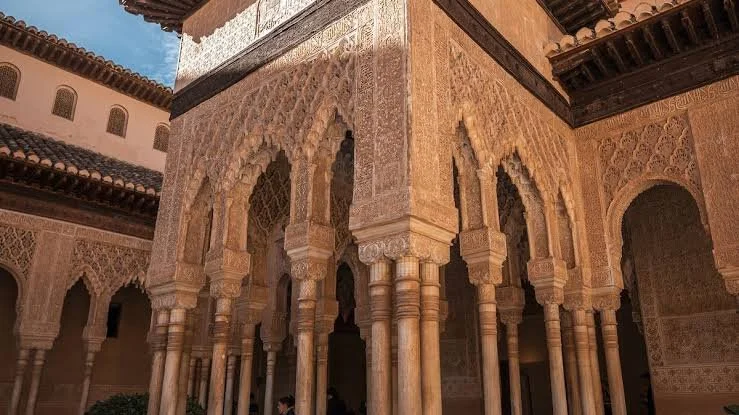
The Court of the Lions is one of the Alhambra's most famous spaces.
At its center stands a fountain supported by twelve sculpted lions.
The courtyard combines architecture, water, geometry, and symbolism.
The surrounding palace spaces create an environment designed for elite life.
But interpreting the exact symbolism of the lions has generated considerable scholarly discussion.
The monument should therefore be appreciated not as a puzzle with one secret answer, but as a space whose meanings developed through multiple historical contexts.
The Fall of Granada
In 1492, Granada surrendered to the Catholic Monarchs Ferdinand and Isabella.
The conquest marked the end of the Nasrid state.
But the Alhambra was not destroyed.
Instead, it was transformed.
Christian rulers occupied and altered portions of the complex.
Later, Charles V commissioned a Renaissance palace within the wider Alhambra complex.
This produced one of the monument's most striking characteristics: multiple civilizations remain physically visible in the same place.
Romanticism and the Rediscovery of the Alhambra
Centuries later, European Romantic writers and artists became fascinated by the monument.
Washington Irving's Tales of the Alhambra helped popularize the site internationally.
However, Romantic fascination sometimes transformed the real history of the monument into fantasy.
The Alhambra became associated with exoticized images of the “Orient.”
Modern scholarship attempts to move beyond these stereotypes.
Why the Alhambra Matters
The Alhambra is one of humanity's greatest architectural achievements because it demonstrates that beauty can emerge from systems.
Water is engineered.
Geometry is calculated.
Poetry becomes architecture.
Light becomes part of design.
The Nasrid rulers built their palace during a period when their kingdom faced enormous political pressure.
Yet instead of producing only military structures, they created one of the most sophisticated artistic environments in world history.
The Alhambra remains proof that even a kingdom approaching its political end can produce cultural achievements that survive for centuries.