India's “Ajanta of the Himalayas”? Inside Tabo's 1,000-Year-Old Monastery of Secret Murals
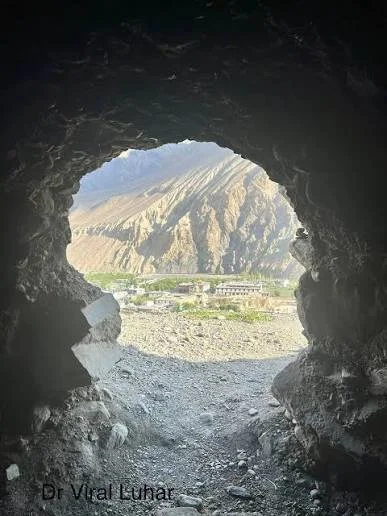
In the cold desert of Spiti, surrounded by mountains that appear almost barren, Tabo Monastery preserves one of the most extraordinary collections of Buddhist art in the Himalayan world.
Founded in the late tenth century, Tabo is often described as one of the oldest continuously functioning Buddhist monastic complexes in the region.
Its importance lies not in dramatic exterior architecture.
In fact, the buildings can appear relatively modest from outside.
The true wonder lies within.
Inside darkened temples are murals, sculptures, inscriptions, and sacred images that preserve an extraordinary visual record of Himalayan Buddhism.
For this reason, Tabo has sometimes been compared with Ajanta, although the two sites belong to very different artistic and historical traditions.
The Historical Background of Tabo
Tabo was founded during a period of major Buddhist revival in western Tibet and the Himalayan regions.
The late tenth and eleventh centuries witnessed renewed connections between Indian Buddhist centers and Tibetan religious communities.
Teachers traveled.
Texts were translated.
Monasteries were established or restored.
Artistic traditions moved across enormous distances.
Tabo emerged within this period of religious and cultural transformation.
Its foundation is traditionally associated with the great western Tibetan ruler Yeshe Ö and the Buddhist translator and teacher Rinchen Zangpo, although the precise nature of individual historical roles must be understood through the complex documentary and religious traditions surrounding the site.
A Monastery Hidden Behind Plain Walls
One of the most remarkable features of Tabo is the contrast between exterior and interior.
From outside, many of the structures appear built from earth and local materials.
They blend into the landscape.
Inside, however, the walls become surfaces for elaborate sacred imagery.
This architectural contrast may have served practical purposes as well as aesthetic ones.
Thick earthen walls helped protect interiors from extreme temperatures.
The enclosed spaces also created controlled environments for painted decoration.
The Murals
Tabo's murals are among its greatest treasures.
They depict complex Buddhist imagery.
The paintings may include:
Buddhas.
Bodhisattvas.
Protective deities.
Teachers.
Donors.
Celestial beings.
Mandalas.
Narrative and symbolic scenes.
The murals were not intended merely as decoration.
They formed part of a visual religious system.
Buddhist teachings can be expressed through image as well as text.
A mural could communicate complex cosmological ideas to monks, pilgrims, and visitors.
Art as Religious Instruction
In a society where literacy was not universal, visual imagery could serve an important educational role.
But even literate monks relied on images.
A mandala could represent an entire sacred universe.
The placement of a deity could communicate religious hierarchy.
Colors, gestures, attributes, and spatial arrangements all carried meaning.
Understanding Buddhist art therefore requires more than identifying the figures.
Researchers must examine iconography—the study of visual symbols and their meanings.
The Role of Rinchen Zangpo
Rinchen Zangpo occupies a central position in the history and traditions of Buddhist revival in western Tibet and the Himalayas.
He is associated with the translation of Buddhist texts and the establishment or artistic development of religious institutions.
The exact history of sites traditionally linked to him can involve later religious memory as well as historical evidence.
Nevertheless, his importance illustrates the transregional nature of Himalayan Buddhism.
The artistic and intellectual world of Tabo was connected with broader networks extending across Tibet and the Indian cultural sphere.
Sculptures and Three-Dimensional Sacred Space
Tabo's interior is not limited to painted walls.
Sculptures create a three-dimensional sacred environment.
A temple visitor may encounter an entire visual hierarchy of religious figures.
The arrangement is deliberate.
Sacred spaces were designed to guide religious attention.
The architecture becomes part of the ritual experience.
A person moves through doors and halls.
Images appear in specific locations.
Light and darkness influence visibility.
The entire building participates in religious meaning.
The Earth Architecture of Spiti
Tabo's survival is also an architectural achievement.
The region's dry climate has helped preserve earth-based structures.
But earthen architecture remains vulnerable.
Water is one of its greatest enemies.
A changing climate can therefore create serious conservation problems.
Heavy rainfall, flooding, and increased moisture can damage walls that survived for centuries under relatively dry conditions.
A Thousand Years of Restoration
Historic monuments are rarely untouched.
Tabo has experienced repairs and restorations over the centuries.
This creates an important challenge for conservators.
What should be preserved?
The original tenth-century fabric?
Later additions?
Traditional repairs?
Modern interventions?
Heritage is often layered.
Removing everything “new” can erase centuries of history.
Preserving everything can create structural challenges.
Therefore, conservation is not simply about making an ancient building look old.
It is about understanding its entire life.
Tabo and the History of Buddhist Art
Tabo is especially valuable because it preserves evidence of artistic connections between regions.
Its imagery reflects traditions influenced by Indian Buddhist art, Kashmiri artistic developments, and Tibetan religious culture.
This makes the monastery a visual record of cultural exchange.
The Himalayas were not an isolated wall separating civilizations.
They were also a network of routes.
Ideas crossed them.
Artists crossed them.
Texts crossed them.
Tabo preserves the result.
Why the Monastery Is Often Called a Himalayan Art Treasure
Few surviving sites offer such an extensive combination of:
Antiquity.
Religious continuity.
Mural painting.
Sculpture.
Architectural preservation.
Documentary and cultural significance.
The monastery is therefore valuable not only to archaeologists but also to art historians, conservators, Buddhists, and scholars of Himalayan history.
The Fragility of a Thousand-Year Legacy
The greatest threat to Tabo may not be a single catastrophic event.
It may be gradual deterioration.
Paint fades.
Plaster separates from walls.
Water enters cracks.
Earth structures weaken.
Increased tourism changes interior conditions.
Conservation must therefore be continuous.
The survival of the murals is not guaranteed simply because they survived for a thousand years.
Why Tabo Still Matters
Tabo demonstrates that some of humanity's greatest artistic achievements were created far from major cities.
A thousand years ago, artists working in a remote Himalayan valley created a sacred visual world of extraordinary complexity.
Their work survived political change, environmental challenges, and centuries of isolation.
Behind seemingly simple earthen walls lies an artistic universe.
And that is the secret of Tabo:
one of the world's great masterpieces of Buddhist art was hidden in plain sight among the mountains.