Olduvai Gorge in northern Tanzania is universally recognized as the crucible of East African paleoanthropology, immortalized by Mary and Louis Leakey’s pioneering discoveries of Paranthropus boisei and Homo habilis in the mid-20th century. Decades after the initial trenches were backfilled, the Leakey lineage and global research collectives returned to the gorge.
The 2026 reexcavation sweeps—leveraging micro-stratigraphic spatial mapping, isotopic residue analysis, and advanced taphonomic modeling—have extracted unprecedented architectural and behavioral data from the deepest horizons of Bed I and Bed II.
                  [ THE 2026 BED I / BED II COMPREHENSIVE RECOVERY ]
                                          │
         ┌────────────────────────────────┴────────────────────────────────┐
         ▼                                                                 ▼
 [ THE EAK MEGAFAUNAL COMPLEX ]                                  [ MACROMOLECULAR RESIDUE ]
 * 1.8 Ma proboscidean butchery site                            * Deep chert/quartzite matrix sweeps
 * Non-opportunistic deliberate processing                       * Extracted direct evidence of starches,
 * Proof of advanced spatial organization                         lipids, and phytolith plant profiles
The EAK Elephant Butchery Complex
The most monumental find of the 2026 field season involves the extensive re-clearing and multi-meter expansion of the Elephant Butchery Site (EAK) located at the junction of the main and secondary branches of the gorge. Dating to roughly 1.8 million years ago at the critical base of Bed II, the 2026 trenching recovered an intact, single-event processing floor:
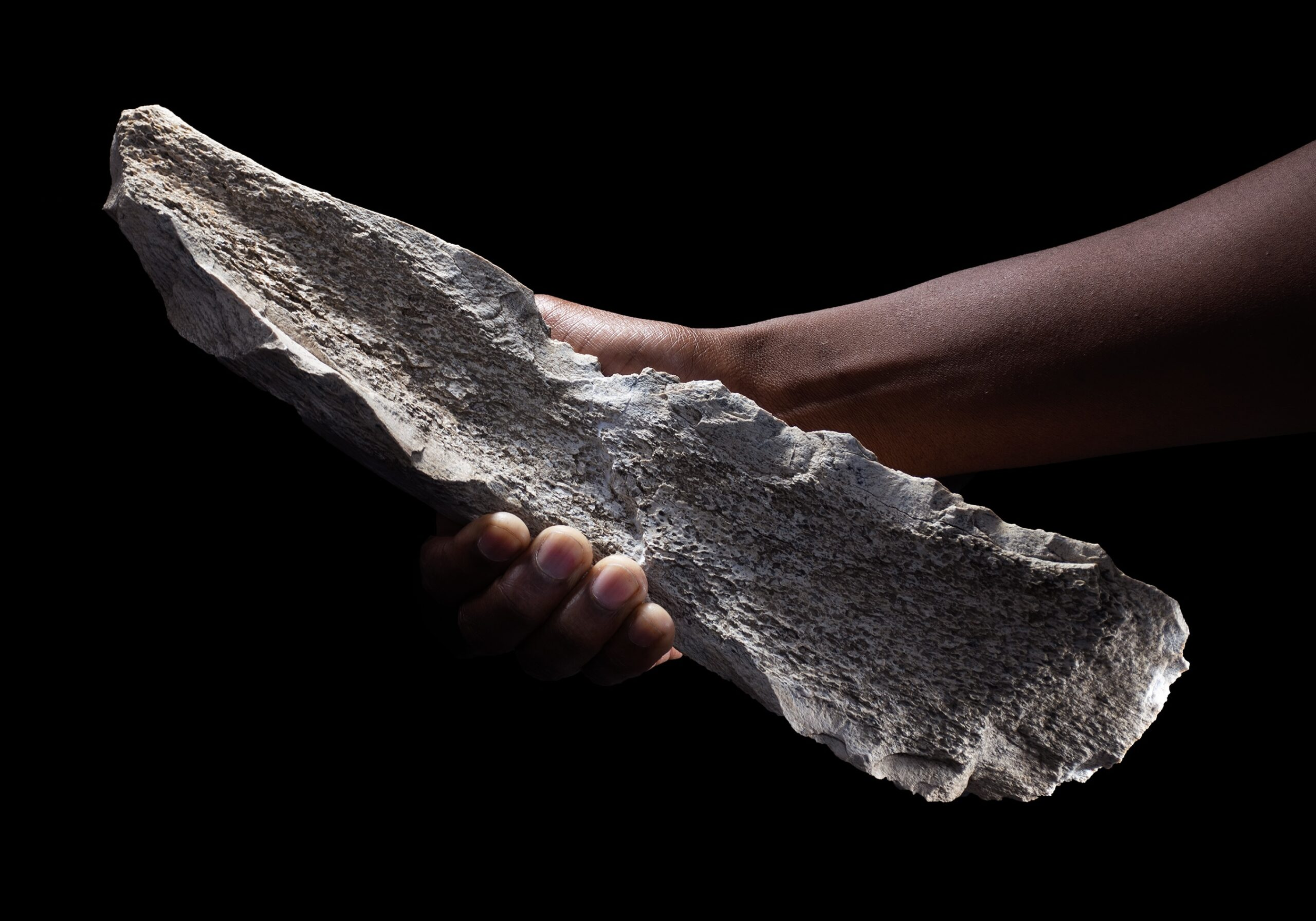
The Megafaunal Horizon: The team unearthed the partial skeleton of an extinct, massive prehistoric elephant (Deinotherium or ancestral Elephas), found in direct spatial association with over 200 fresh, sharp Oldowan chert and Naibor Soit quartzite tools.
Taphonomic Realism: High-resolution 3D photogrammetry of the bone surfaces identified distinct, unambiguous cut marks and impact notches tracing the systematic removal of meat scraps and the smashing of heavy limb bones to extract nutrient-dense bone marrow.
Crucially, the 2026 spatial distribution maps prove this was not opportunistic scavenging by a solitary hominin; the site displays a highly coordinated, organized collective behavior where heavy blocks of raw stone were carried from miles away specifically to butcher a massive megafaunal carcass, signaling an early social complexity previously doubted for Homo habilis.
Macromolecular Residue Extraction
The 2026 reexcavations also pioneered the use of in-situ biochemical isolation directly on newly unearthed stone tools before they were handled or exposed to modern ambient organic pollution:
   [ UNHANDLED LITHIC RECOVERY ] ──► Gas Chromatography-Mass Spectrometry (GC-MS)
                                                 │
                                     (The Residue Fingerprint)
                                                 │
                                                 ▼
   [ REVEALED DIETARY PROFILE ] ◄─── Consumed Tubers, Grass Seeds, and Wild Fat Lipids
By extracting bound lipids, starch grains, and microscopic plant phytoliths directly from the microscopic step-fractures of the cutting edges, the 2026 laboratory teams provided the first empirical, uncompromised evidence of early hominin vegetarian diets.
The tools were not just used for processing meat; Homo habilis and Paranthropus boisei were actively slicing open underground storage tubers, processing fibrous roots, and crushing grass seeds, painting a highly nuanced picture of a flexible, omnivorous survival strategy at the dawn of humanity.