For more than half a century, a core pillar of paleoanthropology was the "Man the Toolmaker" paradigm—the absolute conceptual link between the emergence of our genus, Homo, and the dawn of intentional stone tool technology. This milestone was traditionally anchored to the Oldowan Industrial Complex, which dates back to roughly 2.6 million years ago.
However, the accidental discovery of Lomekwi 3 on the western shores of Lake Turkana, Kenya, shattered this paradigm, pushing the origin of stone tool manufacture back by a staggering 700,000 years into the deep Pliocene.
[ EXTINCT COGNITIVE MODEL ] ──► Oldowan Industry (~2.6 Ma) = Genus *Homo* Exclusive
                                            │
                             (The Lomekwian Displacement)
                                            │
                                            ▼
[ REVISED PLIOCENE MODEL ] ───► Lomekwian Industry (~3.3 Ma) = Pliocene Hominins
The Accidental Discovery and Stratigraphy
In 2011, an archaeological expedition led by Dr. Sonia Harmand inadvertently veered off course, wandering into a heavily eroded series of Pliocene ravines near the Lomekwi River. There, the team identified stone artifacts eroding directly out of a secure geological matrix.
The site's antiquity was anchored to $3.33 \pm 0.11$ million years ago using high-precision tephrostratigraphy—chemically fingerprinting the distinct volcanic ash layers (tuffs) sandwiching the artifact-bearing sediments—and independently validated via magnetostratigraphy tracking the ancient reversals of Earth’s magnetic field.
Passive-Hammer and Block-on-Block Mechanics
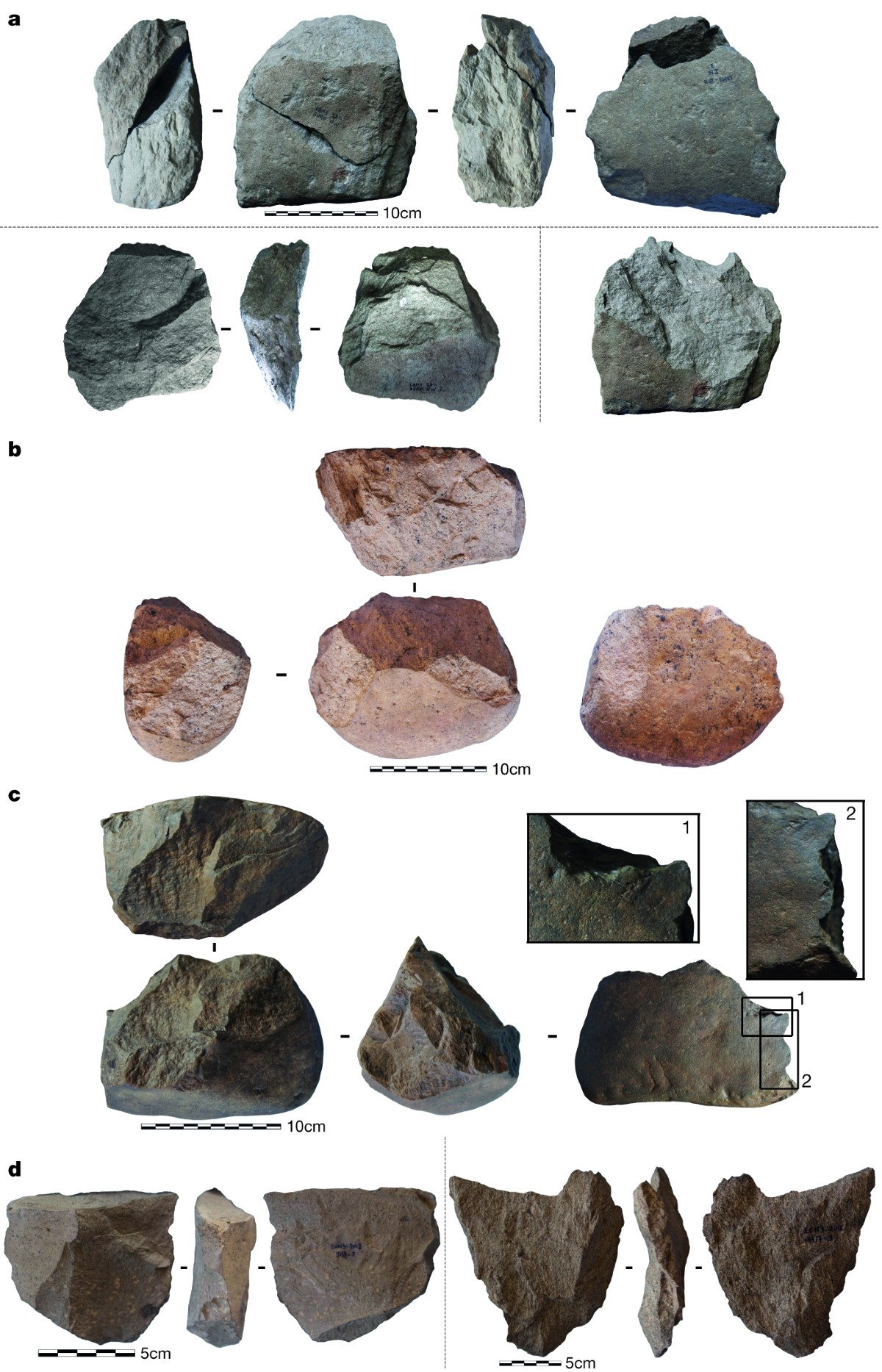
The stone artifacts recovered from Lomekwi 3 represent a completely new, primitive technology designated as the Lomekwian Industry. These tools are morphologically distinct from Oldowan flakes and cores:
Massive Scale: Lomekwian cores and anvils are exceptionally large and heavy, weighing up to 33 pounds ($15\text{ kg}$). This is significantly larger than typical Oldowan tools, which comfortably fit into the palm of a hand.
Primitive Percussion: Rather than utilizing free-hand, two-handed percussion (where one stone strikes another mid-air), Lomekwian knappers relied on crude, stationary mechanics. They practiced block-on-block knapping, violently swinging a massive core downward against a fixed rock anvil embedded in the earth, or passive-hammer knapping, slamming a stone against an anvil to shear off sharp, heavy flakes.
Who Was the Knapper?
The extreme age of Lomekwi 3 means that no members of the genus Homo were alive to manufacture these tools. Instead, the chronological window points directly to two primitive, small-brained Pliocene hominins whose fossils have been unzipped from the Turkana Basin: Kenyanthropus platyops and Australopithecus afarensis (Lucy’s species).
This discovery completely decouples stone tool manufacture from the evolution of large human brains, proving that millions of years before Homo emerged, small-brained, bipedal hominins already possessed the upper-body biomechanics and cognitive spatial mapping necessary to plan, fracture, and deploy sharp-edged tools to exploit their environment.