In the foothills of the Chiapas mountains, the site of Palenque represents an artistic and architectural high point of Maya civilization. While the Temple of the Inscriptions houses the legendary tomb of King K'inich Janaab' Pakal, his son and successor, K'inich Kan Bahlam II (r. 684–702 CE), built an equally brilliant architectural complex known as the Group of the Cross. The largest structure in this group, the Temple of the Cross, houses a series of detailed limestone relief panels that have driven a fascinating debate regarding the Maya integration of architecture, mythology, and astronomy.
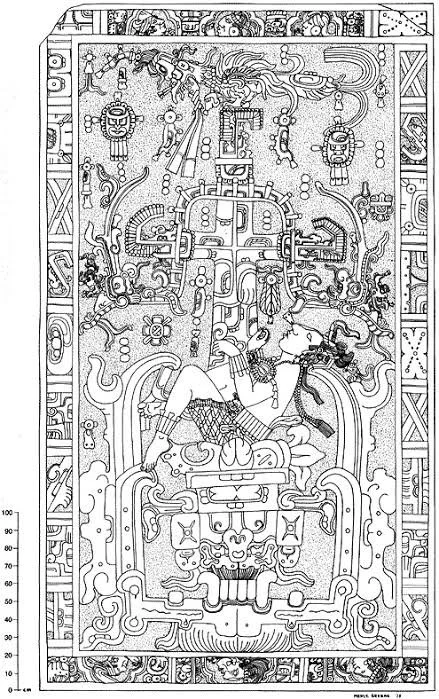
The interior sanctuary of the temple contains a large carved panel depicting King Kan Bahlam II receiving the symbols of rulership from his deified father. At the center of this composition stands a massive, cross-like design that early explorers mistook for a Christian icon, but which epigraphers have identified as the World Tree (Wakah Chan), the central axis of Maya cosmology that links the underworld, the earthly plane, and the heavens.
The debate centers on how this architectural layout aligns with the cosmos. Archaeoastronomers have demonstrated that the Temple of the Cross was built using a precise astronomical matrix. During the winter solstice—the shortest day of the year—the sun sets directly in line with the temple's main axis, casting a beam of light that illuminates the carved image of the dead King Pakal, symbolizing his descent into the underworld. Furthermore, computer models of the Classic period night sky indicate that the arrangement of the World Tree and its accompanying glyphs mirrors the exact position of the Milky Way across the horizon during key calendar dates in 692 CE. This suggests the temple panel functioned as a stone star map designed to prove that the succession of the new king was written into the movements of the stars.