Introduction
Textile production was one of the most important technologies in prehistoric societies. Clothing, blankets, bags, ropes, and other woven materials supported everyday life, trade, shelter construction, and cultural expression. Although textiles rarely survive in ordinary archaeological conditions, evidence from tools, impressions, fibers, and preserved fabrics demonstrates that weaving developed in many parts of the ancient world.
One particularly interesting aspect of textile history is the use of portable looms. Unlike large stationary installations, portable weaving equipment could be transported between settlements, workshops, and temporary camps. This mobility may have helped spread textile techniques across communities and geographical regions.
Studying portable looms provides insight into how technological knowledge traveled before modern transportation and communication systems. It also reveals the relationship between craft specialization, household production, migration, and cultural exchange.
Understanding Portable Looms
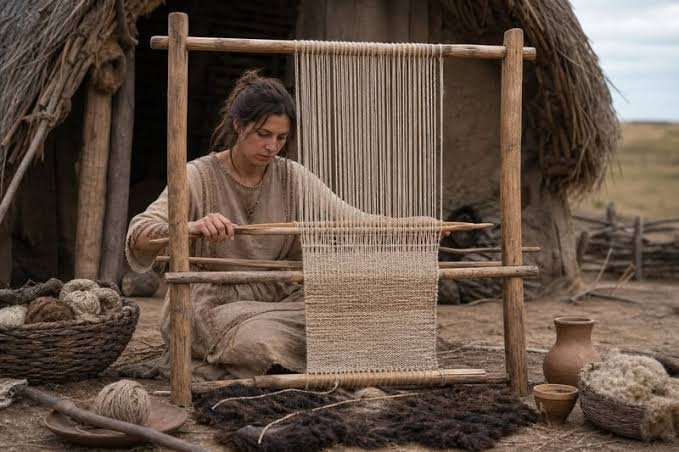
A loom is a device used to hold threads under tension while other threads are interlaced to create fabric. Different loom types use different arrangements of supports, weights, beams, and tensioning mechanisms.
Portable looms are generally smaller or easier to dismantle than permanent installations. Some could be assembled from wooden frames, while others relied on a relatively simple arrangement of bars and supports.
The portability of a loom depended on its design and the materials available. A lightweight frame could be carried by an individual, while a larger apparatus might require several people to transport.
It is important to distinguish portable looms from all forms of ancient weaving equipment. A set of loom weights, for example, may indicate the use of a warp-weighted loom, but it does not automatically establish whether the entire apparatus was portable.
Evidence for Prehistoric Weaving
Textiles are usually made from organic materials that decay rapidly. Wool, flax, cotton, plant fibers, and animal hair are unlikely to survive for thousands of years unless preserved under unusual conditions.
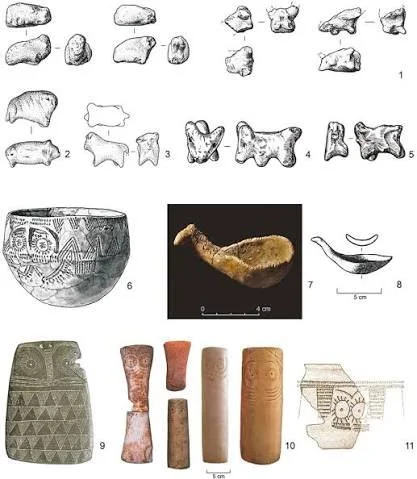
Archaeologists therefore rely on indirect evidence. Loom weights, spindle whorls, needles, weaving tools, and impressions in clay can indicate textile production.
In some cases, actual fabric survives in dry caves, waterlogged environments, frozen deposits, or mineralized contexts. Such discoveries provide direct evidence of fiber selection, spinning techniques, weave structure, and decorative patterns.
The distribution of these objects helps researchers identify areas where textile production occurred and investigate how weaving technologies changed over time.
The Relationship Between Spinning and Weaving
Textile production involves several stages. Fibers must first be collected or prepared, then spun into yarn before they can be woven into fabric.
Spindle whorls helped regulate the spinning process by adding weight and momentum to a spindle. Their size and shape could influence the characteristics of the resulting thread.
The yarn was then arranged on a loom. The lengthwise threads, known as the warp, were held under tension, while the crosswise threads, known as the weft, were passed through them.
Different combinations of warp and weft produce different textile structures. These techniques require practical knowledge that can be transmitted through observation, demonstration, and repeated practice.
How Portable Looms Supported Mobility
Portable weaving equipment could be useful for communities that moved seasonally. Pastoral groups, for example, might carry smaller tools between grazing areas while maintaining textile production during periods of travel.
A portable loom could also support craft production in temporary settlements, trading camps, or frontier communities.
However, not every mobile society necessarily used portable looms. Some may have transported finished textiles or relied on stationary production centers. The presence of weaving tools in a temporary settlement must therefore be interpreted within its broader archaeological context.
Textile Traditions and Cultural Exchange
Textile techniques can spread through migration, trade, intermarriage, apprenticeship, and contact between neighboring communities.
A particular weaving pattern might appear in distant regions because craftspeople moved between settlements. Alternatively, local weavers could adopt a technique after seeing imported fabrics or learning from visiting specialists.
Textile similarities do not always indicate direct migration. Similar patterns can develop independently when communities use comparable materials and equipment.
Researchers therefore examine multiple features, including loom design, yarn preparation, weave structure, decorative methods, and terminology where historical language evidence is available.
Household Production and Specialized Workshops
Textile production could take place at several levels of economic organization.
In some communities, weaving was primarily a household activity. Families produced clothing and domestic textiles for their own needs, sometimes exchanging surplus products with neighbors.
Other societies developed specialized workshops that produced textiles for markets, institutions, or elite households.
Portable looms may have supported both arrangements. A small apparatus could be used within a household, while a larger transportable loom might serve a craftsperson who worked in different locations.
The distribution of tools and production waste can help archaeologists investigate whether textile manufacturing was concentrated in particular buildings or dispersed across settlements.
Identifying Portable Looms Archaeologically
Wooden loom components rarely survive, so researchers often reconstruct looms from indirect evidence.
The arrangement of postholes, weights, beams, and working surfaces may indicate the dimensions and orientation of a weaving apparatus.
A small number of loom weights found together could suggest a limited weaving setup, although objects may have been moved after use.
Archaeologists also compare excavated remains with experimental reconstructions. By building and operating different loom designs, researchers can investigate how much space they require, how they are assembled, and what traces they might leave behind.
The Role of Women and Craft Knowledge
Textile production has frequently been associated with women's labor in many historical societies, although the division of work varied considerably across cultures and periods.
Archaeologists must avoid assuming that every textile tool belonged to a woman or that weaving was exclusively performed by one gender.
The social importance of textiles extended beyond clothing. Fine fabrics could communicate wealth, identity, religious affiliation, and political status.
Knowledge of weaving techniques could also be economically valuable. Skilled craftspeople might contribute to household prosperity or participate in specialized production networks.
Conclusion
Portable looms offer an important perspective on the movement of technology and craft knowledge in prehistory. Their potential use in mobile communities, temporary settlements, and household production demonstrates that textile manufacturing was not necessarily restricted to permanent workshops.
Although direct evidence for portable loom structures is often limited, tools, impressions, preserved textiles, and experimental archaeology can help reconstruct their possible designs and functions.
The spread of textile traditions reminds us that technological exchange did not depend only on the movement of finished objects. It also involved people carrying practical skills, teaching techniques, adapting equipment, and creating new forms of production wherever communities settled.