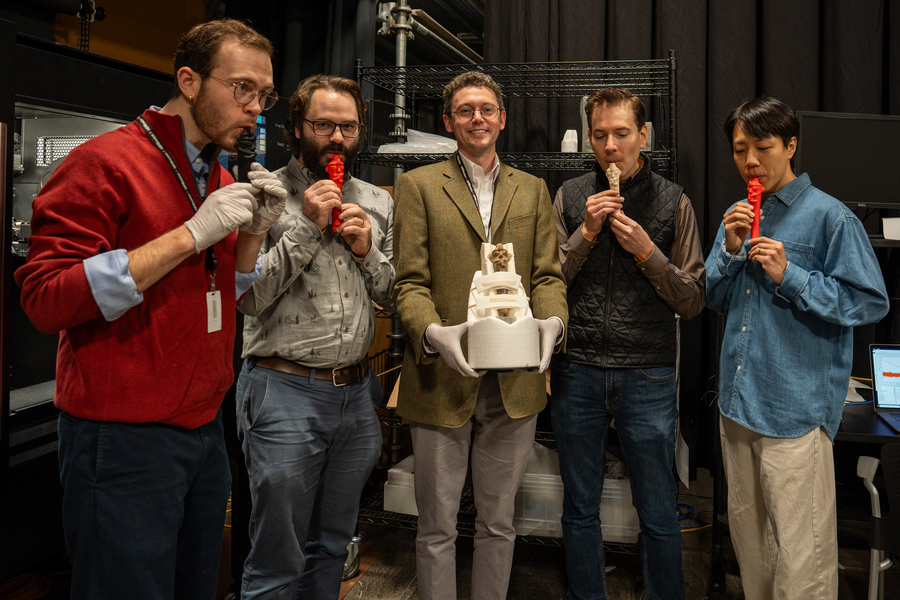
Through an interdisciplinary collaboration between MIT and the Museum of Fine Arts, Boston, researchers are creating playable physical and synthesized replicas.
Scientists Recreate the Sounds of Ancient Instruments Using Modern Technology
Researchers are developing a new way to bring ancient music back to life by creating accurate, playable replicas of historical instruments using advanced scanning and acoustic technology.
The project began when a senior postdoctoral researcher at the Massachusetts Institute of Technology proposed an ambitious collaboration between archaeologists, engineers, and music specialists. The initiative connects experts from the Center for Materials Research in Archeology and Ethnology and the MIT School of Humanities, Arts, and Social Sciences with curators from the Museum of Fine Arts, Boston, which houses one of the world’s largest collections of historical musical instruments.
Together, the team is scanning ancient instruments in order to understand exactly how they were constructed and how they originally sounded.
Bringing Silent Artifacts Back to Life
Museums around the world contain beautifully preserved musical instruments, yet most of them cannot be played because doing so could damage the fragile originals.
Researchers involved in the project hope to solve that problem by producing precise replicas that musicians and audiences can actually hear.
To achieve this, the team uses high-resolution CT scanning technology to capture both the external shape and internal structure of the instruments. The scanners reveal hidden details such as wall thickness, internal chambers, and construction techniques that cannot be seen from the outside.
These digital scans are then combined with acoustic testing. Scientists use specialized tools, including a tiny impact hammer and laser vibration sensors, to measure how the instrument’s body responds to sound and movement. The data allows researchers to model the exact way the instrument vibrates and produces tone.
With this information, they can reconstruct the sound digitally and create physical replicas that behave acoustically like the originals.
3D Printing Ancient Instruments
Once the digital models are complete, the team produces replicas using 3D printing technology.
For ceramic instruments, the printed models are used to create molds, which are then filled with clay materials similar to those used in the past. This process recreates the physical structure of the original artifact while keeping the authentic instrument safely preserved in the museum.
One of the first objects reproduced was the Paracas whistle, a ceramic instrument from Peru dating between 600 and 175 BCE. The replica was successfully demonstrated at a research event, allowing audiences to hear the sound of the ancient whistle for the first time in centuries.
The team also plans to recreate wooden instruments using carefully selected old-growth wood. Local instrument makers, known as luthiers, will help craft these replicas so they behave as closely as possible to the historical originals.
Understanding Ancient Cultures Through Sound
For archaeologists involved in the project, recreating the sound of these instruments is about more than music. Sound can reveal valuable information about the cultures that created them.
The materials used, the shape of the instrument, and the way it produces sound all reflect cultural traditions, craftsmanship, and musical practices from the past.
By analyzing both the physical materials and the acoustics, researchers hope to better understand the people who built and used these instruments thousands of years ago.
A Growing Digital Archive
So far, researchers have scanned around thirty instruments from the museum’s collection. Their long-term goal is to document at least one hundred instruments, creating a detailed digital archive that can support future archaeological and musical research.
The collection at the Museum of Fine Arts, Boston includes more than 1,400 instruments from around the world, with some dating back to around 1550 BCE. Each scan contributes new information about ancient craftsmanship and musical traditions.
Inspiring the Next Generation
The project has also attracted strong interest from university students who are studying materials science, music, mathematics, and engineering.
Students are helping analyze the instruments using computer modeling techniques such as finite element simulations, which allow researchers to study acoustics without physically altering the artifacts.
For many participants, the project represents a rare opportunity to combine science, history, and music into a single field of study.
Protecting the Past While Hearing It Again
Researchers believe their work could transform how museums present historical instruments. Instead of displaying silent artifacts behind glass, institutions could allow visitors to hear accurate recreations of their sounds.
By combining archaeology, engineering, and digital technology, the project is helping ensure that ancient musical traditions are not only preserved visually but also experienced in the way they were originally intended—through sound.