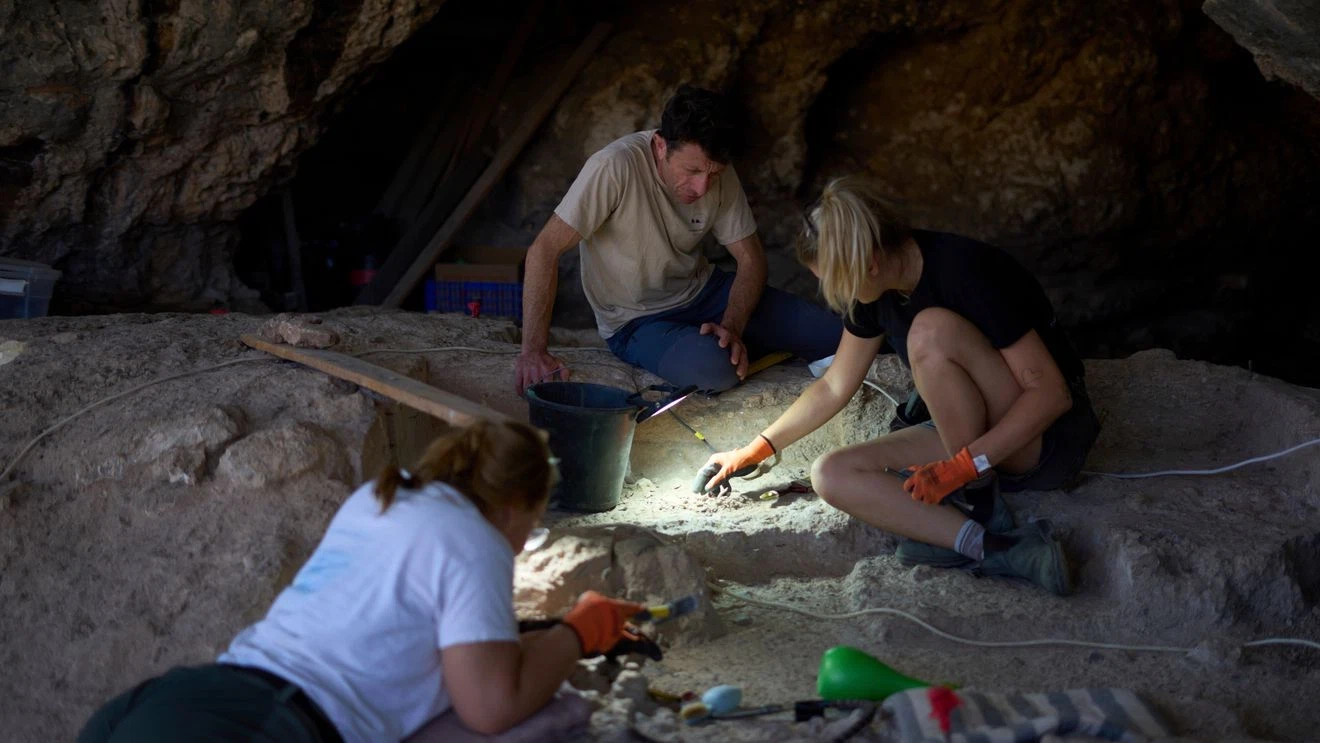
The narrative of early Homo sapiens migrating out of Africa was long thought to be a rapid, uncontested expansion that occurred around 60,000 years ago, quickly overwhelming the Neanderthal populations of Eurasia. However, the deep-layer excavations at Qafzeh Cave, located outside Nazareth in lower Galilee, Israel, radically revised this paradigm.
The site yielded the remains of at least 15 distinct, anatomically modern human skeletons securely dated to 100,000 to 120,000 years ago, documenting a spectacular, early "Levantine wave" of African pioneers who established the world's earliest known, undisputed cemeteries.
   [ PALEOANTHROPOLOGICAL ASSUMPTION ] ──► Burials with Grave Goods = Upper Paleolithic (~40 Ka)
                                                   │
                                        (The Levantine Realignment)
                                                   │
                                                   ▼
   [ REVISED SACRED PARADIGM ] ────────► Complex Intentional Mortuary Rituals (~100 Ka)
The Anatomical Vanguard
The Qafzeh hominins are undeniably anatomically modern Homo sapiens. They possess tall, vertical foreheads, fully formed chins (mental protuberance), and high, globular braincases that lack the heavy brow ridges and elongated vaults of the Neanderthals who occupied adjacent caves in the Levant (such as Amud or Tabun).
Their presence in Israel 100,000 years ago proves that our species had successfully breached the Saharo-Arabian desert corridor during a brief, wet interglacial period long before the final, permanent migration wave.
The Sacred Context: Qafzeh 11 and Grave Goods
The absolute defining discovery at Qafzeh is Burial 11, a pristine, intentionally arranged grave of an adolescent child roughly 12 to 13 years old, laid to rest within a specially carved rock recess:
The child’s body was placed in a highly specific, flexed fetal position on its back. The intentionality of the burial is confirmed by the presence of extraordinary, explicit grave goods:
The Red Deer Antlers: The large, branching antlers of a fallow deer (Dama dama) were carefully severed from the animal's skull and placed directly across the child's chest and hands, mimicking a deliberate, symbolic embrace.
The Red Ochre Matrix: The sediment immediately surrounding the bones and the antlers was heavily saturated with lumps of imported red ochre, indicating the body or the grave lining was intensely painted with red pigment during the funeral ceremony.
The Dawn of Metaphysical Anxiety
The burials at Qafzeh represent an immense cognitive leap into the realm of metaphysics and religious thought. Animals do not bury their dead with decorative items or symbolic animal horns.
By systematically digging graves inside a dark cave, positioning the bodies in standardized postures, coloring the sediments with red pigment (frequently linked to the symbolism of life and blood), and leaving heavy deer antlers to accompany the deceased, the humans of Qafzeh were actively confronting the terrifying reality of mortality.
They were expressing a belief that a person did not simply cease to exist at death; they required protection, ritual care, and material tools to navigate an imagined journey into the afterlife, establishing the absolute, ancient roots of human religion and existential philosophy.