During the 1930s, excavations at Skhul Cave, situated on the slopes of Mount Carmel, Israel, unearthed a spectacular series of ten hominin skeletons dating to approximately 100,000 to 130,000 years ago. When physical anthropologists first analyzed these remains alongside those from neighboring caves, they were confronted with a baffling anatomical enigma.
The Skhul fossils displayed a bizarre, highly variable mixture of archaic Neanderthal-like robustness and gracile modern human architecture, triggering a century-long debate: Were these individuals the world's first documented Neanderthal-human hybrids?
                    [ THE SKHUL MORPHOLOGICAL HYBRID ]
                                    │
         ┌──────────────────────────┴──────────────────────────┐
         ▼                                                     ▼
[ ARCHAIC ROBUST BLUEPRINT ]                          [ MODERN SAFARI ARCHITECTURE ]
* Prominent, thick brow ridges                        * Tall, vertical frontal forehead
* Massive, heavily muscled limbs                      * High, globular cranial vault
* Robust, chinless mandibular variants                * Fully developed modern mental chin
The Anatomical Mosaic
The skeletal variation within the Skhul population was so pronounced that early researchers struggled to categorize them into a single species. Skeletons like Skhul V exhibited a striking morphological mosaic:
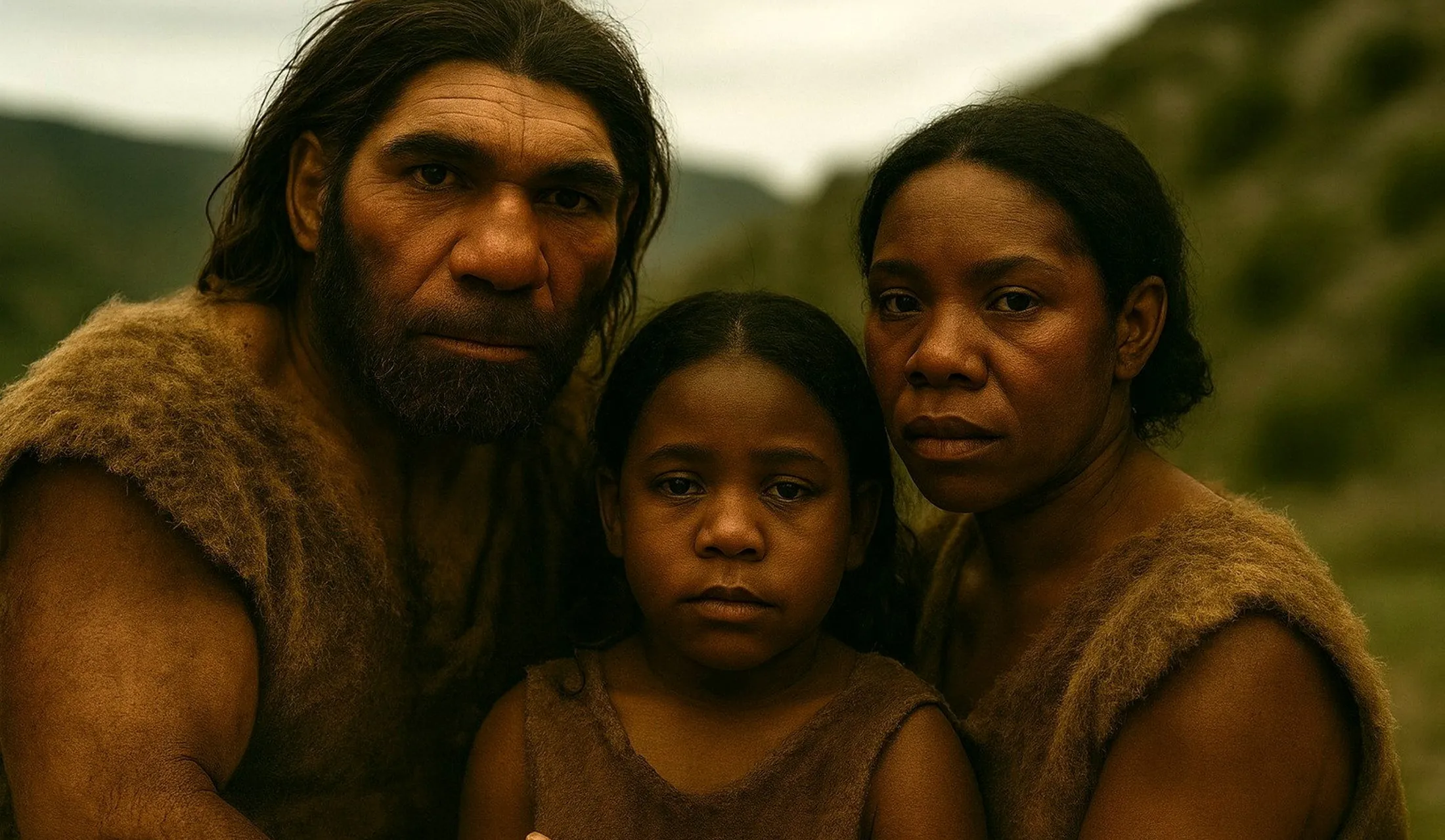
The Archaic Traits: The cranium featured prominent, continuous brow ridges, a broad face, and exceptionally robust, thick-walled limb bones that strongly mirrored the heavy, cold-adapted anatomy of European Neanderthals.
The Modern Traits: Yet, rising directly behind those heavy brows was a tall, vertical forehead and a high, globular, balloon-shaped cranial vault. Most crucially, the lower jaw boasted a clearly defined, protruding mental chin—the diagnostic anatomical hallmark of Homo sapiens.
Hybrids or Early Modern Variation?
This bizarre anatomical intermediate led early paleontologists, including Theodore McCown and Sir Arthur Evans, to hypothesize that Skhul caught a population in the middle of an intense, regional hybridization event.
However, modern paleogenomics and high-definition geometric morphometrics have heavily revised this "hybrid" theory.
[ RETROSPECTIVE SPECULATION ] ──► First-Generation Interbred Hybrids (~100 Ka)
                                             │
                              (The Genomic Realignment)
                                             │
                                             ▼
[ MODERN CONSENSUS MODEL ] ──────► Highly Variable, Plastic Pioneer *Homo sapiens*
While we now know from Neanderthal DNA present in living non-Africans that interbreeding absolutely occurred in the Levant, the Skhul population is no longer viewed as first-generation hybrids. Instead, they are classified as an extraordinarily variable, anatomically plastic population of early anatomically modern Homo sapiens.
Their robust features reflect a primitive ancestral baseline carried out of Africa, demonstrating that before our species' skeleton settled into its modern, gracile uniformity, early Homo sapiens possessed a diverse, rugged anatomy that frequently blurred the lines between ourselves and our Neanderthal cousins.