Roman Hadrian’s Wall: Life and Death on the Edge of the World
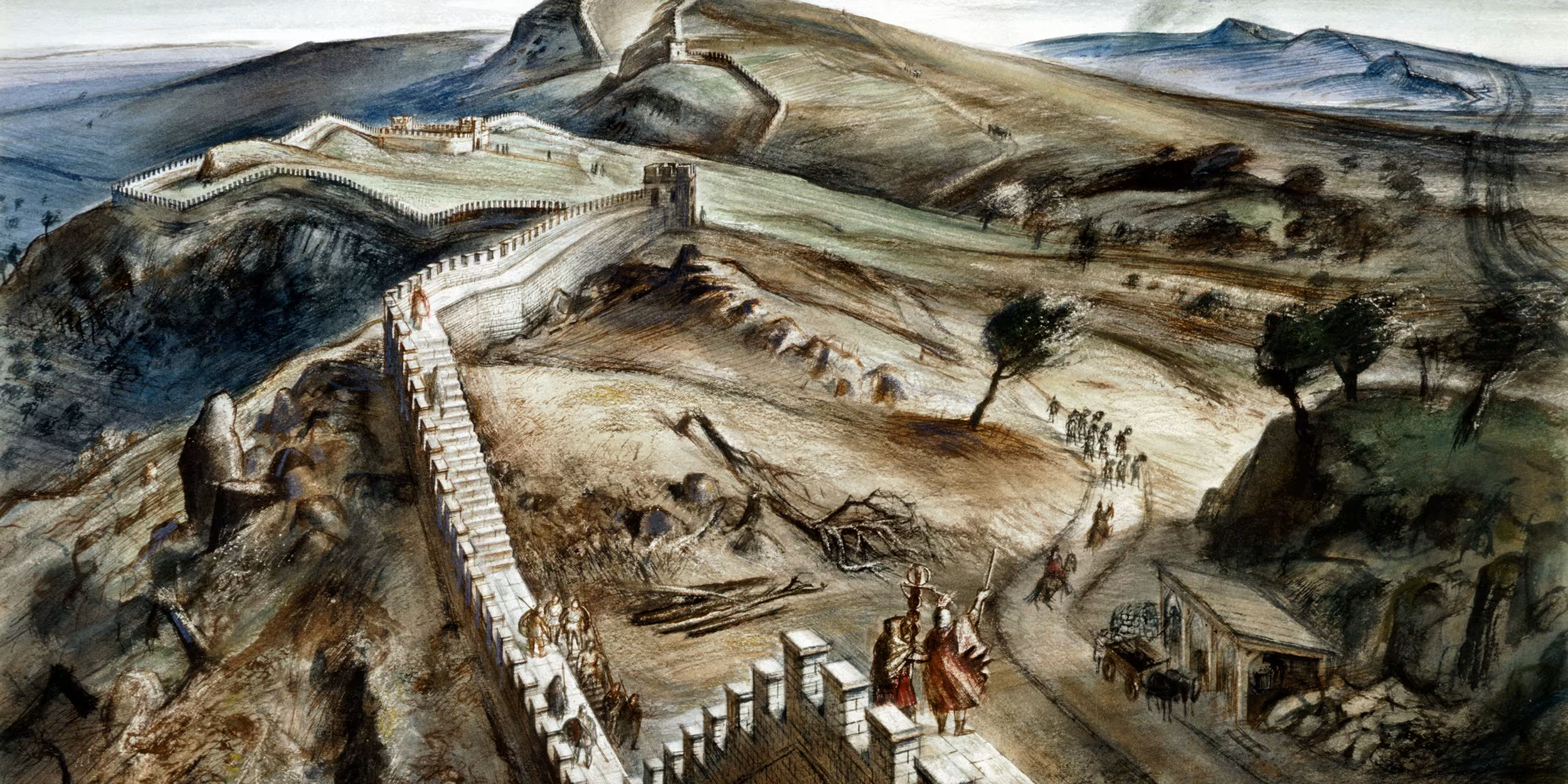
Stretching 73 miles (80 Roman miles) across the narrow neck of northern England, Hadrian’s Wall was the most heavily fortified border of the Roman Empire. Built on the orders of Emperor Hadrian starting in 122 CE, it was more than just a physical barrier; it was a psychological statement of Roman power and a sophisticated military and customs zone.
1. Engineering the Frontier
The wall took approximately six years to complete, involving the labor of three Roman legions (II Augusta, VI Victrix, and XX Valeria Victrix). It was an immense undertaking that required constant maintenance.
The Structure: The wall was originally built largely of stone (though the western section was initially turf). It stood about 15 feet high and 10 feet wide, fronted by a deep ditch to the north.
The Milecastles: Every Roman mile, a "milecastle" (small fort) was built to house about 20 to 30 soldiers. Between each milecastle were two observation turrets.
The Vallum: To the south of the wall lay a massive earthwork known as the Vallum—a ditch flanked by two mounds. This created a "no-man's land" that protected the military zone from the Roman province of Britannia itself.
2. Life for the Soldiers: The Garrison
At its peak, Hadrian’s Wall was garrisoned by roughly 9,000 to 15,000 men. Contrary to popular belief, these were not the elite Italian legionaries who built the wall, but auxiliaries—soldiers recruited from across the empire, including Gaul, Spain, and North Africa.
Diversity on the Edge: A soldier at the wall might have been a cavalryman from the Batavian tribes (modern-day Netherlands) or an archer from Syria.
The Vindolanda Tablets: These thin, wooden writing tablets found at the nearby fort of Vindolanda offer a rare glimpse into daily life. They include:
Birthday party invitations between the wives of fort commanders.
Requests for more socks and underwear to combat the cold British climate.
Official military reports and complaints about the "wretched Britons" and their fighting style.
3. Death and Conflict: Fighting the "Barbarians"
The wall was not a passive line; it was a base for offensive operations. To the north lived the Caledonians and later the Picts, tribes the Romans viewed as ferocious and untamable.
Guerrilla Warfare: Conflict rarely took the form of massive pitched battles. Instead, it was a war of attrition involving cattle raiding, ambushes, and small-scale skirmishes.
The Gates as Valves: The wall featured many gates, suggesting it was used to control trade and the movement of people. Those wishing to cross had to pay taxes, and those caught raiding were dealt with ruthlessly.
The End of the Wall: By the late 4th and early 5th centuries, as the Roman Empire began to withdraw its legions to defend the heart of Italy, the wall's supply lines failed. Soldiers often turned to farming the land they once guarded, eventually fading into the local population as the Roman administration collapsed.
4. The "Edge of the World" Mentality
For a Roman citizen in Rome, Hadrian’s Wall was the literal end of the civilized world. Beyond lay the "Ocean" and the "Great Wilderness."
Religion and Ritual: Soldiers brought their gods with them. Archaeologists have found altars to Jupiter alongside shrines to Mithras (a mystery cult popular with soldiers) and local Celtic deities like Coventina.
The Civilian Towns (Vici): Outside the walls of the great forts like Housesteads and Chesters, vibrant civilian settlements sprang up. These towns housed the families of soldiers, merchants, tavern keepers, and craftsmen, creating a bustling frontier economy.