The Discovery of the Terracotta Army: A Farmer’s Chance Encounter
The discovery of the Terracotta Army is often cited as one of the most significant archaeological finds of the 20th century. Unlike many excavations that begin with historical records or academic theories, this "Eighth Wonder of the World" was revealed by a group of local farmers attempting to solve a mundane problem: a lack of water.
1. The Moment of Discovery (March 1974)
In the spring of 1974, Shaanxi Province in China was suffering from a severe drought. A farmer named Yang Zhifa, along with five of his brothers and a neighbor, decided to dig a new well in a wasteland near Mount Li.
The Encounter: At a depth of about two meters, Yang’s shovel struck something hard—not a rock, but a piece of terracotta. Initially, they thought they had found an ancient kiln or perhaps a "bronze head" that could be sold for a few yuan.
The "Earth God": Local villagers were initially superstitious, fearing the clay fragments were "Earth Gods" that would bring bad luck. However, Yang Zhifa recognized the significance and reported the find to local authorities.
2. What the Farmers Found
What started as a well-digging project soon revealed a massive underground vault. This was the burial complex of Qin Shi Huang, the first Emperor of China (reigned 221–210 BCE).
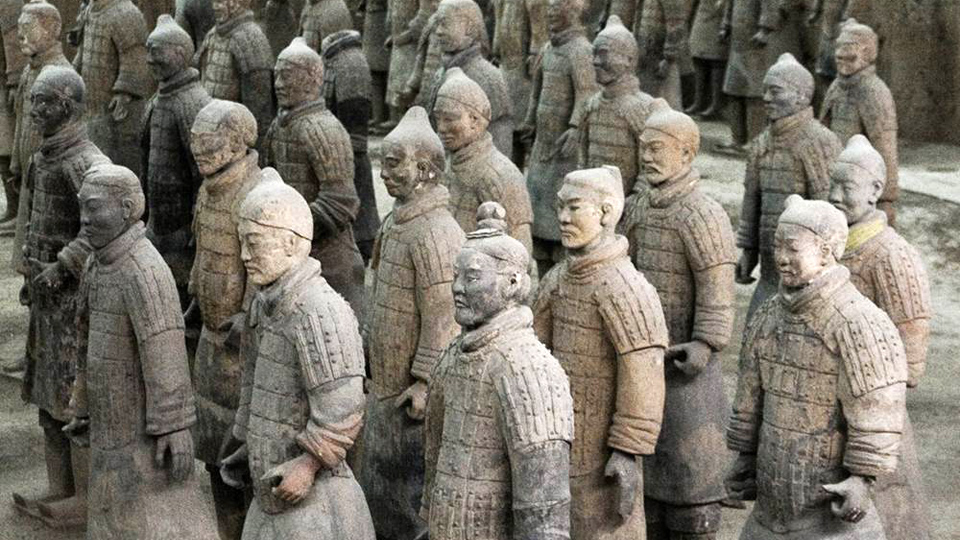
A Massive Scale: Archaeologists eventually uncovered three main pits containing an estimated 8,000 soldiers, 130 chariots, and 670 horses.
Individualized Faces: One of the most stunning features of the army is that no two faces are exactly alike. Each soldier possesses unique facial features, hairstyles, and expressions, suggesting they were modeled after real individuals in the Emperor's guard.
Functional Weapons: The soldiers were originally equipped with fully functional bronze swords, spears, and crossbows, many of which remained sharp after 2,000 years due to a protective coating of chromium oxide.
3. The Purpose of the Army
The Terracotta Army was not meant to be seen by the living. It was a spiritual garrison designed to protect the Emperor in the afterlife.
The Necropolis: The army is part of a larger, mostly unexcavated necropolis covering nearly 100 square kilometers. It serves as a miniature version of the Emperor's palace and empire.
Military Formation: The soldiers are arranged in precise military formations based on rank and role, including archers, infantry, cavalry, and high-ranking officers.
4. Artistic and Scientific Achievement
The construction of the army required an unprecedented level of industrial organization.
Modular Construction: Research shows that the figures were created using a modular system. Heads, arms, and torsos were cast separately and then joined together with clay slip.
Vivid Coloration: Though they appear earthy-gray today, the soldiers were originally painted in brilliant hues of red, blue, green, and purple. When exposed to the dry air of the modern world, the lacquer coating curled and peeled away in seconds—a challenge that continues to face conservators today.