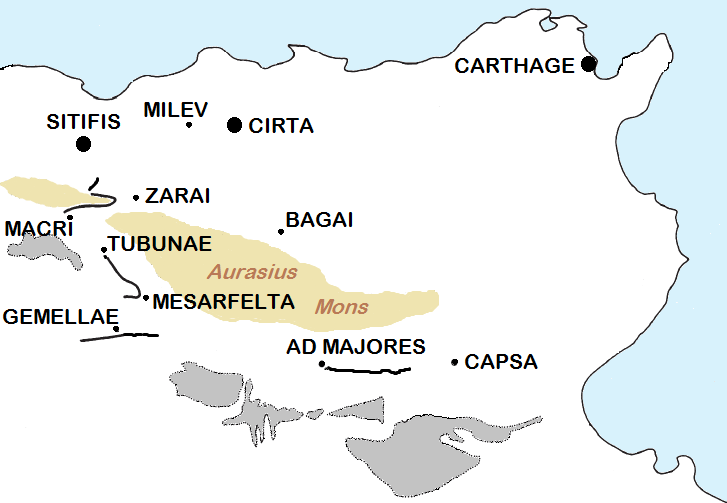
The Fossatum Africae (Latin for "African Ditch") is a monumental archaeological feature of Roman North Africa, but it is a common historical misconception to classify it as an irrigation system.
What Was the Fossatum Africae?
The Fossatum Africae was a vast, linear defensive and administrative barrier system, not a water management project. Spanning approximately 750 kilometers (about 470 miles) across modern-day Algeria and Tunisia, it functioned as a "frontier line" (limes) designed to secure the southern borders of the Roman Empire in Africa.
Primary Purpose: Its main function was to regulate the movement of Saharan nomadic tribes (such as the Garamantes and Gaetulians) and to manage trade and migration. It funneled travelers toward controlled crossing points where taxes and tariffs could be collected, effectively serving as an early form of customs and border control.
Construction: The system consisted of a complex, segmented network of ditches (typically 3–6 meters wide), earthen embankments, and dry-stone walls. These were complemented by a series of watchtowers, forts, and military outposts positioned to monitor the vast, open plains and desert fringes.
Historical Misidentification: Because the structure spans such a great distance and appears in arid regions, local populations in the Middle Ages and some 19th-century archaeologists often mistook these deep, elongated trenches for abandoned irrigation canals (often called saqiya). However, 20th-century aerial archaeology by researchers like Jean Lucien Baradez confirmed its role as a strategic military border rather than a water delivery system.
Water Management in Roman North Africa
While the Fossatum Africae was not used for irrigation, Roman North Africa was indeed famous for its highly sophisticated water management—a necessity for maintaining agricultural productivity in an arid environment. Instead of long-distance ditches, Roman engineers utilized:
Cisterns and Reservoirs: To capture seasonal rainfall, Romans built massive cisterns and dams in natural depressions to collect water for agricultural use.
Aqueducts: They engineered complex aqueduct systems to bring water from distant springs to cities and agricultural estates.
Wadi Diversion: Romans frequently practiced "wadi farming," where they constructed low stone dams across dry riverbeds (wadis) to slow down and divert flash-flood waters into fields and terraces, preventing erosion and maximizing soil moisture.
Groundwater Extraction: Romans also utilized advanced well-digging and tunnel systems (similar to the qanat or foggara systems found in the Middle East) to tap into deep-seated groundwater.
In summary, the Fossatum Africae was a defensive and regulatory line of defense that helped protect the Roman agricultural heartlands, but it did not deliver the water that made those fields bloom.