For the wealthy elite of the Roman Empire, jewelry was more than mere decoration; it was a potent language of status, legal standing, and protection. As Rome expanded its trade routes into the East and Africa, the variety of materials grew, leading to a golden age of craftsmanship that favored bold colors and intricate carvings.
1. The "Queen of Gems": Roman Pearls (Margaritae)
In the Roman hierarchy of gemstones, pearls held the absolute top position—surpassing even diamonds and gold in value.
Source: Most pearls were imported through arduous trade routes from the Red Sea and the Persian Gulf.
The Status Symbol: High-ranking Roman matrons would wear multiple strands of pearls to public events. A famous style was the crotalia (rattlers), earrings made of two or three large pearls that would click together as the wearer walked, audibly announcing their wealth.
The Cleopatra Influence: The Roman obsession with pearls peaked after the conquest of Egypt. Legend says Julius Caesar was so captivated by them that he forbade women under a certain age or rank from wearing them, reserving the "Queen of Gems" for the elite.
2. Sapphires and Exotic Stones
The Romans loved the "Polychrome" (multi-colored) style. Unlike modern jewelry, which often focuses on the "fire" of a cut diamond, Roman jewelry focused on the deep, saturated color of the stone.
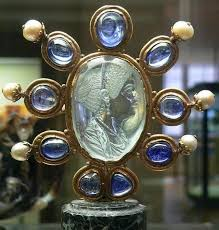
Sapphires: Known then as sapphirus (though the term sometimes referred to lapis lazuli), true blue sapphires were imported from Sri Lanka. They were rarely faceted as they are today; instead, they were polished into smooth, rounded cabochons.
Emeralds and Garnets: The Romans were particularly fond of green plasma (chalcedony) and emeralds from the "Mons Smaragdus" mines in Egypt. These were often strung as hexagonal prisms in their natural crystal shape.
3. The Art of the Intaglio
The Intaglio was perhaps the most functional form of Roman jewelry. These were gemstones (usually carnelian, jasper, or amethyst) where an image was carved into the surface of the stone.
The Signet Ring: For a Roman man, the intaglio ring was his legal signature. When pressed into hot wax, the recessed carving created a raised relief image, sealing official documents and letters.
Subject Matter: Carvings ranged from portraits of ancestors and emperors to mythological scenes. A ring featuring Hercules might be worn for strength, while Venus was worn for luck in love.
The Cameo: In contrast to the intaglio, a cameo featured a raised image carved in relief, usually utilizing the different colored layers of sardonyx to create a white figure against a dark background.
4. Materials and Techniques
Roman jewelers (aurifices) were masters of metal manipulation, moving away from the simple solid gold bands of the early Republic to highly complex designs.
Gold Purity: Romans typically used high-purity gold (22k or 24k), which was soft enough to be worked into delicate shapes.
Opus Interrasile: This was a "pierced work" technique where the jeweler would punch holes in a thin sheet of gold to create a lace-like pattern. This allowed them to create large, impressive pieces that were relatively lightweight.
Serpent Rings: Gold rings shaped like coiled snakes were incredibly popular, symbolizing immortality, healing (the rod of Asclepius), and protection.