Roman Military Strategy: The Use of the Testudo Formation
Introduction
The Roman army was famous for its discipline, organization, and tactical innovation. One of its most recognizable battlefield formations was the testudo, or “tortoise” formation. This tactic was designed to protect soldiers from missiles during sieges and assaults.
What is the Testudo Formation?
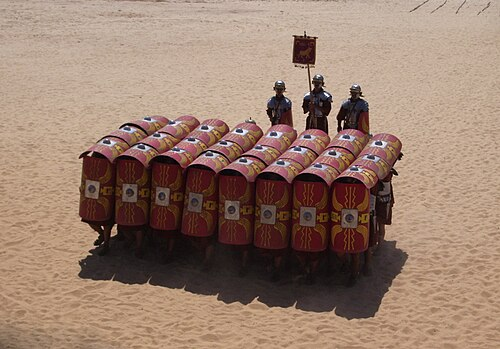
The testudo formation was a defensive arrangement used by Roman infantry, especially the Roman legions.
In this formation:
Soldiers stood tightly packed together
Shields were held overhead and at the sides
The group formed a nearly sealed protective shell
This made the unit resemble a turtle or tortoise, hence the name testudo.
How It Worked
Formation Structure
Front row held shields forward
Side ranks protected flanks
Rear ranks covered the top with overlapping shields
This created a strong barrier against:
Arrows
Javelins
Stones
Other projectiles
Movement
Even while fully protected, soldiers could slowly advance as a unit. However, movement was:
Slow
Highly coordinated
Vulnerable to close combat if disrupted
When the Testudo Was Used
The testudo was mainly used in:
Siege Warfare
Roman troops used it to approach enemy walls safely during:
Assaults on fortified cities
Gate breaches
Defensive counterattacks
Defensive Maneuvers
It protected soldiers when:
Crossing open ground under missile fire
Approaching enemy artillery
Retreating under pressure
Advantages of the Testudo
Excellent protection against ranged weapons
High discipline and unit cohesion
Effective in controlled siege environments
Reduced casualties during approach phases
Disadvantages
Despite its strength, the formation had weaknesses:
Very slow movement
Limited visibility and mobility
Vulnerable to flanking attacks
Ineffective in close-quarters combat
Requires highly trained soldiers to maintain
If the formation broke, it could quickly become disorganized.
Role in Roman Military Success
The testudo reflects broader Roman military strengths:
Strict training and discipline
Ability to coordinate large groups of soldiers
Adaptation to siege warfare
Engineering and tactical planning
It was not used in every battle, but it became a symbol of Roman military precision.
Historical Depictions
Ancient writers such as Julius Caesar described formations similar to the testudo during campaigns like the conquest of Gaul, especially in siege situations.
Reliefs such as those on Roman monuments also depict soldiers using shield formations during assaults.
Legacy
The testudo formation influenced:
Later medieval shield wall tactics
Modern military riot control formations
Popular depictions of Roman armies in film and literature
It remains one of the most iconic symbols of Roman military organization.
Conclusion
The testudo formation demonstrates the Roman army’s ability to combine discipline, coordination, and practical engineering on the battlefield. Though slow and specialized, it provided crucial protection during sieges and helped the Roman legions succeed in some of the most challenging military operations of the ancient world.