The Minoan Civilization: The Social Status of Women in Crete
Introduction
The Minoan civilization is often noted for its unique social structure compared to many other ancient societies. One of the most debated topics among historians is the role and status of women in Minoan society, particularly in religious, social, and possibly political life.
Evidence from Art and Archaeology
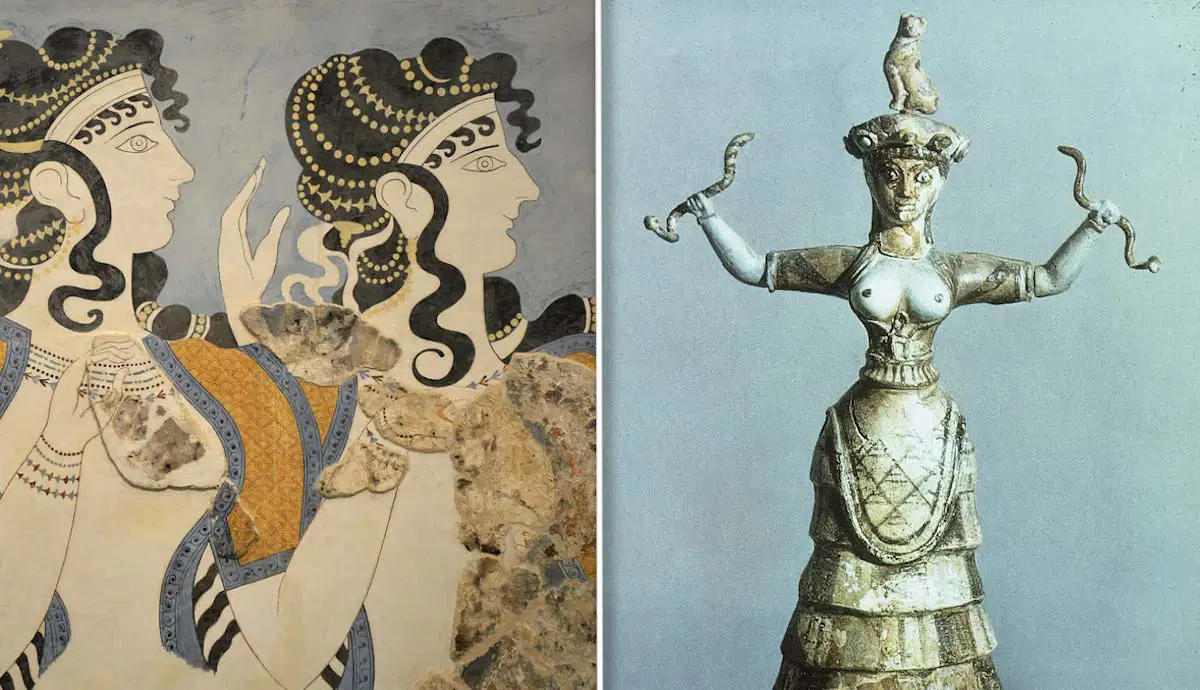
Much of what we know about Minoan women comes from frescoes, figurines, and seal impressions found in palaces such as Knossos.
Depictions of Women
Women are frequently shown:
Participating in religious ceremonies
Wearing elaborate clothing and jewelry
Appearing in public ritual spaces
Possibly holding prominent positions in rituals
Unlike many contemporary societies, women are not hidden from public imagery.
Religious Role of Women
Religion appears to have been a central sphere where women held important roles.
Possible Priestesses
Many scholars believe women served as:
Priestesses in temple rituals
Participants in sacred ceremonies
Figures associated with fertility and nature cults
Religious imagery often highlights female figures more prominently than male ones.
Social Status and Daily Life
Clothing and Appearance
Minoan women are often depicted wearing:
Elaborate layered skirts
Open bodices (a distinctive artistic feature)
Jewelry and decorative hairstyles
This suggests a culture that valued display, status, and ceremonial presentation.
Participation in Society
Evidence suggests women may have:
Taken part in public festivals and gatherings
Had visibility in civic and religious life
Possibly held influential family or household roles
However, exact political authority remains uncertain.
Comparison with Other Ancient Civilizations
Compared to contemporary societies such as:
Mycenaean Greece
Ancient Egypt (in most periods)
Mesopotamia
The Minoans appear to show:
Greater visibility of women in art
More emphasis on female ritual roles
Less focus on warfare imagery and male dominance
This has led some scholars to suggest a relatively more balanced gender representation, though this is still debated.
The “Mother Goddess” Theory
Early interpretations of Minoan religion emphasized a dominant mother goddess figure.
However, modern scholarship is more cautious:
Many figurines may represent multiple deities or ritual roles
There is no definitive proof of a single supreme goddess
Minoan religion likely included a complex pantheon
Still, female imagery remains highly significant.
Limitations of Evidence
Understanding women’s status is difficult because:
The Linear A script remains undeciphered
Most evidence is visual, not textual
Artistic representation may be symbolic rather than realistic
Archaeology cannot fully reveal legal or political structures
Therefore, conclusions remain interpretative.
Decline and Transition
After the decline of Minoan civilization, influence shifted to the Mycenaean civilization, where male warrior culture became more dominant.
This shift likely changed gender roles in the Aegean world significantly.
Conclusion
The social status of women in Minoan Crete remains one of the most intriguing topics in ancient history. While evidence suggests women played visible and possibly influential roles in religion and society, the lack of written records makes full understanding difficult. Nevertheless, the Minoan civilization stands out in the ancient world for its distinctive and prominent representation of women in art and ritual life.