Introduction
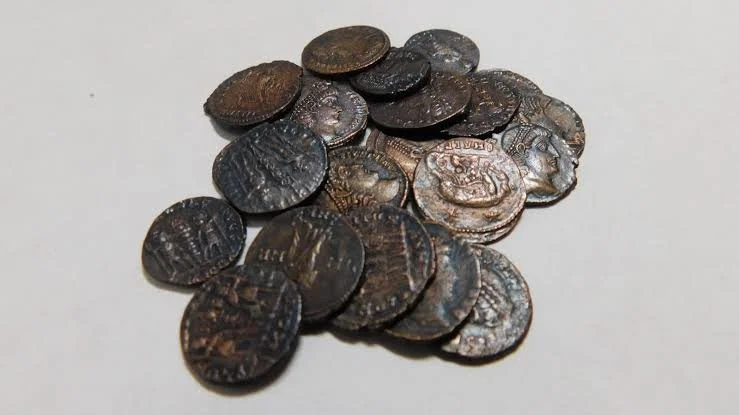
Coin hoards are among the most informative discoveries in numismatics and archaeology. A group of coins buried together can reveal patterns of wealth, trade, political instability, savings, and monetary circulation.
When hoards are recovered from coastal environments, shipwrecks, salt marshes, or submerged settlements, however, preservation becomes more complicated. Salt deposits can accumulate on coin surfaces, obscure inscriptions, and interact with metal corrosion.
A coin that appears to be covered in a thick mineral crust may contain valuable identifying details beneath the deposit. Recovering those details without damaging the object requires careful conservation and scientific analysis.
How Salt Encrustation Develops
Salt-encrusted coins are often associated with marine or highly saline environments.
Seawater contains dissolved salts, including sodium chloride, as well as other minerals. When seawater enters cracks or remains in contact with a metal surface, salts may crystallize as conditions change.
Repeated wetting and drying can cause deposits to accumulate.
In submerged environments, corrosion products, sediment, shells, and biological growth may combine with mineral deposits to form a dense crust.
Not every crust is pure salt. It may contain several materials produced by different environmental processes.
Different Metals, Different Preservation Problems
Ancient coins were made from various metals and alloys, including gold, silver, copper, bronze, and occasionally other materials.
Their reactions to saline environments differ.
Gold is relatively resistant to corrosion, although its surface can still become coated with sediment and mineral deposits.
Silver may develop corrosion products and surface discoloration.
Copper and bronze are particularly vulnerable to corrosion in chloride-rich environments. Chloride compounds can contribute to destructive corrosion processes that continue even after an object has been recovered.
The metal composition therefore influences both the appearance of a coin and the conservation strategy required.
Why Identification Becomes Difficult
Salt crusts can conceal the features numismatists use to identify coins.
These include portraits, inscriptions, mint marks, dates, symbols, denominations, and decorative designs.
Even a thin deposit may obscure a small letter or detail.
Heavy encrustation can make several coins appear nearly identical, preventing researchers from determining whether they belong to the same issue or period.
Mechanical removal is risky because the original surface may be fragile beneath the crust.
Archaeological Recovery and Initial Documentation
The conservation process begins before cleaning.
Archaeologists record the position of the hoard, its relationship to surrounding objects, and the conditions in which it was found.
For underwater discoveries, divers may document the arrangement of coins before recovery.
The position of individual coins can reveal whether they were stored in a container, scattered by shipwreck processes, or deposited in another context.
Coins should be photographed and documented before treatment whenever possible.
Removing the crust without preserving this initial information can destroy evidence about the object's archaeological condition.
Scientific Examination
Modern conservation laboratories use several techniques to examine encrusted coins.
Radiography can reveal internal structure and sometimes help identify objects hidden beneath thick deposits.
X-ray fluorescence can provide information about surface elemental composition, although corrosion and encrustation may affect readings.
Microscopy allows conservators to examine surface details and distinguish mineral deposits from metal corrosion.
Computed tomography may be useful for certain heavily encrusted objects, particularly when internal structure or the relationship between multiple objects needs to be understood.
These techniques help researchers decide whether cleaning is appropriate and how it should be carried out.
Conservation and Cleaning Risks
Cleaning salt-encrusted coins is not simply a matter of removing visible deposits.
Aggressive scraping can destroy inscriptions and decorative details.
Acidic chemicals may damage the metal.
Even water-based treatments can be unsuitable if the alloy or corrosion products are unstable.
Conservators therefore select methods according to the metal, condition, and archaeological context.
In some cases, controlled mechanical cleaning under magnification is appropriate. Other objects may require specialized chemical or electrochemical treatment performed by trained professionals.
The objective is not to make every coin look new. It is to preserve original material and recover information without unnecessary intervention.
The Problem of Chloride Corrosion
Copper-alloy coins recovered from marine environments may contain chloride compounds within their corrosion layers.
After recovery, exposure to moisture and oxygen can allow certain corrosion reactions to continue.
This may produce recurring pale green or powdery deposits, sometimes associated with active bronze disease.
If untreated, the corrosion can gradually damage the coin.
Conservators monitor humidity and storage conditions and may use appropriate stabilization treatments.
A coin that looks stable immediately after cleaning may still require long-term observation.
Numismatic Identification After Treatment
Once sufficient surface detail becomes visible, numismatists compare the coin with known issues.
They examine inscriptions, portraits, symbols, style, metal composition, weight, and dimensions.
A group of coins can sometimes be linked to a particular mint or ruler.
The latest coin in a hoard may provide a terminus post quem: the earliest possible date after which the hoard could have been buried.
However, coins can circulate for decades or longer, so the burial date may be considerably later than the date of the newest coin.
What Hoards Reveal About History
Coin hoards can provide evidence of economic behavior and periods of uncertainty.
A buried group may represent savings, emergency concealment, commercial storage, or an offering.
Its interpretation depends on the surrounding archaeological evidence.
A hoard discovered in a shipwreck may reveal commercial activity, while one found beneath a house floor could reflect household wealth or emergency concealment.
Salt-encrusted hoards are especially valuable because they may preserve evidence of maritime trade and coastal economic activity that would otherwise be difficult to reconstruct.
Conclusion
Salt-encrusted coin hoards present a challenging combination of archaeological, numismatic, and conservation problems.
Mineral deposits can conceal important identifying features, while chloride corrosion may threaten the metal long after recovery.
Successful study requires careful documentation, scientific examination, and conservation methods adapted to each object.
The ultimate goal is not simply to reveal the image on a coin. It is to preserve the evidence that allows researchers to reconstruct its production, circulation, burial, and recovery within the wider history of ancient economies.