Introduction
Hand-carved tobacco pipes are valuable archaeological objects because they reveal how everyday habits, craftsmanship, trade, and cultural exchange developed during the colonial period.
Although tobacco originated in the Americas, its consumption spread rapidly across Europe, Africa, Asia, and other regions following sustained contact between the Old and New Worlds. Pipes became important objects of personal use, social interaction, and commercial production.
Some were manufactured in specialized workshops, while others were carved by individuals using locally available materials. Their archaeological remains can help reconstruct the movement of tobacco, changing smoking practices, and the relationships between colonial societies and Indigenous communities.
The Global Spread of Tobacco
Tobacco was cultivated and used by Indigenous societies in the Americas long before European arrival.
Following transatlantic contact, European sailors and merchants introduced tobacco to other parts of the world. Its consumption expanded during the sixteenth and seventeenth centuries.
Tobacco became a commercial commodity. Colonial plantations, maritime trade, taxation, and consumer demand contributed to its rapid expansion.
As tobacco became more widely available, people developed different ways to consume it. Pipes became especially common in several regions, although smoking practices varied according to local customs.
Materials Used in Hand-Carved Pipes
Archaeological tobacco pipes were produced from numerous materials.
Wood was widely used because it could be carved with relatively simple tools. Different hardwoods offered varying degrees of durability and resistance to heat.
Bone, horn, stone, and other organic materials were also suitable for certain pipe components.
Clay pipes became especially important in European production, but handmade wooden and bone examples continued to circulate in many communities.
The choice of material depended on availability, cost, cultural preference, and the intended design.
Carving Techniques and Craftsmanship
Hand-carved pipes required control over the shape of the bowl, the airflow passage, and the connection between components.
A maker could use knives, drills, scrapers, and other tools to hollow the bowl and create the stem.
Some pipes were decorated with geometric patterns, animal figures, human faces, or symbols associated with local traditions.
Differences in workmanship may indicate whether a pipe was made by a professional craftsperson, an experienced amateur, or an individual producing an object for personal use.
Tool marks can sometimes help identify the manufacturing process.
Tobacco Pipes in Colonial Society
Smoking became part of social life in many colonial environments.
Pipes could be used in private households, taverns, military camps, ships, workshops, and trading settlements.
They were sometimes associated with leisure and hospitality. In other settings, smoking had ceremonial, medicinal, or symbolic associations.
The presence of a pipe in an archaeological deposit does not reveal exactly how it was used. Its interpretation requires comparison with other objects and the historical context of the site.
Indigenous and European Interactions
Colonial tobacco consumption involved extensive cultural exchange.
European settlers adopted tobacco practices from Indigenous populations, while Indigenous communities sometimes incorporated imported pipe forms and materials into existing traditions.
These interactions were not uniform. Some communities maintained distinctive smoking practices, while others adapted to new commercial products.
Archaeological pipe assemblages can therefore reveal a mixture of local and imported influences.
However, stylistic similarity does not necessarily establish the identity of the maker or user.
Identifying Pipes in Archaeological Sites
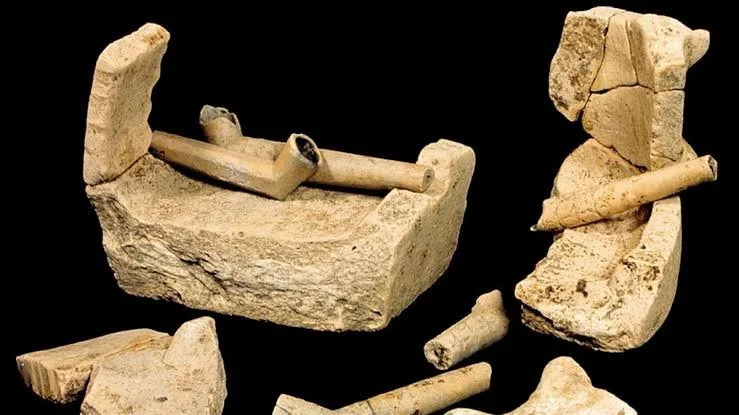
Pipe fragments are often recovered from domestic refuse, commercial deposits, shipwrecks, and colonial settlement layers.
Researchers examine bowl shape, stem construction, material, decoration, manufacturing marks, and dimensions.
Clay pipes may sometimes be dated through typological comparison with established production sequences.
Hand-carved wooden pipes are more difficult to date because their forms could remain similar for long periods.
Associated artifacts and stratigraphic evidence are therefore particularly important.
Trade, Consumption, and Economic History
Tobacco pipes can provide evidence of commercial networks.
Imported materials may indicate access to distant markets, while locally produced objects may reflect regional craft traditions.
The distribution of pipe fragments across settlements can help researchers examine patterns of consumption.
Differences between wealthier and poorer households may also be visible, although pipe quality alone is not a reliable measure of social status.
The objects should be studied alongside tobacco-related containers, trade records, plantation evidence, and other consumer goods.
Preservation Challenges
Organic pipes made from wood, bone, or horn are vulnerable to decay.
They may survive in waterlogged environments, dry caves, or deposits with favorable chemical conditions.
Clay pipes generally preserve more readily, but their fragments can be damaged by pressure, soil chemistry, and later disturbance.
Conservation specialists must also consider residues and surface deposits before cleaning.
Chemical analysis may sometimes identify traces of substances associated with tobacco use, although contamination and preservation conditions can complicate interpretation.
Conclusion
Hand-carved tobacco pipes provide a valuable record of colonial consumption, craftsmanship, and cultural exchange.
Their materials and designs reveal how people adapted imported habits to local resources and traditions.
When studied alongside archaeological context and historical documentation, pipes can help reconstruct the everyday lives of people whose experiences are often absent from official colonial records.
They are small objects, but their distribution connects domestic life with global trade, Indigenous knowledge, and the expanding commercial networks of the colonial world.