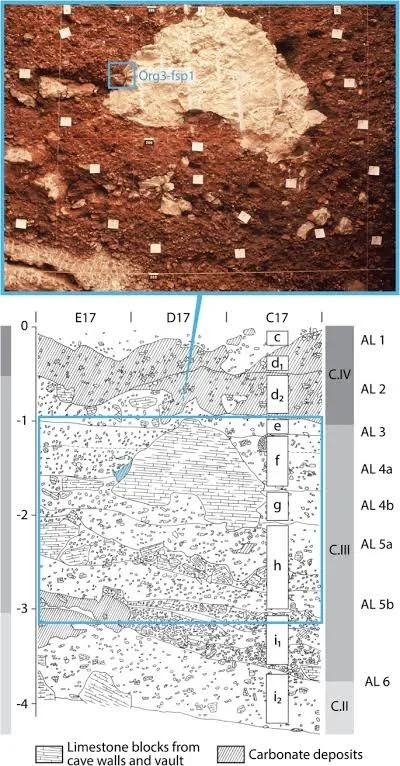
Rock shelters have provided natural protection for human communities throughout prehistory. Formed beneath overhanging rock faces or within shallow recesses, these spaces could offer shelter from rain, wind, and intense sunlight while remaining accessible to surrounding landscapes. Archaeological investigations of rock shelters frequently uncover hearths, stone tools, food remains, and deposits accumulated through repeated visits. Among the most informative traces are layers of soot and smoke residue, which can help researchers investigate the use of fire, changes in occupation intensity, and possible patterns of seasonal activity.
Soot forms when the incomplete combustion of organic material produces fine carbon-rich particles that settle on nearby surfaces. In a rock shelter, smoke from a hearth may leave dark deposits on the ceiling, walls, and overhanging rock. Repeated fires can gradually create visible layers or stains, although the appearance of these deposits depends on fuel type, airflow, fire temperature, and the shape of the shelter. Wood, brush, grasses, and other fuels do not necessarily produce identical combustion residues, and different burning conditions can change the amount of soot deposited.
Mapping these deposits allows archaeologists to examine how people used space over time. Darkened ceilings above a particular area may indicate repeated fire use, while variations in soot thickness could reflect differences in fire intensity or duration. Areas with little residue may have been used for sleeping, storage, tool production, or other activities that did not involve frequent fires. However, the absence of soot is not definitive evidence that a location was never occupied. Smoke may have escaped through openings, and later erosion or cleaning could have removed earlier traces.
The distribution of soot can also help researchers identify changes in the arrangement of domestic activities. If a shelter contains several hearth locations, their relationship to soot deposits may reveal whether fires were repeatedly built in one place or moved as the occupants reorganized the space. Archaeologists can compare the soot map with the positions of stone tools, animal bones, charcoal, and other materials. Such comparisons may show whether particular activities occurred together or were separated within the shelter.
Establishing a reliable chronology is essential because a rock shelter may have been used for thousands of years. Soot deposits can accumulate through repeated visits, but they may also be interrupted by erosion, rockfall, cleaning, or later occupation. Charcoal associated with a particular hearth may sometimes be radiocarbon dated, providing an estimate of when the burned material was formed. Yet a date from charcoal does not automatically date every soot layer on the surrounding rock. Researchers must establish the physical relationship between the sample and the deposit before drawing conclusions.
Seasonal use is a particularly interesting question. Some shelters may have served as temporary camps during hunting seasons, while others may have been occupied repeatedly throughout the year. Evidence of seasonal activity can come from animal remains, plant residues, growth patterns in certain biological materials, and other environmental indicators. For example, the presence of animals associated with particular seasons may suggest when a hunting episode occurred, although the interpretation depends on local ecology and the possibility that remains were transported or stored.
Soot alone rarely provides enough information to identify a season. Smoke deposits can indicate repeated burning, but they do not directly reveal whether a fire was used during winter, summer, or another part of the year. Stronger conclusions emerge when soot mapping is combined with independent evidence, such as seasonally available food resources, environmental changes, and occupation layers that can be dated. This integrated approach reduces the risk of interpreting a simple difference in fire use as a seasonal pattern.
Microscopic analysis can further reveal details that are not visible to the naked eye. Researchers may examine soot particles, charcoal fragments, mineral deposits, and the surfaces beneath the residue. These observations can help distinguish ancient smoke deposits from modern pollution, recent fires, or natural darkening of the rock. In some cases, chemical analysis may provide clues about the combustion materials, although fuel identification is not always possible from soot alone.
Rock shelters are also vulnerable to modern damage. Visitors may light fires, touch painted or soot-covered surfaces, or introduce new residues that obscure archaeological evidence. Conservation efforts therefore benefit from accurate documentation before deposits are disturbed. High-resolution photography, digital mapping, and carefully selected samples can preserve information that might otherwise be lost through erosion or human activity.
Soot layer mapping offers a valuable method for investigating how prehistoric people organized their shelters and managed fire. When interpreted alongside archaeological chronology and environmental evidence, smoke deposits can help reconstruct changing patterns of occupation, domestic activity, and resource use. The strongest interpretations recognize both the information preserved in soot and the limitations of using a single type of evidence to reconstruct the lives of people who inhabited these spaces long ago.