Storms Expose Hidden WWII Coastal Defences in Northumberland
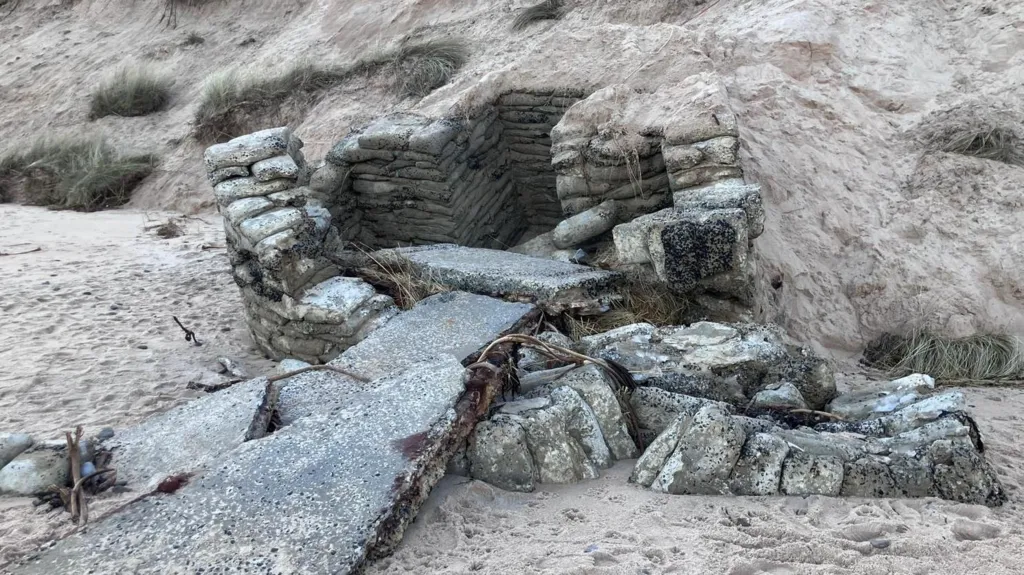
Recent storms along England’s northeast coast have uncovered more reminders of the Second World War. Shifting sand dunes at Low Newton-by-the-Sea in Northumberland have revealed the remains of a collapsed beehive-style pillbox that had been buried for decades.
According to the National Trust, the structure once formed part of a wider defensive network built to protect Britain’s coastline during the war.
A Coastal “Front Line” After Dunkirk
Following the 1940 evacuation of Dunkirk, Britain’s east coast became a critical defensive zone. Fears of invasion led to the rapid construction of bunkers, barriers, and pillboxes designed to provide soldiers with protected firing positions.
The newly exposed pillbox would have served exactly that purpose—offering troops shelter while guarding this vulnerable stretch of shoreline.
How the Pillbox Was Built
Chris Scott, an archaeologist with the conservation charity, explained that the structure was constructed using stacked sandbags filled with concrete. As the material dried, the sandbags bonded together, forming solid walls. The bunker was then finished with a reinforced concrete roof for added protection.
Though weathered and partially collapsed, the pillbox remains a striking example of wartime engineering designed for speed and practicality.
A Coastline That Never Stands Still
Scott noted that discoveries like this are not unusual, especially during winter months when storms reshape the shoreline. “We’ve experienced significant bad weather recently, and winter is often when features like these become visible,” he said.
He described this section of coastline as highly dynamic—constantly shifting with tides, wind, and storms. As a result, buried structures can suddenly appear, only to be covered again just as quickly.
History Hidden Beneath the Sand
The exposure of this pillbox highlights how natural forces continue to reveal fragments of Britain’s wartime past. Along ever-changing coastlines like Northumberland’s, history can literally rise from the sand—offering powerful reminders of a time when these beaches stood on the nation’s front line.
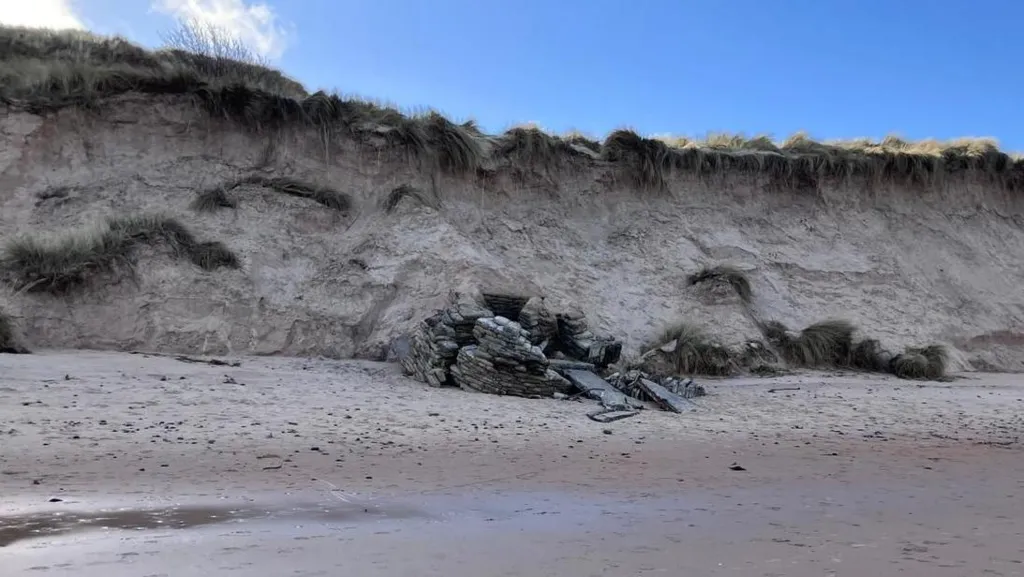
The structure was revealed on the beach at Low Newton-by-the-Sea
Built in 1940 at a Moment of National Crisis
Chris Scott explained that most of the coastal defences in this part of Northumberland were constructed in 1940, shortly after the evacuation of Dunkirk. At that time, fear of a German invasion was very real.
“The beach in Northumberland—like much of England’s east coast—effectively became the front line,” he said. “There was genuine concern that an invasion could happen at any moment.”
These emergency fortifications, including pillboxes and other barriers, were designed to strengthen Britain’s vulnerable shoreline during one of the most uncertain periods of the war.
Public Access — With Caution
Scott noted that several pillboxes along the coast remain intact and accessible, allowing visitors to see and even touch these pieces of wartime history. However, he urged caution around the recently exposed structure at Low Newton-by-the-Sea, as it has partially collapsed and may be unstable.
The site sits on land cared for by the National Trust, which is responsible for balancing public access with safety and preservation.
Climate Change and Accelerated Erosion
Scott also highlighted a broader environmental concern. Increasingly intense and frequent storms—linked to climate change—may be accelerating natural coastal erosion.
This presents a growing challenge. Stronger weather systems can quickly uncover buried archaeological remains, but they can just as easily damage or destroy them before they are properly documented.
“It’s a real challenge for us,” Scott said, referring to the Trust’s ongoing conservation work.
Layers of History Beneath the Dunes
Beyond the pillbox, Scott emphasized that the sand dunes conceal extensive archaeological material from many different time periods—much of it still unrecorded.
The Trust is now working to document the exposed structure and gather as much information as possible. Their goal is not only preservation but public engagement.
As Scott put it, archaeology belongs to everyone. By recording and sharing these discoveries, the Trust hopes to connect people with the rich and varied history hidden beneath their feet—even along a coastline that never stops changing.