8,000-Year-Old Skeleton Discovered in Flooded Cave Along Mexico’s Caribbean Coast
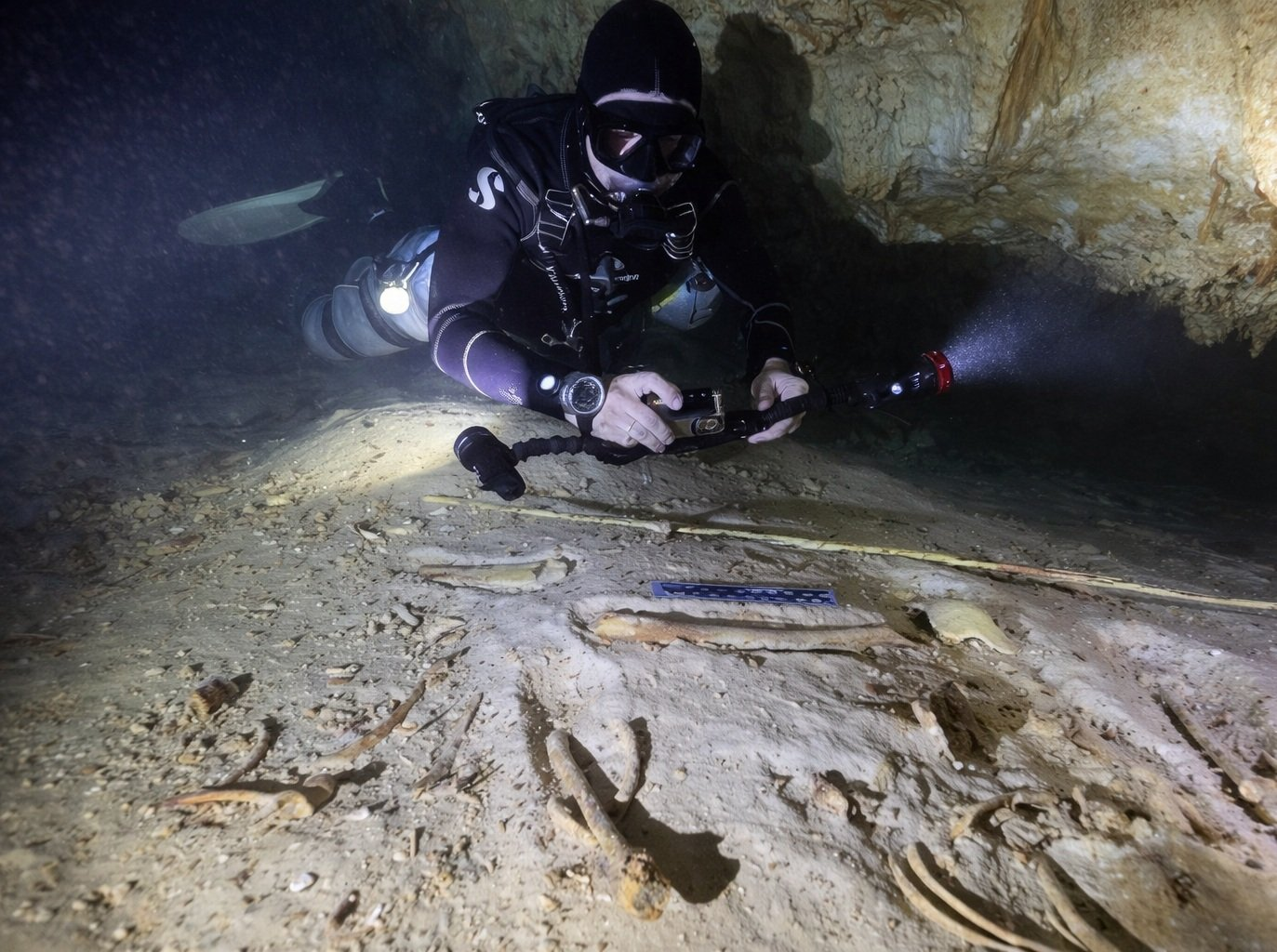
Underwater archaeologists have uncovered a prehistoric human skeleton deep inside a submerged cave system along Mexico’s Caribbean shoreline. Experts believe the remains could be part of a burial dating back at least 8,000 years.
The skeleton was found about eight metres below the surface inside a flooded cavern that forms part of an extensive network of cenotes and underground rivers between Tulum and Playa del Carmen.
A Cave Once Dry at the End of the Ice Age
Today, these caves lie underwater. However, toward the end of the last Ice Age, they were dry passages stretching for kilometres beneath the Yucatán Peninsula. Around 8,000 years ago, rising sea levels gradually flooded the system, preserving whatever had been left inside.
According to Octavio del Río of Mexico’s National Institute of Anthropology and History (INAH), the skeleton could only have reached that location when the cave was still dry.
The remains were recovered at the end of 2025 and are now undergoing detailed scientific analysis.
Evidence of a Possible Ritual Burial
The position of the bones offers important clues. The skeleton was discovered on a sediment dune within a tight space beside an interior chamber. Researchers say the arrangement does not appear accidental.
Del Río noted that the placement suggests a deliberate funerary deposit, possibly linked to ritual practices carried out by early inhabitants of the region. If confirmed, this would indicate that the cave served as a burial site long before it was submerged.
One of Eleven Prehistoric Skeletons Found in the Region
This marks the eleventh prehistoric human skeleton uncovered in the area over the past 30 years. Some earlier discoveries rank among the oldest human remains found in the Americas, dating back more than 13,000 years.
Each new find helps scientists better understand how ancient populations migrated into and adapted to the Yucatán Peninsula. Thousands of years ago, the region looked very different. Instead of today’s dense jungle and coastline, it featured open plains and rocky cliffs.
A Window Into Ice Age Ecosystems
The cave systems have yielded more than human remains. Researchers have also recovered fossils of extinct megafauna, including giant sloths, sabre-toothed cats, and ancient bears. These discoveries are helping scientists reconstruct the ecosystems that existed during the Ice Age.
Together, the human and animal remains offer a rare and detailed glimpse into a prehistoric world that has long since disappeared.
Conservation Efforts Gain Momentum
The discovery comes at a critical time. The cenote systems have faced environmental pressure in recent years, particularly during construction of the Maya Train railway project.
In response, Mexican authorities are working toward officially designating the underground river network as a protected natural and cultural heritage zone by 2026. The goal is to preserve both its fragile ecosystem and its extraordinary archaeological importance.
As research continues, this newly uncovered skeleton may provide valuable insight into early life in the Americas—adding another chapter to the deep and complex history hidden beneath the Yucatán Peninsula.