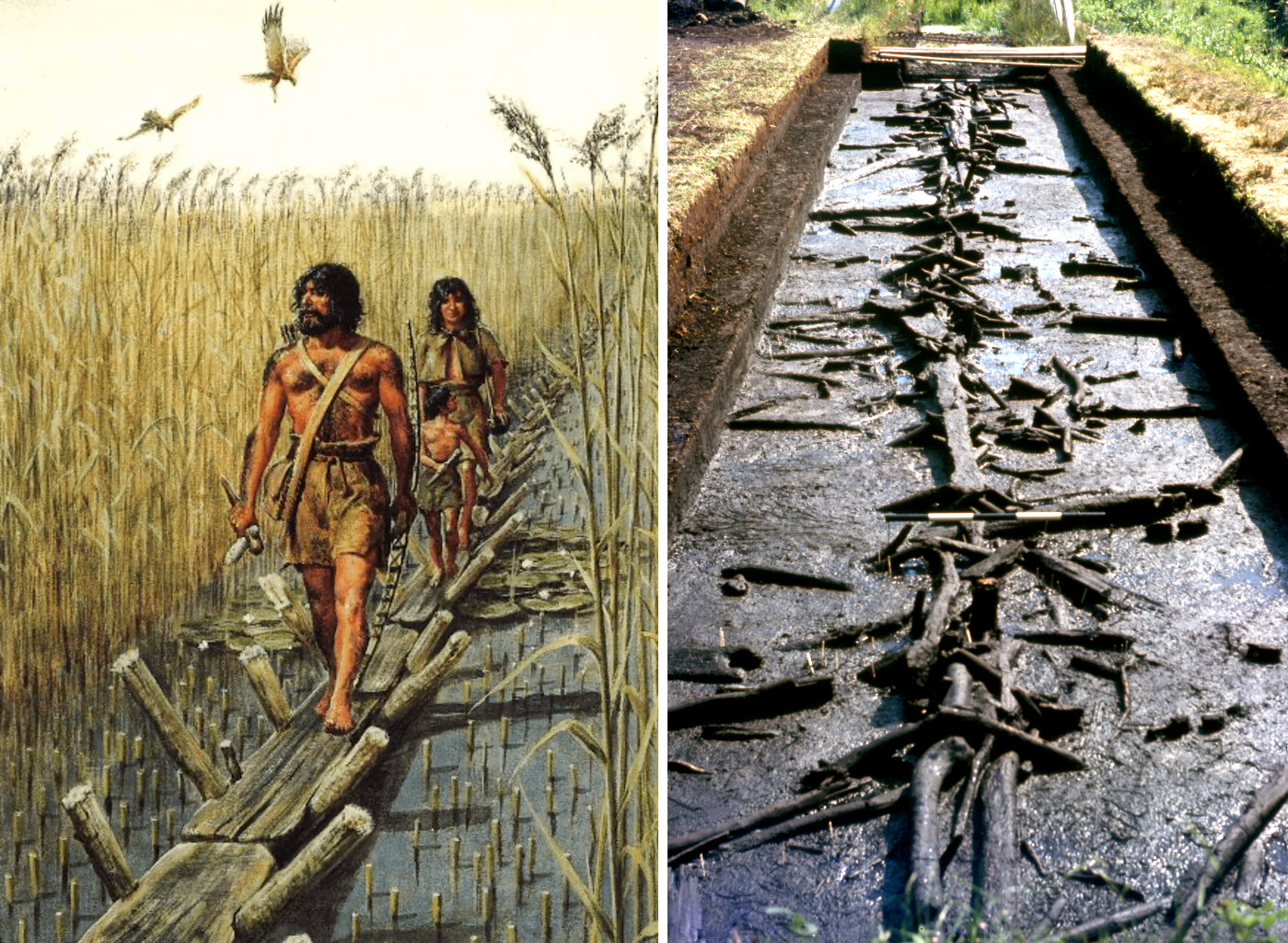
Introduction
Peat bogs preserve some of the most remarkable archaeological materials found in wetland environments. Their waterlogged and often oxygen-poor conditions can slow the decomposition of organic materials, allowing wooden structures, tools, trackways, and other remains to survive for centuries or even millennia.
Among these discoveries are wooden walkways constructed across wetlands. These structures allowed people to cross unstable ground, reach resources, connect settlements, and travel through landscapes that were otherwise difficult to navigate. Determining their age is essential for understanding when they were built, how long they remained in use, and what role they played in past societies.
Dating submerged wooden walkways requires several scientific methods because the age of the timber does not always correspond directly to the construction date.
Understanding Peat Bog Environments
Peat bogs are wetlands where partially decomposed plant material accumulates over long periods. They commonly develop in environments with high moisture levels and limited oxygen availability.
The slow decomposition of vegetation creates layers of peat that can gradually cover objects and structures. These conditions may preserve wood, leather, textiles, plant remains, and other organic materials that would normally disappear in dry soil.
The chemical characteristics of peat can also affect preservation. Acidity may help inhibit certain microorganisms, although it can damage some materials, including bone and other mineralized remains.
Because peat develops gradually, its layers can provide a record of environmental change and human activity.
The Construction of Wooden Walkways
Wooden walkways were built to make movement across wetlands safer and more practical. Their construction varied according to available materials, terrain, and the intended purpose.
Some structures consisted of logs placed directly across wet ground. Others used split timber, branches, planks, or wooden supports arranged to create a more stable walking surface.
The simplest walkways may have been temporary and intended for seasonal use. More substantial examples could connect settlements, agricultural areas, grazing grounds, or resource-gathering locations.
Construction methods depended on local knowledge of the wetland. Builders needed to understand ground stability, water levels, available timber, and the direction of travel.
Why Accurate Dating Matters
Dating a wooden walkway helps establish when people began using a particular route. It may also reveal whether the structure belonged to a period of settlement expansion, agricultural development, or increased movement through wetlands.
However, determining the age of a walkway is not always straightforward. Timber may have been reused from older structures, while later repairs could introduce younger wood into an earlier construction.
A walkway may also have been used for generations. Its original construction date therefore does not necessarily represent the full period of activity at the site.
Archaeologists must distinguish the date of the wood, the date of construction, and the period during which the walkway was actually used.
Radiocarbon Dating
Radiocarbon dating is one of the most widely used methods for determining the age of organic archaeological materials.
Living trees absorb carbon dioxide from the atmosphere, including a small proportion of radioactive carbon-14. After a tree is cut or dies, its carbon-14 content gradually decreases through radioactive decay.
By measuring the remaining carbon-14 in a wood sample, scientists can estimate when the tree stopped exchanging carbon with the atmosphere.
Radiocarbon dating can be especially useful when wooden walkways lack distinctive construction features or associated artifacts.
However, the method dates the growth of the sampled wood, not automatically the moment when it was placed in the walkway. If builders used an old tree or reused timber, the resulting date may be older than the actual construction event.
Calibration is also necessary because atmospheric carbon-14 concentrations have changed over time.
Dendrochronology and Tree-Ring Dating
Dendrochronology is a dating method based on annual tree-ring patterns. Trees growing in seasonal climates commonly produce rings that reflect variations in environmental conditions.
Wet years, dry years, temperature changes, and other environmental factors can influence ring width. These patterns can be compared with established regional reference chronologies.
When the outermost growth rings are preserved, dendrochronology may identify the year a tree was felled with considerable precision.
This makes it especially valuable for dating wooden walkways. If several timbers show similar final ring patterns, researchers may be able to determine whether they were cut during the same period.
The method has limitations. Not all tree species produce easily readable annual rings, and reference chronologies may not exist for every region or period.
Stratigraphic Dating
Stratigraphy involves studying the arrangement of archaeological and geological layers. In peat bogs, successive layers may preserve evidence of environmental change and human activity.
If a walkway lies beneath a well-dated peat layer, researchers can establish that its construction predates the formation of that layer. Similarly, deposits covering the structure may provide evidence of when it was abandoned or buried.
Stratigraphic relationships are particularly useful when combined with radiocarbon dating and environmental analysis.
However, peat accumulation is not always uniform. Flooding, erosion, drainage, and human disturbance can alter the sequence of deposits.
Researchers must therefore examine whether the layers remain undisturbed before relying on their chronological relationships.
Archaeological and Environmental Dating Evidence
Artifacts discovered near a walkway may provide additional chronological information. Pottery fragments, tools, metal objects, and other materials can sometimes be assigned to established archaeological periods.
However, artifacts may have moved through water, animal activity, or later human disturbance. Their relationship to the walkway must be demonstrated rather than assumed.
Environmental evidence can also contribute to dating. Pollen grains, plant remains, and microscopic charcoal may reveal changes in vegetation and human activity.
Pollen analysis can help reconstruct the development of the surrounding landscape, including changes associated with agriculture, woodland clearance, and settlement.
These environmental records can provide a broader context for understanding when a walkway was constructed and how the surrounding wetland changed.
Preservation and Excavation Challenges
Peat bogs can preserve wood exceptionally well while also creating difficult excavation conditions. Archaeologists must work carefully because exposed timbers can shrink, crack, and deteriorate when they dry.
Waterlogged wood requires specialized conservation after excavation. Depending on its condition, treatment may involve controlled drying, chemical stabilization, or other conservation techniques.
Excavation must also account for the fragility of the surrounding peat. Removing large sections without proper recording can destroy the relationships between timbers, sediment layers, and associated materials.
Because wetland environments are sensitive, researchers increasingly use non-invasive survey methods before excavation. Ground-penetrating radar, remote sensing, and environmental coring may help locate structures and understand their context.
What Wooden Walkways Reveal About Ancient Mobility
Wooden walkways demonstrate that ancient communities developed practical solutions for moving through challenging environments.
Their construction may indicate repeated travel between settlements, access to natural resources, agricultural activity, or seasonal movement of livestock.
A network of walkways could connect different parts of a wetland landscape and make otherwise isolated areas more accessible.
Dating these structures can also reveal changes in land use. A walkway constructed during a period of expanding agriculture may reflect a growing need to access fields or grazing areas.
However, the exact purpose of each structure must be established through its location, construction, associated artifacts, and relationship to nearby settlements.
Conclusion
Submerged wooden walkways in peat bogs provide valuable evidence of ancient engineering and movement through wetland environments. Their organic materials may survive because of the unusual preservation conditions created by peat, but establishing their age requires careful analysis. Radiocarbon dating, dendrochronology, stratigraphy, artifact study, and environmental reconstruction each contribute different information. When combined, these methods help researchers distinguish the age of the timber from the construction and use of the walkway, allowing a more accurate reconstruction of ancient landscapes and human activity.