Introduction
Access to freshwater was one of the most important factors influencing where ancient communities established settlements. During the Bronze Age, populations depended on reliable water sources for drinking, cooking, agriculture, livestock, craft production, and sanitation. While major rivers and large lakes often attracted settlement, smaller water sources may have been equally important in certain landscapes.
Minor springs, which produce relatively limited quantities of groundwater, could provide dependable water in locations where larger rivers were absent or difficult to access. Their importance may be overlooked when researchers focus primarily on major waterways and large settlements. Examining these smaller sources offers an opportunity to understand how Bronze Age communities evaluated their environments and selected places to live.
Understanding Minor Springs
A spring occurs when groundwater naturally emerges at the Earth's surface. Springs can develop along hillsides, geological fractures, limestone formations, and areas where underground water-bearing layers meet less permeable rock.
Minor springs generally produce smaller or more localized water flows than major springs. Some may provide water throughout the year, while others experience seasonal fluctuations depending on rainfall, groundwater levels, and geological conditions.
Despite their limited output, minor springs can be valuable because they may provide relatively accessible freshwater. In dry environments, even a modest spring could support a small settlement, a livestock enclosure, or a temporary agricultural community.
Freshwater and Bronze Age Settlement Patterns
The Bronze Age was characterized by significant developments in agriculture, metallurgy, trade, and settlement organization. These activities required access to water, although the amount needed varied according to the size and function of a community.
Agricultural settlements needed water for crops and livestock. Craft production could also require water for preparing clay, processing fibers, cooling materials, and other activities.
The availability of freshwater influenced where people could establish permanent homes. Settlements located near springs could reduce the time and labor required to obtain water, particularly in hilly or mountainous regions.
However, water was rarely the only factor involved in settlement choice. Soil fertility, defensive advantages, access to trade routes, building materials, and relationships with neighboring communities also shaped settlement decisions.
Why Small Springs Could Be More Useful Than Large Waterways
Large rivers provide substantial water supplies, but they can also present disadvantages. Seasonal flooding, changing channels, marshy terrain, and long distances between safe crossing points may make certain river environments difficult to occupy.
A minor spring may offer a more predictable and manageable source of water. Its limited flow could be sufficient for a small population while reducing the need to build complicated water-management systems.
Springs located on elevated ground may also offer strategic advantages. A settlement could occupy a defensible hillside while maintaining access to water below or nearby.
In some regions, minor springs may have been especially important for pastoral communities that moved livestock between seasonal grazing areas.
Archaeological Evidence for Spring-Related Settlements
Identifying the role of minor springs requires more than finding a settlement near a modern water source. Springs can shift, dry up, or become obscured through geological and environmental changes.
Archaeologists investigate the surrounding landscape to reconstruct ancient water availability. Geological mapping can identify natural groundwater outlets, while sediment analysis may reveal former wet areas or water channels.
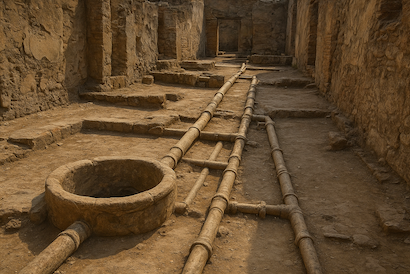
Settlement remains can provide additional clues. Wells, storage containers, drainage channels, animal enclosures, and water-related installations may indicate how residents accessed and managed freshwater.
The distribution of pottery, domestic structures, and agricultural features around a spring may also reveal patterns of occupation and daily movement.
Geological and Environmental Reconstruction
Geological conditions influence whether a spring existed during the Bronze Age and whether it could have provided a reliable supply.
Researchers study rock formations, groundwater pathways, and sediment deposits to reconstruct ancient hydrological conditions. Limestone landscapes are particularly important because groundwater can move through underground channels and emerge at localized points.
Pollen analysis may help identify changes in surrounding vegetation. Wetland plants and moisture-sensitive species can provide evidence of former water availability, although they do not always identify a specific spring.
Stable isotope analysis of suitable archaeological materials may also contribute to understanding past water sources and environmental conditions.
Combining geological and archaeological evidence is essential because a spring visible today may not have existed in the same form thousands of years ago.
Springs, Livestock, and Pastoral Economies
Minor springs may have been particularly important for Bronze Age pastoral communities. Herds of sheep, goats, cattle, and other domestic animals required regular access to water.
A spring could support a temporary grazing station or a seasonal settlement where herders gathered animals before moving to other pastures.
The location of livestock remains, dung deposits, and animal enclosures may provide evidence of pastoral activity near water sources. Isotopic analysis of animal teeth and bones can sometimes help reconstruct movement between different environmental zones.
Small springs may therefore have influenced not only permanent settlements but also the wider network of seasonal occupation and livestock movement.
Social and Political Importance of Water Sources
Even a small spring could become socially significant if several households depended on it. Access to freshwater may have required shared rules, maintenance practices, or agreements between neighboring groups.
In areas with limited water availability, springs could become important meeting places and strategic resources. Their control may have influenced settlement boundaries and relationships between communities.
However, evidence of competition or ownership cannot be inferred from proximity alone. Archaeologists need supporting information, such as defensive structures, restricted access, water installations, or historical records.
Springs may also have held symbolic or ritual importance. Natural water sources sometimes became associated with religious practices, offerings, and ceremonial activity, although such interpretations must be based on specific archaeological evidence.
Limitations of the Archaeological Record
Minor springs are difficult to study because their physical traces may disappear over time. Modern construction, agricultural activity, groundwater extraction, and changes in vegetation can obscure ancient spring locations.
Furthermore, settlements may have used several water sources rather than relying on a single spring. Seasonal movement between springs, wells, streams, and rainwater collection systems could have been part of a broader water-management strategy.
The absence of visible water installations does not necessarily mean that a settlement lacked access to freshwater. Natural springs may have required little construction, leaving limited archaeological evidence.
Conclusion
Minor springs may have played an important role in Bronze Age settlement choice, particularly in landscapes where major rivers and lakes were unavailable or inconvenient. Their accessibility and potentially dependable water supplies could support households, livestock, and small agricultural communities. By combining geological reconstruction, environmental analysis, and archaeological survey, researchers can investigate how these modest water sources influenced settlement distribution, seasonal mobility, and the organization of ancient communities.