Introduction
Before industrial textile manufacturing, the production of colored fabrics depended on skilled labor, natural dyes, specialized knowledge, and access to suitable water and raw materials.
In many pre-industrial towns, dyeing was conducted in small workshops or work areas rather than only in large centralized facilities. These spaces could be located within residential districts, near streams, close to markets, or alongside other textile-related businesses.
Small-scale dye yards are particularly valuable to archaeology because they provide evidence of everyday manufacturing and the organization of urban economies. Their remains can reveal how craftspeople transformed raw materials into colored textiles and how specialized work was integrated into the wider community.
Understanding Small-Scale Dyeing
Dyeing is the process of adding color to fibers or finished textiles.
Before synthetic dyes became widespread, craftspeople relied on natural substances derived from plants, insects, minerals, and other sources.
The exact materials varied according to region and period.
Some dyes required complicated preparation, while others could be extracted through relatively simple processes.
Dyeing also required knowledge of temperature, acidity, water quality, and the chemical behavior of different fibers.
Natural Dye Sources
Plants were among the most important sources of ancient and pre-industrial dyes.
Different roots, leaves, bark, flowers, and fruits could produce a range of colors.
Certain insects also provided valuable pigments, while mineral substances could be used to create or modify particular shades.
The availability of dye materials depended on local ecology and trade.
A town might obtain some materials from its surrounding countryside while importing others through regional or long-distance commercial networks.
The Organization of a Dye Yard
A small dye yard could contain several functional areas.
These might include spaces for preparing dye materials, soaking fibers, heating water, washing textiles, and drying finished products.
Large containers or vats could be used to hold dye solutions.
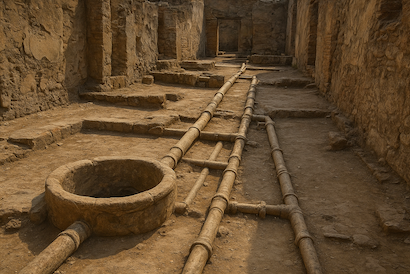
Furnaces or hearths might provide heat, while drains and channels helped remove wastewater.
The arrangement of these features would depend on the scale of production and the types of textiles being treated.
Not every workshop required the same equipment.
Water and Waste Management
Water was essential to textile dyeing.
Fibers needed to be washed, prepared, soaked, and rinsed.
The quality of the water could influence the final color, while repeated production created wastewater containing organic materials, mineral compounds, and dye residues.
For this reason, dye workshops often benefited from access to streams, wells, or other water sources.
Their location within a town may also have been influenced by concerns about odors, waste disposal, and competition with households for clean water.
Mordants and Color Fixing
Some natural dyes do not attach strongly to fibers without additional substances.
Mordants are materials used to help dyes bind to textiles or alter the resulting color.
Different mordants could produce different shades from the same dye source.
Their use required practical knowledge of chemical processes, even when craftspeople did not describe those processes in modern scientific terms.
Archaeologists may investigate traces of mineral substances, workshop containers, and residues to explore the materials used in dye preparation.
However, identifying a specific mordant from archaeological remains can be difficult because many compounds have multiple possible uses.
Archaeological Evidence for Dyeing
Small dye yards may leave several types of physical evidence.
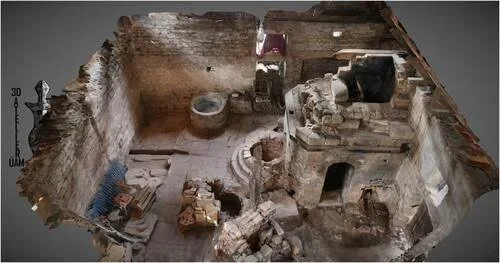
These include hearths, vats, drains, basins, storage pits, working surfaces, and deposits containing production waste.
Ceramic vessels may have been used for preparing or storing dye materials.
Chemical analysis can sometimes identify organic or inorganic residues associated with dye production.
Textile fragments may preserve traces of colorants, although preservation depends heavily on burial conditions.
The strongest interpretation usually comes from several features appearing together in a context consistent with textile processing.
Distinguishing Dyeing from Other Crafts
A basin or furnace does not automatically indicate a dye workshop.
Similar installations could have been used for cooking, pottery production, metalworking, leather processing, or other activities.
Researchers therefore examine the entire archaeological context.
The presence of multiple washing areas, suitable containers, chemical residues, textile fragments, and workshop waste may strengthen a dyeing interpretation.
Comparisons with historically documented workshops can also help identify likely production arrangements.
Craft Specialization and Urban Economies
Small-scale dye yards were part of larger textile economies.
A town might contain spinners, weavers, fullers, dyers, tailors, and merchants.
Each specialist contributed to the transformation and distribution of textile products.
Dyers could work independently or provide services to other craftspeople.
Their income depended on the availability of raw materials, market demand, technical skill, and access to customers.
The organization of these activities varied considerably between towns and historical periods.
Trade and the Movement of Color
Dye materials could travel considerable distances.
Some valuable colorants were difficult to obtain locally and therefore became important trade commodities.
The presence of imported dye substances in an archaeological workshop could reveal connections with distant regions.
Finished textiles could also circulate through markets, diplomatic exchanges, religious institutions, and elite households.
Color therefore provides an opportunity to investigate both local manufacturing and long-distance trade.
Environmental Impact
Dye production could affect the surrounding environment.
Repeated disposal of wastewater might alter soil chemistry or introduce organic and mineral substances into nearby water sources.
The environmental impact depended on the scale of production, the materials used, and local waste-management practices.
Archaeological soil analysis may help identify areas where craft activities left chemical signatures.
However, natural geological conditions and later contamination must be considered before attributing unusual chemical concentrations to dyeing.
Conclusion
Small-scale dye yards were important components of pre-industrial urban economies. They connected agricultural resources, specialized craft knowledge, water management, and commercial exchange.
Although their archaeological remains can be difficult to identify, the combination of workshop structures, containers, chemical residues, and textile evidence can reveal how craftspeople produced colored fabrics on a local scale.
Studying these modest workspaces helps reconstruct the economic lives of towns beyond their major markets and monumental buildings, showing how specialized artisans contributed to the everyday material culture of pre-industrial society.