This Himalayan Monastery Looks Like a Fortress: Inside Spiti's 1,000-Year-Old Key Gompa
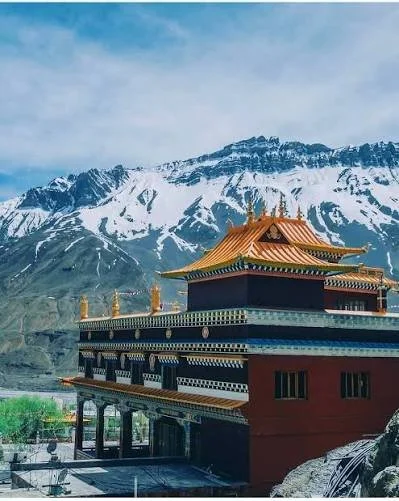
From a distance, Key Monastery appears almost inseparable from the mountain beneath it.
Its whitewashed structures rise in layers above the Spiti Valley, producing an irregular silhouette that resembles a fortified settlement more than a conventional monastery.
This dramatic appearance is not accidental.
Over centuries, Key Monastery—also spelled Ki, Kee, or Kye—developed through repeated construction, destruction, rebuilding, expansion, and adaptation.
The result is one of the most recognizable Buddhist monuments in the Indian Himalayas.
A Monastery Founded in the Eleventh-Century Buddhist World
Key Monastery is traditionally associated with the great period of Buddhist revival and institutional development that transformed the western Himalayas during the late first and early second millennia.
The eleventh century was especially important for the spread and reorganization of Buddhist learning in Himalayan regions.
Monastic networks expanded.
Teachers traveled between India and Tibet.
Texts were translated.
New religious institutions were established.
Key emerged within this broader world.
Although traditions surrounding individual founders and exact construction phases can be complex, the monastery's historical identity is closely connected with the approximately thousand-year development of Buddhism in Spiti.
Why the Monastery Looks Like a Fortress
The present appearance of Key Monastery reflects centuries of adaptation.
Rather than following a single perfectly symmetrical architectural plan, structures accumulated around the core religious complex.
Rooms, prayer halls, passages, and monastic spaces were added according to need and terrain.
The result resembles an architectural organism.
Buildings appear stacked upon one another.
Narrow passages connect different levels.
The entire complex follows the contours of the hillside.
This irregularity gives Key its fortress-like appearance.
It also reflects the realities of Himalayan construction.
Spiti: A High-Altitude World
Spiti is a cold desert region.
The landscape is shaped by:
High altitude.
Limited rainfall.
Extreme winters.
Sparse vegetation.
Dramatic erosion.
Long periods of isolation.
These conditions influenced every aspect of life.
Building materials had to be locally available.
Communities had to prepare for severe winters.
Agriculture was limited by altitude and climate.
Monasteries became important centers of religious, educational, and social organization.
A Center of Buddhist Learning
A monastery is more than a place where monks live.
Historically, major gompas could function as:
Religious centers.
Educational institutions.
Libraries.
Centers of manuscript preservation.
Locations for artistic production.
Administrative institutions.
Community gathering places.
Key Monastery played an important role in the religious life of Spiti.
Generations of monks studied Buddhist philosophy, ritual, language, and scripture within its walls.
Manuscripts and the Preservation of Knowledge
Before printing became widespread, religious knowledge depended heavily on manuscripts.
Texts had to be copied by hand.
This required enormous labor.
A single manuscript could represent months or years of work.
Monasteries became essential repositories.
They preserved:
Buddhist scriptures.
Commentaries.
Ritual texts.
Historical records.
Philosophical works.
The survival of Himalayan Buddhism depended partly on these institutions.
When political conflict or natural disaster destroyed a monastery, manuscripts could be lost forever.
A History of Conflict and Reconstruction
Like many Himalayan monasteries, Key experienced periods of destruction and restoration.
Its position within a frontier landscape exposed it to political instability and conflict.
Accounts of the monastery's history include episodes involving raids, attacks, and rebuilding.
These events help explain its fortified appearance.
The architecture was not created under ideal conditions.
It evolved in response to historical threats.
Art Inside the Mountain Fortress
Despite the harsh exterior environment, Himalayan monasteries could contain highly sophisticated interior art.
Prayer halls may preserve:
Murals.
Painted deities.
Mandalas.
Sculptures.
Religious banners.
Decorative textiles.
Such art transformed interior spaces into visual representations of Buddhist cosmology.
A monk entering a prayer hall was not simply entering a decorated room.
The architecture and imagery created a sacred environment.
The Defensive Landscape
Mountains can protect and isolate at the same time.
Key's elevated location provided a strategic advantage.
A hillside position could offer visibility across surrounding valleys.
At the same time, difficult access created natural defenses.
The monastery therefore demonstrates how geography influenced architecture.
In the Himalayas, spiritual and strategic landscapes could overlap.
Life at Key Monastery
Daily monastic life traditionally involved discipline and routine.
Activities could include:
Morning prayers.
Scriptural study.
Philosophical debate.
Ritual performance.
Maintenance work.
Teaching.
Community interaction.
The monastery was therefore a living institution rather than a static monument.
The architecture supported this social world.
Rooms were needed for sleeping.
Halls were needed for collective worship.
Storage areas preserved food and materials.
Libraries protected texts.
Key Monastery and the Gelug Tradition
Key is associated with Tibetan Buddhist monastic traditions and later became connected with the Gelug school, one of the major traditions of Tibetan Buddhism.
The Gelug school became historically influential across Tibet and the Himalayan world.
Monastic education and institutional organization formed central elements of its development.
The connection of Key with wider Tibetan Buddhist networks demonstrates that even an apparently remote monastery participated in transregional religious systems.
Modern Preservation
The survival of a millennium-old monastery in an earthquake-prone Himalayan environment is never guaranteed.
Conservation challenges include:
Earthquakes.
Weathering.
Water infiltration.
Structural instability.
Increased tourism.
Pressure on traditional building materials.
Preservation requires specialized knowledge.
Modern materials may not always behave the same way as historic earth and timber construction.
Therefore, restoration must balance structural safety with historical authenticity.
Why Key Monastery Matters
Key Monastery represents more than Tibetan Buddhism in the Himalayas.
It represents adaptation.
Its architecture adapted to a mountain.
Its community adapted to a high-altitude environment.
Its institution survived political change.
Its buildings were rebuilt after destruction.
Its appearance today is the accumulated result of centuries of resilience.
Standing above the Spiti Valley, Key looks like a fortress because, in many ways, it has been one.
Not only a fortress of stone.
A fortress of knowledge, memory, religion, and cultural survival.