The discovery of King Richard III in 2012 remains one of the most significant triumphs of modern forensic archaeology. For over 500 years, the location of the last English king to die in battle was a matter of urban legend, with some stories claiming his bones had been thrown into the River Soar.
The project, led by the University of Leicester in collaboration with the Richard III Society, combined historical detective work with cutting-edge science to locate a "needle in a haystack."
1. The Historical Compass: Finding Greyfriars
The search began not with shovels, but with maps. Historical records stated that Richard III was buried in the church of the Greyfriars, a Franciscan priory in Leicester.
The Parking Lot: After the Dissolution of the Monasteries in the 1530s, the priory was demolished and its location lost to time. By 2012, the site was covered by a social services parking lot.
The Trenching: Using Ground Penetrating Radar (GPR) and map regression, the team identified the most likely location of the church's choir—the traditional burial place for high-status individuals. Remarkably, the skeleton was found within the first few hours of excavation, directly beneath a parking space marked with a letter "R."
2. Osteology: The "Curse" of Scoliosis
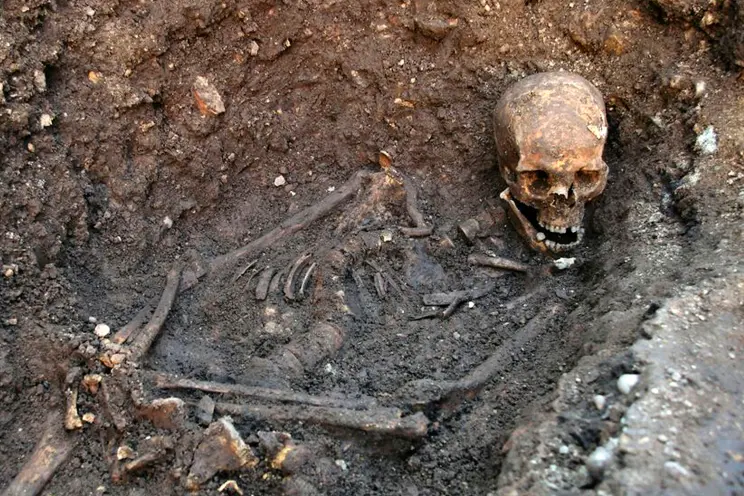
Once the remains (designated Skeleton 1) were unearthed, osteological analysis provided immediate, striking physical evidence that matched historical descriptions of Richard.
Spinal Deformity: The skeleton exhibited severe idiopathic adolescent onset scoliosis. His spine had a pronounced "S" curve, which would have caused one shoulder to be higher than the other. This debunked the Tudor propaganda of a "hunchback" (kyphosis) but confirmed he had a noticeable physical impairment.
The Slender Frame: Despite his reputation as a warrior, the skeleton revealed a surprisingly gracile (slender) build, almost feminine in its bone structure, which matched contemporary accounts of his appearance.
3. Forensic Pathology: A Violent End
The bones told a grizzly story of Richard’s final moments at the Battle of Bosworth (1485). Forensic pathologists identified 11 distinct injuries, 9 of them to the skull.
Battlefield Execution: Two of the head wounds were fatal: one from a halberd (a poleaxe) that sliced off the back of the skull, and another from a sword that penetrated the brain.
"Humiliation Injuries": Several wounds, including a blade strike to the pelvis, were inflicted after death. These "post-mortem" injuries suggest that after Richard was stripped naked and thrown over a horse, the victors continued to mutilate his body as a final act of disrespect.
4. DNA: The Genetic Smoking Gun
The most definitive proof came from Mitochondrial DNA (mtDNA), which is passed down through the female line.
The Descendants: Researchers tracked down Michael Ibsen (a Canadian cabinet maker) and Wendy Duldig, both direct descendants of Richard's sister, Anne of York.
The Match: The DNA from the skeleton matched the modern descendants perfectly. The statistical probability that the skeleton was not Richard III was calculated at less than 1 in 6.7 million.
5. Diet and Environment: Isotope Analysis
By analyzing the chemical isotopes in Richard's teeth and bones, scientists reconstructed his life and habits.
The Royal Diet: Isotope levels showed a massive shift in his diet during the final years of his life. He began consuming huge amounts of expensive "prestige" foods, including freshwater fish and wildfowl (like swan and heron).
The Wine: The analysis also suggested he was drinking up to a bottle of wine every day toward the end of his reign—likely a reflection of the intense stress and lavish court life during the War of the Roses.
6. Reburial and Legacy
In 2015, Richard III was reinterred in Leicester Cathedral with full royal honors. The discovery transformed our understanding of the king, stripping away the Shakespearean villainy to reveal a man of his time—physically fragile, brutally killed, and buried in a grave that was too short for his body (forcing his head into a propped-up position).
Since we now have the physical proof of his scoliosis and the brutality of his death, do you think forensic archaeology has "redeemed" Richard III from his reputation as a villain, or does the science only tell us how he died, leaving the mystery of his character (and the Princes in the Tower) as unsolved as ever?