Introduction
Iron tools transformed many aspects of daily life in ancient and medieval societies. Knives, axes, agricultural implements, chisels, and other iron objects supported farming, construction, craft production, and household activities. However, iron tools required maintenance. Repeated use caused cutting edges to become blunt, damaged, or uneven, making sharpening an essential part of everyday work.
Sharpening stones are among the most practical objects associated with this maintenance. They could be used to restore the edges of knives, blades, and other tools through abrasion. Because many sharpening stones are small, durable, and easily carried, they can be found in a wide variety of archaeological contexts.
Studying household sharpening stones can reveal how people maintained their equipment, organized domestic work, and depended on iron tools in everyday life.
Understanding Sharpening Stones
A sharpening stone is an abrasive material used to remove small amounts of metal from a tool's edge. The process can restore a cutting surface and improve the tool's performance.
Sharpening stones may be made from sandstone, quartz-rich rock, fine-grained sedimentary stone, or other materials with suitable abrasive properties.
Their effectiveness depends on grain size, hardness, surface texture, and the presence of water or other lubricating substances.
Some stones are coarse and designed to remove damaged material quickly. Others have finer surfaces that produce a smoother cutting edge.
Ancient users may have selected different stones according to the type of tool being maintained.
Household Iron Tools and Their Maintenance
Iron tools were used in many domestic activities.
Knives were essential for food preparation and general cutting. Small blades could be used for craft work, while axes and agricultural implements supported heavier tasks.
As tools became worn, households could repair or sharpen them rather than replacing them entirely.
This was economically practical because iron production required fuel, skilled labor, and access to raw materials or trading networks.
Maintaining a tool extended its useful life and reduced the need to acquire new equipment.
Sharpening could therefore form part of regular household maintenance rather than being restricted to specialized workshops.
Identifying Sharpening Stones Archaeologically
A stone found in a household deposit is not automatically a sharpening tool.
Archaeologists examine its shape, surface texture, wear patterns, and relationship to other artifacts.
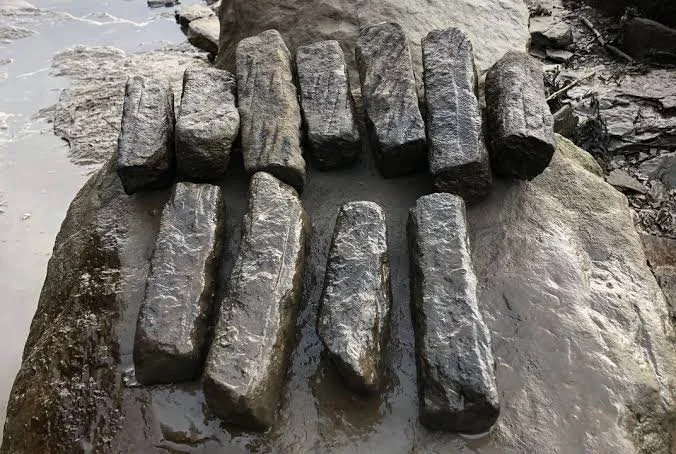
Repeated abrasion may produce smooth areas, grooves, or localized depressions. Some stones develop elongated wear surfaces where blades were repeatedly drawn across them.
The presence of metal particles may provide additional evidence, although such residues can be difficult to identify and may result from later contamination.
A stone with a suitable abrasive texture and characteristic wear is more convincing when discovered alongside iron tools and other domestic equipment.
Types of Wear and Sharpening Techniques
Different sharpening techniques produce different patterns of wear.
A blade may be drawn repeatedly across a flat stone, producing a relatively smooth and elongated surface.
A narrow stone may be used for sharpening smaller blades or tools with restricted edges.
Grooved stones may be associated with the maintenance of pointed objects or narrow metal components, although their exact functions vary.
Some stones may have been used with water to reduce friction and remove metal particles. Others may have been used dry.
The interpretation of a particular stone requires comparison with experimentally produced wear patterns and known historical examples.
Household Sharpening and Craft Production
The discovery of sharpening stones within a household may indicate that tools were maintained locally.
However, not every sharpening stone belonged to a domestic setting. Similar objects could have been used by blacksmiths, carpenters, farmers, leatherworkers, and other craftspeople.
Archaeologists examine the wider assemblage to distinguish household maintenance from specialized production.
A settlement containing several sharpening stones, ironworking debris, slag, and unfinished metal objects may have supported metalworking activities.
By contrast, an isolated sharpening stone associated with domestic pottery and food remains may reflect ordinary household tool maintenance.
Material Sourcing and Trade
The geological origin of a sharpening stone can provide information about how it was acquired.
Some stones may have been collected locally from riverbeds, hillsides, or exposed rock formations.
Others may have been transported from specialized quarrying areas.
Petrographic analysis can identify mineral composition and compare the stone with known geological sources.
If a sharpening stone originated far from the settlement where it was found, it may indicate exchange or movement through regional trade networks.
However, geological sourcing must account for the possibility that similar stone types occur in several locations.
Dating Sharpening Stones
Sharpening stones are difficult to date directly because stone itself may remain unchanged for long periods.
Their chronology is usually established through archaeological context.
Pottery, coins, metal objects, and other associated materials can help date the deposits in which sharpening stones are found.
Stratigraphic relationships may reveal whether a stone was deposited during an early occupation phase or introduced through later activity.
Wear patterns can indicate repeated use, but they do not independently establish a precise date.
Some sharpening stones may also have been inherited or reused over generations, making their period of manufacture different from the date of their final deposition.
Experimental Archaeology
Experimental research can help determine how sharpening stones were used.
Researchers can produce replicas of ancient iron tools and sharpen them using stones with comparable geological characteristics.
The resulting wear patterns can be compared with archaeological examples.
Experiments may also investigate how water, pressure, blade angle, and sharpening duration affect the stone surface and metal edge.
This work helps distinguish sharpening from other possible activities, such as grinding pigments, polishing objects, or shaping small stone tools.
Social and Economic Significance
Sharpening stones provide evidence of the practical value attached to tools.
A household that regularly maintained its iron equipment could reduce replacement costs and preserve important resources.
The presence of specialized stones may also indicate knowledge of tool maintenance and the availability of materials suitable for sharpening.
In some settings, sharpening may have been performed by particular household members or skilled craftspeople. However, assigning specific social roles requires additional evidence.
Comparing sharpening stones across different households may help researchers investigate differences in occupation, wealth, and access to technology.
Conclusion
Household iron sharpening stones provide a small but valuable window into the maintenance practices of ancient communities. Their wear patterns, geological composition, and archaeological context can reveal how people preserved the usefulness of knives, agricultural tools, and other iron equipment. Because sharpening stones could also serve other grinding and polishing functions, identifying their purpose requires careful examination and comparison with experimental evidence. Through these studies, archaeologists can better understand the everyday technologies that supported domestic life and the long-term use of iron tools.