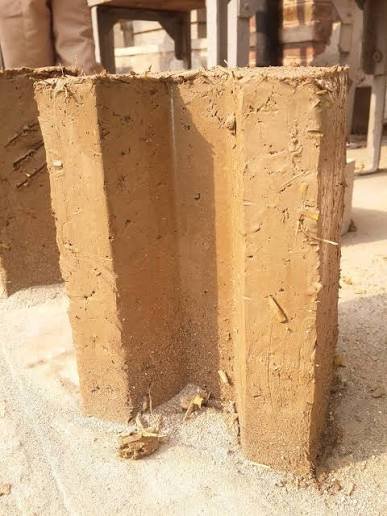
Mudbrick was one of the most widely used building materials in many ancient societies. Made primarily from earth mixed with water and shaped into blocks, mudbrick offered an accessible construction method in regions where suitable stone was scarce or expensive. Although relatively simple to produce, mudbrick buildings required an understanding of soil composition, moisture, drying conditions, and structural stability. Builders sometimes incorporated plant fibers or other organic materials into earthen mixtures to improve their handling properties and reduce certain forms of cracking. The archaeological study of these reinforcements can reveal how communities developed practical construction knowledge and adapted building materials to local environments.
The performance of mudbrick depends on the properties of the soil used to make it. Clay particles help bind the mixture, while sand and other mineral grains influence its texture and shrinkage during drying. A mixture containing too much clay may shrink substantially and develop cracks, whereas a mixture with insufficient binding material may crumble easily. Builders therefore needed to select and combine available earth materials according to their intended use. The addition of fibers could further influence the behavior of the brick by distributing stresses, limiting some cracks, and improving the cohesion of the material as it dried.
Straw is among the best-known reinforcements used in earthen construction. Plant stems can be mixed into wet mudbrick material, creating a network of fibers within the finished block. These fibers may help reduce the development or widening of shrinkage cracks by bridging small separations in the earth matrix. They can also influence the brick's density, texture, and drying behavior. The effectiveness of straw depends on factors such as fiber length, quantity, distribution, and the properties of the surrounding soil. Excessive organic material may weaken the block or create voids as it decomposes, so the mixture must balance workability with structural performance.
Other plant materials could also be used, depending on regional availability. Chopped grasses, reeds, chaff, and other agricultural by-products may have served as reinforcement or as components of a workable earthen mixture. The use of such materials could link construction directly to farming practices, allowing households to reuse residues from harvesting and food processing. Archaeologists may investigate the presence of plant fibers through microscopic analysis of surviving bricks. However, not every plant fragment represents deliberate reinforcement. Seeds, roots, and other organic remains can enter mudbrick accidentally when soil is collected from agricultural fields or disturbed ground.
Animal hair is another possible fiber material, although its use must be demonstrated for each archaeological context rather than assumed. Hair can be incorporated into some construction mixtures, but it is less consistently documented than plant-based reinforcement in many earthen building traditions. If animal hair is identified within a mudbrick, researchers need to determine whether it was intentionally added or introduced accidentally through animal activity, contaminated soil, or later biological processes. Microscopic examination may reveal features of the fibers, while chemical or protein-based methods could potentially support identification where preservation allows. Even a reliable identification of hair does not by itself establish the reason for its inclusion.
Archaeological analysis begins with examining the structure and composition of the brick. Researchers may record its dimensions, color, density, surface texture, and visible inclusions. Thin-section micromorphology allows the internal structure of a small sample to be examined under a microscope, revealing mineral grains, pores, plant fragments, and the relationships between these components. This can help distinguish fibers distributed throughout the original mixture from organic material that entered through cracks or later deterioration. The arrangement of fibers may also provide clues about mixing methods and manufacturing practices, although the precise sequence of preparation may remain uncertain.
The preservation of organic reinforcement varies greatly. Plant fibers may survive as recognizable fragments in dry environments, but they often decay in damp soils. In some cases, the original fiber disappears while leaving a void or impression within the brick. Charred fibers may survive under conditions that destroy unburned material, although burning can alter their microscopic characteristics. Animal hair and other protein-based materials may also deteriorate or become chemically altered. As a result, the absence of visible fibers does not prove that builders never used reinforcement, especially at sites where preservation conditions were unfavorable.
Experimental archaeology can help explain how different fibers affect mudbrick performance. Researchers can prepare replica bricks using locally appropriate soil mixtures and vary the type, length, and quantity of added fibers. By observing drying times, shrinkage, cracking, resistance to handling, and responses to moisture, experiments can test the practical effects of different recipes. Such work can also help distinguish fibers added to improve construction performance from materials that were present incidentally. Nevertheless, modern experiments cannot reproduce every ancient production process, and results should be compared with archaeological specimens rather than used as a substitute for direct evidence.
The use of agricultural residues in construction may reveal relationships between household economies and building maintenance. Straw and other plant materials could be readily available after harvest, making them convenient additions to bricks and plaster. The choice of reinforcement may therefore reflect seasonal resource availability as well as technical preferences. In some communities, construction practices may have been passed between generations through practical experience rather than formal instruction. Similar recipes across neighboring settlements could indicate shared knowledge, while differences may reflect local soils, climate, building traditions, or access to materials.
Mudbrick reinforcement also has implications for the study of ancient architecture and conservation. The composition of a brick influences how it responds to rainfall, humidity, temperature changes, and structural loads. Understanding the original mixture can help explain why certain walls survived while others eroded rapidly. It can also inform conservation strategies, since modern repairs that use incompatible materials may cause additional damage. Preserving surviving mudbrick requires attention to drainage, moisture control, protective coverings, and the chemical and physical compatibility of replacement materials.
The archaeology of mudbrick reinforcement shows how seemingly simple construction materials can embody sophisticated practical knowledge. Straw and other fibers could help builders manage shrinkage, improve workability, and make effective use of locally available resources. Animal hair and less common reinforcements remain possibilities that require careful identification and contextual support. By combining microscopic analysis, material characterization, experimental archaeology, and environmental study, researchers can investigate how ancient builders designed their mixtures and maintained their structures. These findings contribute to a broader understanding of technological adaptation, agricultural reuse, and the everyday knowledge that sustained earthen architecture across many regions and periods.