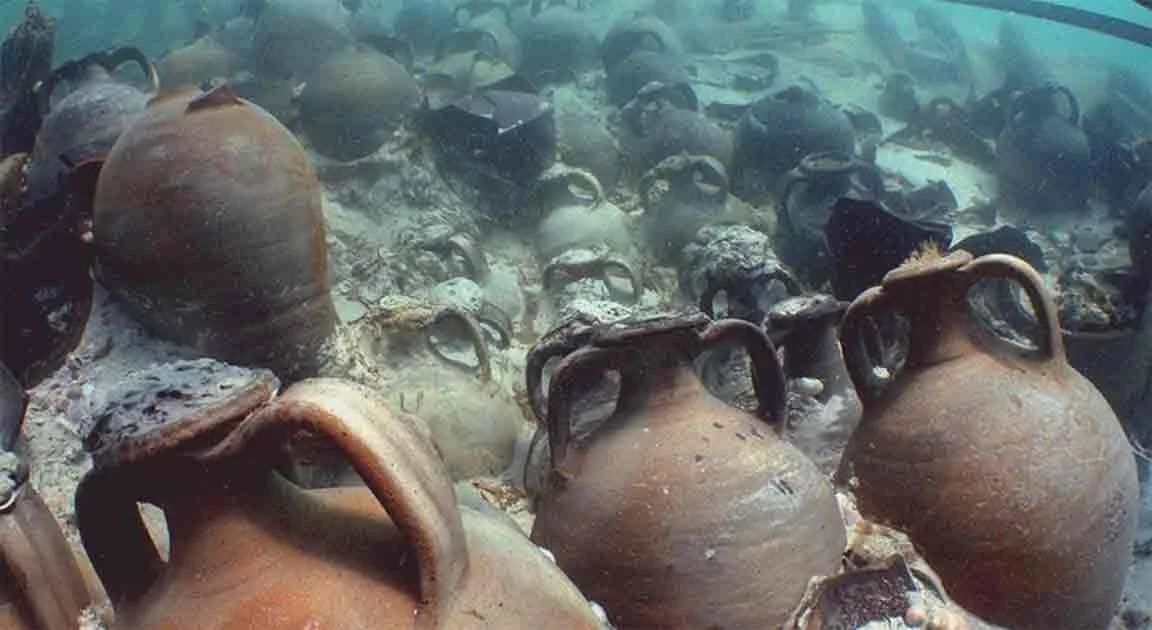
Amphorae were widely used in the ancient Mediterranean and neighboring regions to transport commodities such as wine, olive oil, fish products, and other liquids or preserved foods. Their distinctive shapes, handles, and narrow necks made many types suitable for stacking and handling during maritime transport. When ships sank during storms, their cargoes could be buried beneath sediment or scattered across the seabed. In some underwater environments, amphorae become coated with salt deposits or mineral crusts that obscure their surfaces and complicate identification. The archaeology of salt-encrusted amphorae examines how these objects can reveal ancient trade, shipwreck formation, cargo handling, and the preservation processes that occur underwater.
Shipwrecks can form when vessels encounter storms, navigational hazards, structural failures, or other maritime dangers. Storms may push ships toward reefs, cliffs, shallow shoals, or exposed coastlines, where waves and currents can destroy the vessel and disperse its cargo. The final arrangement of a wreck depends on many factors, including the depth of the water, the strength and direction of currents, the shape of the seabed, and the construction of the ship. A concentration of amphorae may represent a largely intact cargo, while a broad scatter of vessels may indicate extensive post-wreck movement. Archaeologists must reconstruct these processes before using artifact distribution to infer how the ship sank.
The term "salt-encrusted" can refer to several different forms of surface accumulation. Seawater contains dissolved salts, but not every crust found on an underwater artifact consists of simple salt crystals. Mineral deposits, biological growth, corrosion products, sediment cementation, and combinations of these processes can form hard layers over amphora surfaces. The composition of the crust depends on the water chemistry, surrounding sediment, temperature, biological activity, and the material from which the vessel was made. Scientific analysis is therefore necessary to distinguish soluble salts from other mineral or biological deposits.
Ceramic amphorae are generally more resistant to corrosion than metal objects, but their surfaces can still be altered underwater. Salt crystallization may occur when dissolved salts move into pores and later crystallize as moisture conditions change, particularly during recovery and drying. These crystals can exert pressure within the ceramic body and contribute to surface flaking or cracking. Mineral crusts may also conceal painted marks, inscriptions, potter's stamps, manufacturing details, and traces of the original contents. Conservation specialists must therefore consider the risks of removing deposits too aggressively, since cleaning can damage information that has survived for centuries.
The shape and manufacture of amphorae provide important evidence for identifying their origins and functions. Different production centers developed distinctive vessel forms, clay recipes, handles, rims, bases, and surface treatments. Archaeologists can compare these characteristics with known typologies to estimate a vessel's date and place of manufacture. Petrographic and chemical analyses may help determine the geological origin of the clay. However, typological similarities do not always prove that two vessels came from the same workshop, and local imitations can resemble imported forms. The strongest identifications combine visual examination with material analysis and archaeological context.
Residue analysis can help identify what amphorae originally contained. Organic compounds preserved within the ceramic fabric may provide evidence of wine, plant oils, fish products, or other substances, depending on preservation and analytical methods. Researchers may use techniques such as gas chromatography and mass spectrometry to examine chemical residues. Yet the interpretation of residues is not always straightforward. A vessel could have been reused, contaminated during burial, or exposed to substances after the shipwreck. A single chemical marker rarely establishes the original cargo with certainty, so residue results should be compared with vessel type, associated artifacts, and the broader wreck context.
Cargo arrangement can reveal how a ship was loaded and operated. Amphorae were often transported in groups, sometimes packed into spaces within the hull to reduce movement during a voyage. The positions of surviving vessels may help researchers reconstruct the cargo hold and estimate the scale of the shipment. Differences in amphora types could indicate mixed cargoes, multiple suppliers, or successive loading events. However, the present distribution of objects may not reflect the original arrangement because storms, currents, scavenging, and later human activity can displace artifacts. Careful mapping and documentation are essential before reconstructing the ship's cargo.
The presence of salt crusts may also provide information about the post-depositional history of a wreck. Deposits can form or change after an amphora reaches the seabed, influenced by the chemistry of the surrounding water and the movement of sediment. In some cases, a thick crust may conceal an older surface, while in others it may consist largely of material accumulated after the wreck. Researchers can examine the mineral composition and structure of the deposits to investigate how they developed. Such studies help distinguish evidence associated with the original voyage from changes that occurred after the vessel sank.
Storm wrecks can preserve evidence of the human and economic networks that connected coastal communities. Amphorae manufactured in one region might have been transported through several ports before reaching their destination. A wreck containing vessels from multiple production centers could reflect a complex commercial system rather than a single direct route. Other artifacts, such as anchors, ship fittings, cooking vessels, coins, and personal belongings, may help identify the vessel's operating environment. Still, the exact destination of a ship is not always recoverable from its cargo, because merchants could change plans or transfer goods between vessels during a journey.
Conservation is a critical part of underwater amphora research. Objects recovered from the sea may carry salts deep within their porous structure. If they are allowed to dry rapidly without appropriate treatment, salt crystallization can damage the ceramic. Conservators therefore assess the material, document the condition of the crust, and choose cleaning and desalination procedures suited to the object. Some deposits may be retained if they contain useful information or protect fragile surfaces. Decisions about cleaning must balance the need to identify the amphora with the responsibility to preserve its archaeological evidence.
The archaeology of salt-encrusted amphorae from storm wrecks brings together maritime archaeology, ceramic studies, chemistry, and conservation science. Amphorae can reveal the transport of foodstuffs and other commodities, while their surface deposits provide evidence about the conditions in which shipwrecks were buried and preserved. By combining detailed mapping, typological study, residue analysis, material characterization, and careful conservation, researchers can reconstruct aspects of ancient trade and maritime activity. Each vessel is more than a container recovered from the seabed; it is a surviving component of a commercial journey whose route, cargo, and final disaster can be investigated through the evidence it retains.