The Colossus of Rhodes, a 33-meter-tall bronze statue of the sun god Helios, was the shortest-lived of the Seven Wonders of the Ancient World. It stood for only 54 years before being snapped at the knees by an earthquake in 226 BCE.
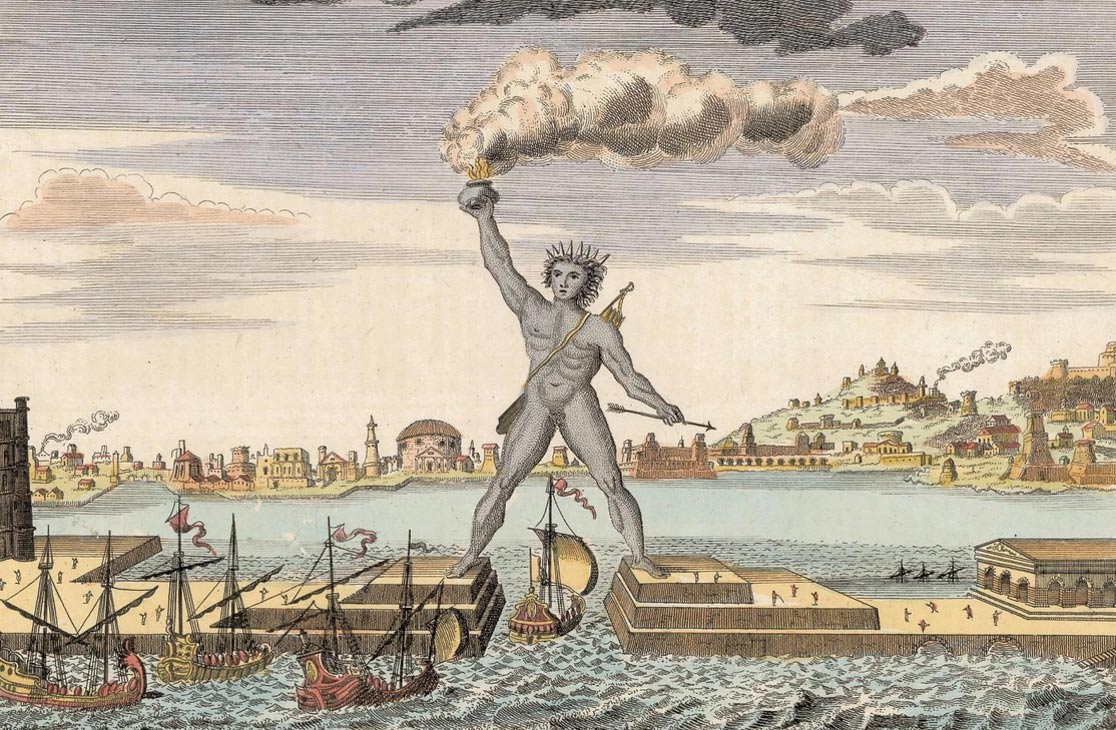
For centuries, the popular image of the Colossus has been a giant straddling the harbor entrance, allowing ships to pass beneath its legs. However, modern archaeology and engineering have largely debunked this "straddling" myth, offering new theories on where it actually stood and what it really looked like.
1. The Engineering Myth: The Harbor Straddle
The classic depiction of the Colossus with its feet on two separate piers at the mouth of the Mandraki harbor is almost certainly a medieval invention.
Structural Impossibility: If the statue had straddled the harbor, the entrance would have been closed for the decades it took to build. Furthermore, the weight of the bronze and stone would have caused the statue to collapse outward under its own gravity.
The "Fall" Clue: Ancient accounts state that when the statue fell, it "fell on the land." If it had been straddling the harbor, it would have blocked the shipping channel, but there is no record of the harbor being obstructed.
2. The New Location: The Acropolis of Rhodes
Recent research by archaeologists like Ursula Vedder suggests that the Colossus didn't stand at the water's edge at all.
The Temple of Helios: New theories place the statue on the Acropolis of Rhodes (Monte Smith), overlooking the city. Excavations there have revealed a massive foundation that could have supported such a monument.
Visibility: From the height of the Acropolis, the statue would have acted as a true "Colossus," visible to ships miles out at sea, catching the first and last rays of the sun.
Sanctuary Context: Placing the statue within a religious sanctuary on the hill aligns more closely with Greek traditions of dedicated cult statues.
3. Appearance: The "Rayed" Sun God
While we have no contemporary sketches, the Colossus likely followed the Hellenistic style of the sculptor Chares of Lindos, a student of the famous Lysippos.
The Crown of Rays: Coins from Rhodes minted shortly after the statue's construction show Helios with a crown of solar rays. Some theories suggest these rays were made of gilded bronze to reflect the sun’s glare.
The Pose: Instead of straddling, Helios was likely standing with his feet together or in a slight "contrapposto" (one leg slightly bent). One arm may have been raised to shade his eyes or hold a torch, while the other held a cloak or a spear.
The Face: Based on other statues of Helios from that period, he likely had flowing, "leonine" hair and an upward-looking, youthful expression.
4. Construction: The "Iron Man" of Antiquity
The construction of the Colossus was an unprecedented feat of metallurgy and logistics.
Recycled War Machines: The statue was funded by selling the siege engines left behind by Demetrius Poliorcetes after his failed siege of Rhodes in 305 BCE.
The Iron Skeleton: Because bronze is too soft to support its own weight at that scale, Chares used a massive internal framework of iron bars and stone pillars.
The Stacking Method: Rather than casting the whole statue and raising it, workers built it from the ground up, casting the bronze skin in sections and filling the interior with stones to stabilize it as they climbed higher.
5. The Long Afterlife: 800 Years in the Dust
One of the most fascinating aspects of the Colossus is what happened after it fell. For nearly 800 years, the broken statue lay on the ground, becoming a tourist attraction in its own right.
The Giant Fingers: Pliny the Elder visited the ruins and noted that "few people could encircle the thumb with their arms," and the empty cavities of the limbs looked like great caverns.
The Final Sale: In 653 CE, an Arab force captured Rhodes. They reportedly broke up the bronze remains and sold them to a Jewish merchant from Edessa, who carried the metal away on 900 camels.
The search for the Colossus continues today, with some underwater archaeologists still scanning the Mandraki harbor for the "lost" feet or the original pedestal. Even if the physical bronze is long gone, the statue's legacy lives on in the Statue of Liberty, which was directly inspired by the Colossus’s solar crown and monumental scale.