The Future of the Past: How New Technology is Changing Archaeology Forever
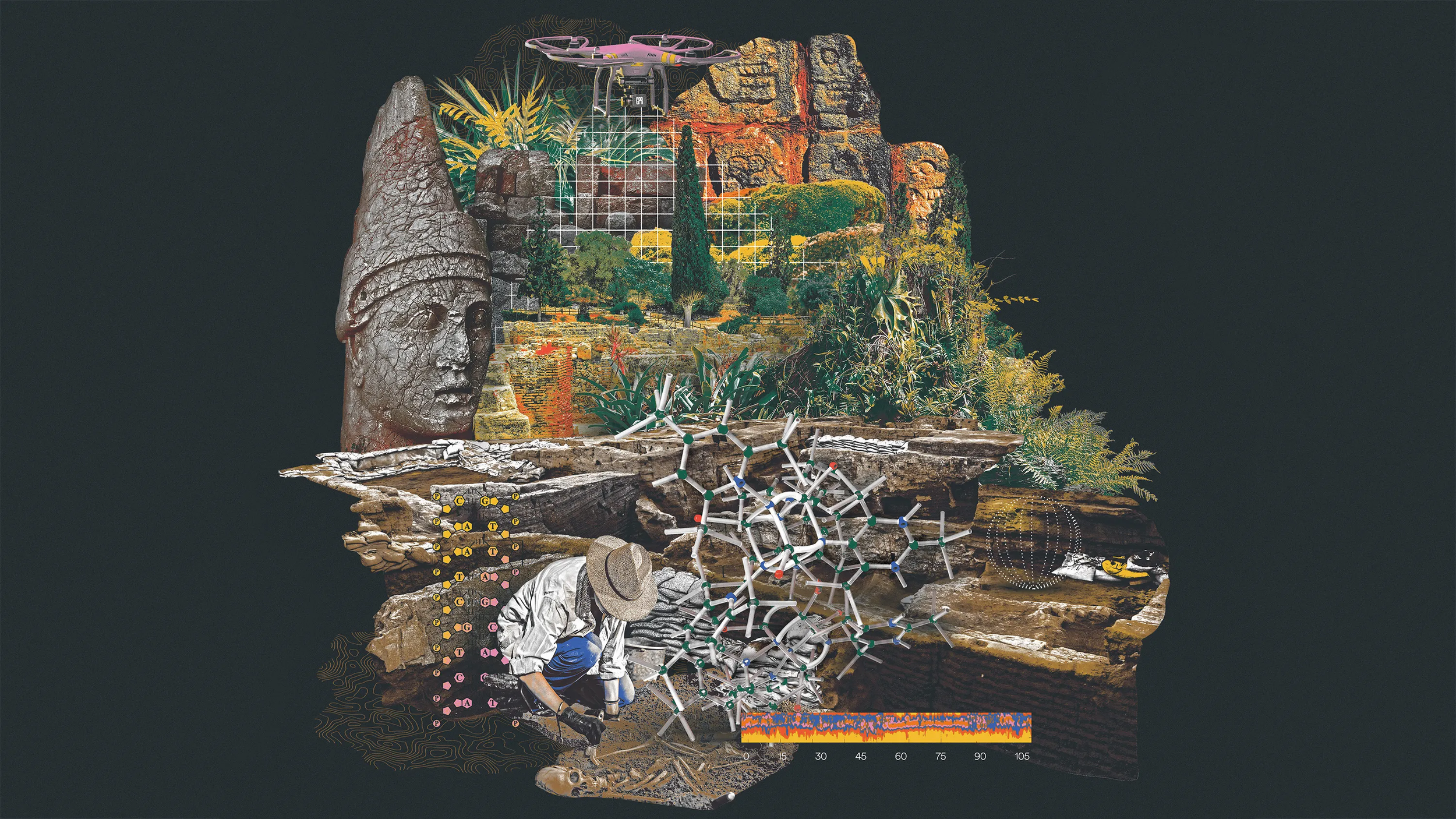
The field of archaeology has evolved far beyond the traditional trowel-and-brush excavation. Today, it stands at the intersection of science and computing, allowing researchers to peer beneath the ground, unroll carbonized scrolls without touching them, and map lost cities hidden deep within dense jungles.
These digital and technological advancements are fundamentally changing how we discover, document, and understand our shared human heritage.
1. Seeing Through the Ground: Remote Sensing and Aerial Mapping
Technological breakthroughs allow archaeologists to discover sites without moving a single spade of dirt, preventing unnecessary excavation and site damage.
LiDAR (Light Detection and Ranging): By firing millions of laser pulses from aircraft or drones and measuring their return time, LiDAR penetrates heavy vegetation to map the underlying topography. In recent years, this technology has revealed tens of thousands of hidden structures in Central America and the Amazon, completely changing our understanding of pre-industrial population densities.
Space Archaeology: Satellites use multispectral and thermal imagery to detect subtle differences in soil moisture and plant growth, revealing lost settlements, paths, and monuments buried beneath desert sands without breaking the surface.
2. Non-Invasive Diagnostics: GPR and Photogrammetry
Modern excavations strive to preserve the archaeological record in its entirety, relying on non-destructive exploration methods before and during fieldwork.
Ground-Penetrating Radar (GPR): By sending radio waves into the ground and recording the reflections, GPR acts like an X-ray of the earth. Researchers can see architectural remains, graves, and buried artifacts in situ before deciding whether to excavate.
3D Photogrammetry: Drones can map archaeological sites in hours instead of weeks. They capture thousands of high-resolution images that are stitched together by software to create accurate 3D models of every excavated layer.
3. Artificial Intelligence and Machine Learning
Archaeologists are now dealing with massive datasets containing petabytes of images and millions of artifacts, making AI an invaluable assistant.
Reading the Unreadable: Machine learning tools have been used to read carbonized papyrus scrolls from places like Herculaneum, allowing researchers to see characters hidden for two millennia without unrolling and damaging the physical artifacts.
Pattern Recognition: AI algorithms can process satellite images, LiDAR, and surface mapping data in minutes, finding anomalies that indicate unectavated settlements, or identifying minute traces of wear patterns on ancient artifacts to determine their purpose.
4. Biomolecular Analysis and Dating
Beyond the physical items and structures, new scientific methods allow us to extract information from the tiniest fragments of remains.
Ancient DNA (aDNA): Extracted from bones and teeth, aDNA reveals migration patterns, family lineages, and ancient diets, rewriting historical narratives about Bronze Age migrations and interactions between early human species.
Precision Dating: Refined radiocarbon and uranium-thorium dating methods have significantly narrowed the margin of error, giving scholars more confidence when placing discoveries on the historical timeline.
5. Robotics and Future Fieldwork
Robotics are taking on the physically demanding and delicate tasks of actual digging to minimize human error and damage.
The ArchaeoBot: Pioneering platforms equipped with sensors, cameras, and machine learning operate in the field to identify, retrieve, and clean delicate finds, ensuring that the recovery process is as precise as the analysis that follows.
Summary of Technological Impact
Discovery: Drones and LiDAR uncover massive structures in minutes rather than decades.
Documentation: 3D photogrammetry and digital archives create permanent virtual representations.
Analysis: AI and biomolecular testing decode ancient scripts and trace ancient DNA with high precision.