The ongoing archaeological revolution across the Taş Tepeler (Stone Mounds) region in southeastern Turkey—anchored by Göbekli Tepe and its sister site Karahan Tepe—has entered an entirely new era. Recent fieldwork leveraging advanced 3D laser scanning, geophysical surveys, and digital modeling has profoundly altered our understanding of the world's oldest monumental enclosures.
Rather than uncovering a sudden "2026 revelation" of distinct shaman figures via laser scans, the reality of recent discoveries is far more fascinating. Advanced spatial scanning and targeted excavations have yielded pristine, tangible evidence of life-size human imagery, abstract self-expression, and complex ritual architecture dating back 12,000 years.
1. 3D Laser Scanning and the Spatial Blueprint
Recent geological and geophysical surveys across Göbekli Tepe’s 20-acre artificial mound have confirmed that what we see today is only the tip of an immense prehistoric iceberg.
Researchers have mapped at least 15 more mega-monumental temples and over 200 buried standing stones still waiting beneath the soil. When archaeologists fed precise 3D laser scan data of the existing enclosures into spatial analysis models, the results dismantled the old theory that these massive stones were arranged randomly by primitive hunter-gatherers.
The digital data reveals highly sophisticated layouts with exact geometric proportions, uniform wall thickness, and premeditated architectural axes. This proves that long before the invention of writing or metal tools, humanity possessed an advanced grasp of geometry, structural engineering, and spatial planning.
2. Breaking the "T-Shape" Barrier: The Discovery of Human Faces
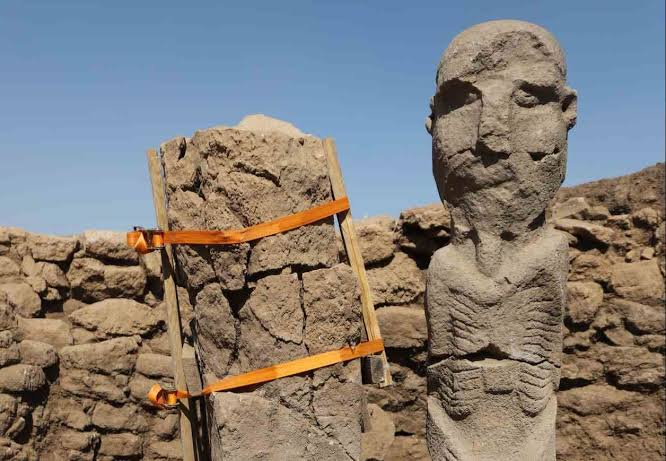
For decades, the defining feature of Göbekli Tepe has been its massive, monolithic T-shaped pillars. While scholars long hypothesized that these pillars were highly abstract, stylized representations of the human form—noting the faint carvings of arms, hands, and loincloths on their sides—they noticeably lacked distinct human heads or faces.
Recent discoveries at neighboring Karahan Tepe (part of the same 12,000-year-old cultural complex) have completely filled this missing link.
Excavators unearthed a 135 cm-tall standing stone featuring an incredibly detailed human face. Staring out with deep-set eyes, a prominent nose, and a sharp, angular jawline, this find marks the very first time a literal human face has been found integrated directly onto a monumental pillar within the Taş Tepeler network. It serves as undeniable material proof that these ancient stone complexes were built around the explicit symbolic representation of humans, ancestors, or spiritual leaders.
3. The Enigmatic Votive Statues
At Göbekli Tepe itself, newly uncovered artifacts are shedding direct light on the site's intense ceremonial life. During recent excavations, archaeologists discovered a life-size human statue deliberately embedded into a stone wall between Structures B and D.
    [ STONE WALL MASONRY ] ◄─── (Deliberate Architectural Inset) ───► [ HUMAN SCULPTURE ]
                                               │
                                     (Ritual Purpose)
                                               │
                                               ▼
                              [ Votive Offering / Commemoration ]
The sculpture was mounted horizontally directly inside the structural framework of the chamber. Because it was integrated straight into the wall's architecture rather than standing freely, researchers evaluate it as a votive offering—a permanent, physical token left behind to sanctify the structure, commemorate a profound ritual, or honor a revered spiritual guardian of the community.
4. Summary of the Latest Prehistoric Insights
The Scale: Geophysical scanning has confirmed the existence of over 15 undiscovered mega-structures and hundreds of standing pillars still buried across the plateau.
The Geometry: 3D digital scans reveal highly precise, calculated mathematical proportions across the layout of the stone circles, pointing to a sophisticated understanding of prehistoric engineering blueprints.
The Iconography: The discovery of an explicit human face carved onto a monolith at Karahan Tepe confirms that the anonymous T-shaped pillars were designed as grand symbolic representations of the human form.
The Rituals: The unearthing of an intact human statue embedded horizontally inside a Göbekli Tepe wall points to a complex system of architectural offerings and spiritual dedication.
The ongoing work across these ancient plateaus proves that the transition from nomadic hunter-gatherers to settled, highly organized societies was driven by a deep obsession with symbolic thought, monumental craftsmanship, and spiritual architecture. As digital scanning continues to look through the soil and expose the pristine geometry of these 12,000-year-old sanctuaries, the lines separating primitive ancient humans from advanced builders continue to blur, revealing a world of profound artistic clarity at the very dawn of human civilization.