When the Greek-speaking Mycenaeans descended into the Aegean basin around 1600 BCE, they encountered the Minoans—a highly sophisticated, literate, and artistically advanced civilization centered on the island of Crete. At the time, the Mycenaeans were primarily a tribal, warrior-dominated society. Recognizing the immense cultural power of the Minoans, the Mycenaean elite did not simply conquer; they engaged in a massive, centuries-long process of cultural appropriation and adaptation.
This profound Minoan influence transformed the Mycenaeans from isolated regional chieftains into the rulers of Greece's first great literate, palatial civilization.
1. Linear A to Linear B: The Adaptation of Literacy
The most profound intellectual leap the Mycenaeans made under Minoan influence was the acquisition of writing. The Minoans had long utilized a unique, logo-syllabic script known today as Linear A to manage their complex palace bureaucracies. Because the Mycenaeans spoke an entirely different language (an early form of Greek), they could not use Linear A directly.
Instead, Mycenaean scribes systematically overhauled the Minoan writing system:
The Structural Borrowing: They kept the underlying phonetic mechanics, formatting styles, and numeric systems of Linear A.
The Linguistic Shift: They adapted the individual signs to represent the sounds of the Mycenaean Greek language, creating Linear B.
The physical medium remained identical: both cultures recorded their accounts by scratching the symbols into unbaked clay tablets using bone or bronze styluses. However, while Linear A remains untranslated to this day because the Minoan language is unknown, Linear B was famously deciphered in 1952, revealing the oldest written records of the Greek language.
2. Re-Engineering the Palace Economy
Before interacting with Crete, Mycenaean rulers lived in modest, stone-and-timber defensive longhouses called megarons. As they absorbed Minoan culture, they adopted the entire concept of the Palace Economy.
The Mycenaeans looked to the sprawling complexes of Knossos and Phaistos as architectural blueprints, borrowing advanced Minoan engineering techniques to build their own palatial administration hubs at Mycenae, Tiryns, and Pylos.
   [ Minoan Open Palaces ] ──────► Focus: Trade, Rituals, Lightwells, No Walls
                                           │
                                (Mycenaean Selective Adaptation)
                                           │
   [ Mycenaean Citadels ] ───────► Focus: Fortification, Cyclopean Walls, Central Megaron
However, the Mycenaeans adapted this architecture to fit their warrior psychology. While Minoan palaces were open-air, sprawling, and completely unfortified, Mycenaean palaces were tightly condensed, defensive fortresses enclosed by massive, multi-ton Cyclopean stone walls. At the center of the Mycenaean palace, instead of an open Minoan courtyard, sat a grand, enclosed throne room built around a massive hearth—the ancestral Greek megaron.
3. Artistic Plagiarism: Weapons and Frescoes
The early Mycenaean elite possessed a voracious appetite for Minoan luxury goods, which they used as status symbols to legitimize their royal authority. They imported Minoan artisans directly to the Greek mainland to decorate their palaces and forge their weapons, resulting in a fascinating hybridization of styles.
The Shaft Graves of Mycenae
Excavations of the royal Shaft Graves at Mycenae yielded spectacular treasures crafted almost entirely by Minoan hands or by Mycenaeans trained in Minoan workshops. The most famous examples are the Niello Daggers—bronze ceremonial blades inlaid with gold, silver, and dark copper alloys.
While the physical technique and fluid artistic style of these daggers are completely Minoan, the subject matter is purely Mycenaean: instead of peaceful marine life or religious processions, the blades depict violent lion hunts and soldiers marching with heavy shields, reflecting the militaristic values of the mainlanders.
The Frescoes
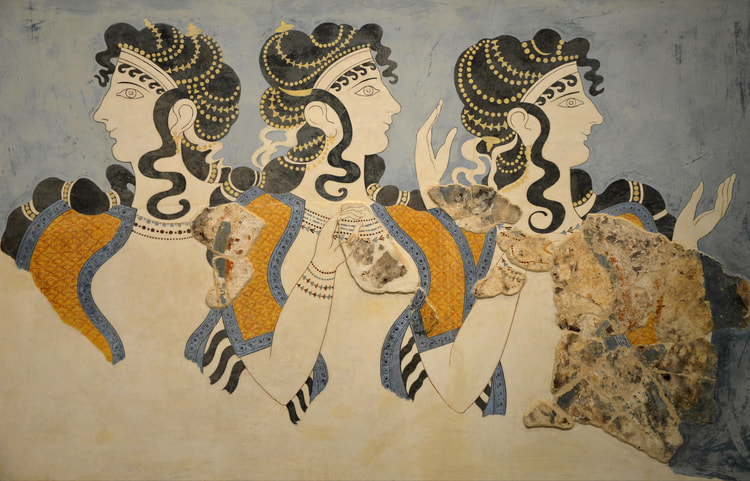
Mycenaean palace walls were covered in brilliant, wet-plaster frescoes that utilized the exact chemical formulas and color palettes pioneered on Crete. Mycenaean artists copied the Minoan conventions for depicting the human form—rendering figures with pinched waists, stylized long hair, and profile views.
However, the thematic focus shifted dramatically. Where Minoan walls featured playful dolphins, lilies, and peaceful bull-leaping rituals, Mycenaean walls were covered in lines of heavy chariots, soldiers clad in boar's-tusk helmets, and bloody battle scenes.
4. Religious Syncretism: Goddesses and Gods
The Mycenaeans did not just adopt Minoan art; they absorbed parts of the Minoan spiritual world. Minoan religion was heavily centered around a dominant, earth-centric matriarchal pantheon, featuring a supreme Mother Goddess associated with snakes, birds, and double-headed axes (labrys).
Linear B tablets reveal that the Mycenaeans adopted many of these Minoan nature deities into their religious practices. They worshiped a prominent female divinity known as Potnia ("The Mistress" or "Lady"), who held immense economic and spiritual power over palace lands.
Over time, the Mycenaeans fused these indigenous Minoan earth goddesses with their own Indo-European, male-dominated sky gods. This complex religious synthesis laid the direct foundations for the classical Greek pantheon, combining Minoan concepts of sanctuary worship with the early iterations of familiar Olympian gods like Zeus, Poseidon, Hera, and Athena.
5. Summary of Cultural Exchange
Minoan Original (Crete): Linear A script, open-air labyrinthine palaces, marine/nature artwork, matriarchal earth-deity worship, peaceful trade focus.
Mycenaean Adaptation (Mainland): Linear B script, heavily fortified citadels with a central megaron, war and hunting motifs, syncretic warrior-god pantheon, militaristic focus.
The relationship between the Minoans and Mycenaeans serves as an enduring template for how civilizations evolve through cultural contact. The Mycenaeans did not merely mimic Crete; they weaponized Minoan literacy, administrative strategy, and artistic technology to fit their own geopolitical ambitions. By pouring their fierce warrior energy into the structural molds forged by Minoan genius, the Mycenaeans created a powerful cultural synthesis that defined the Greek Bronze Age and echoed through the legends of Homer centuries later.