While popular culture often associates the Viking Age with an array of flashy swords, the weapon that struck the absolute greatest terror into the hearts of medieval European armies was the axe. In the early Germanic world, the axe was an affordable, everyday tool adapted for the battlefield. However, as warfare evolved, this simple woodcutting implement was re-engineered into a highly specialized weapon of shock cavalry destruction: the Dane Axe (also known as the English longaxe or hafted axe).
Emerging in the late 10th century, the Dane Axe was the premier weapon of elite Viking warrior cliques—such as the Danish King's Hird and the Anglo-Saxon Housecarls—and it permanently altered the tactical landscape of medieval infantry combat.
1. The Anatomy of an Engineering Masterpiece
The Dane Axe was not a clumsy, oversized block of iron. It was a masterpiece of precise metallurgy and weight distribution, balanced perfectly to deliver maximum kinetic force without sacrificing the wielder's agility.
The Thin, Light Blade: Unlike thick woodcutting axes designed to wedge open logs, the Dane Axe blade was forged remarkably thin—often only a few millimeters thick just behind the cutting edge. This made the head surprisingly light, usually weighing between 1 and 2 pounds.
The Steeled Edge: To save precious carbon steel, blacksmiths used a two-part forging technique. They constructed the main body and eye of the axe out of flexible, shock-absorbing wrought iron, and then forge-welded a high-carbon, razor-sharp steel bit onto the cutting edge.
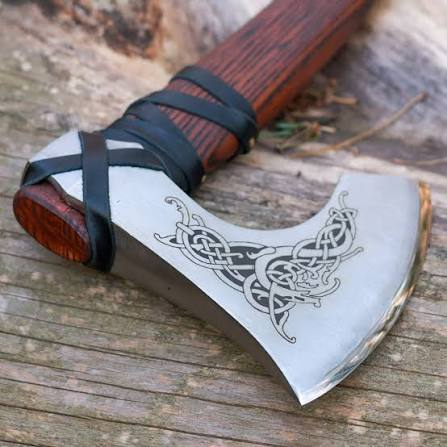
The Swept Profile: The blade featured pronounced, exaggerated upper and lower "horns" (a broad-axe silhouette). This crescent-shaped, sweeping edge maximized the cutting area, meaning that upon impact, the blade sliced through flesh and mail armor rather than just crushing it.
The Massive Haft: The head was mounted on a thick ash or oak pole ranging from 4 to 6 feet in length. This long haft granted the wielder immense leverage, turning the weapon into a two-handed kinetic engine.
2. Tactical Execution on the Battlefield
The Dane Axe was a dedicated shock weapon. Because it required two hands to swing, the warrior had to slink his shield onto his back or rely on comrades to protect him while he operated the weapon.
   [ Overhead Kinetic Cleave ] ───► Crushes Helmets / Shears Mail Armor
                                               │
                                   (Dynamic Versatility)
                                               │
   [ The Extended Horns ] ────────► Hooks Shield Rims / Trips Ankles / Pulls Cavalry
When deployed within a dense infantry formation like the Shield Wall, Dane axe-wielders were typically stationed just behind the front line of shield-bearing spearmen. At the critical moment of collision, they would step forward through gaps in the wall to unleash devastating overhead or diagonal cleaves.
The weapon operated on pure physics: the immense leverage of the 5-foot haft combined with the thin, heavy-striking steel edge concentrated all of the swing's kinetic energy into a tiny point of impact. Contemporary accounts note that a single, well-placed blow from a Dane Axe could cleanly decapitate a warhorse, shatter a heavy iron helmet, or shear straight through a warrior's chainmail sleeve and arm.
3. Beyond Bludgeoning: Hooking and Controlling
The Dane Axe was also a highly sophisticated tool for tactical manipulation. Elite housecarls used the unique geometry of the swept blade to control their opponents' gear:
Shield Hooking: If an enemy was locked tightly behind a shield wall, the axe-wielder could catch the top or side rim of the enemy's shield with the lower horn of the axe blade. With a violent, twisting pull, they could yank the shield away, exposing the enemy's neck and torso to a spear thrust from an ally.
Cavalry Defense: The upper horn could be used like a hook or short pike to pull horsemen out of their saddles, catch the ankles of fleeing infantry, or parry incoming sword strikes by trapping the enemy's blade against the wooden haft.
4. The Apex of the Axe: Hastings and the Varangian Guard
The historical climax of the Dane Axe occurred during the monumental battles of 1066. At the Battle of Hastings, King Harold Godwinson's elite Anglo-Saxon Housecarls formed a legendary shield wall at the top of Senlac Hill, defending it primarily with Dane Axes.
The anonymous author of the Carmen de Hastingae Proelio recorded that the blows of these axes sliced easily through the shields and chainmail of William the Conqueror's Norman cavalry, blunting multiple cavalry charges.
Following the Norman conquest of England, many displaced Anglo-Saxon axe-wielders fled south to Constantinople, where they were eagerly recruited into the Byzantine Empire's elite imperial bodyguard: The Varangian Guard.
The Byzantines specifically referred to these Norse mercenaries as the Pelekyphoroi—the "Axe-Bearing Barbarians." For centuries, these northern guardsmen stood directly behind the Byzantine Emperor in the Hagia Sophia, carrying their gold-inlaid Dane Axes as both an ultimate symbol of imperial authority and a terrifying final line of battlefield defense.
5. Summary of Weapon Evolution
Early Viking Age Axe (8th–9th Century): Hand-axes and bearded axes; dual-purpose (woodcutting and fighting), shorter hafts, heavier heads, used in one hand alongside a round shield.
Late Viking Age Dane Axe (10th–11th Century): Specialized military broad-axe; two-handed execution, 5-to-6 foot hafts, ultra-thin steeled blades with sweeping horns maximized for military cutting and leverage.
Tactical Application: Shock infantry deployment; utilized behind shield walls to break stalemates, hook enemy shields, shatter mail armor, and neutralize incoming cavalry.
The development of the Dane Axe demonstrates that Viking military technology was highly adaptive and sophisticated. It took the basic tool of the northern farmer and optimized it into an elite weapon system that dominated the shield-wall warfare of Northern Europe. Though eventually eclipsed by the rise of fully armored plate knights and longer polearms like the halberd, the Dane Axe remains an enduring testament to an era when Norse metallurgy and battlefield tactics struck fear into the heart of an entire continent.