The Temple of Jupiter at Baalbek (located in modern-day Lebanon) is one of the largest and most ambitious religious structures ever constructed by the Roman Empire. At the heart of the mystery surrounding this ancient site are the Trilithon stones—three colossal limestone blocks fitted into the western podium wall of the temple.
The Trilithon remains a marvel of ancient engineering, prompting the question of how a pre-industrial civilization managed to quarry, transport, and lift such massive weights.
1. The Dimensions of the Trilithon
The Trilithon consists of three individual limestone blocks positioned about 20 feet above the ground.
Weight: Each block is estimated to weigh between 800 and 1,000 metric tons (approximately 1.6 to 2 million pounds).
Dimensions: Each stone measures roughly 19 meters (62 feet) long, 4.3 meters (14 feet) high, and 3.6 meters (12 feet) thick.
Precision Fitting: Despite their massive size, the blocks are fitted together so tightly that a knife blade cannot be inserted between them.
2. The Quarry and the Stone of the Pregnant Woman
The stones were quarried about 900 meters (2,950 feet) away from the temple site, meaning they had to be moved uphill to their current location. In a nearby quarry, there are even larger stones that were never transported.
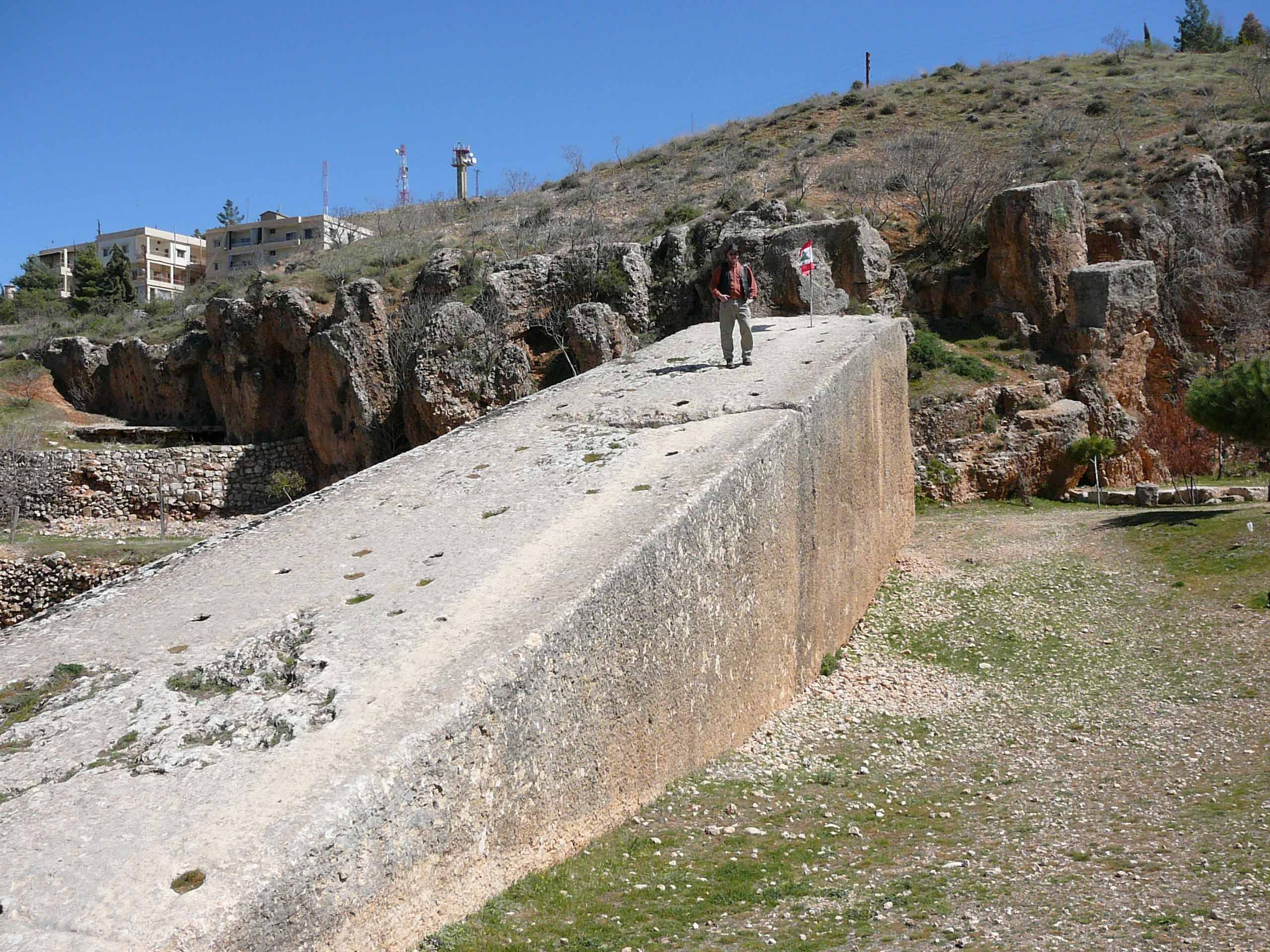
Hajjar el-Hibla (Stone of the Pregnant Woman): This monolithic block weighs an estimated 1,000 to 1,200 metric tons and remains partially attached to the quarry floor at an angle.
The Theory of Abandonment: The discovery of this stone suggests that the Romans were actively trying to quarry and move even larger blocks before the project was abandoned, or that this particular stone cracked and was deemed unusable.
3. Engineering Theories: How They Moved the Stones
While the sheer scale of the Trilithon has led to various pseudoscientific theories regarding ancient alien or lost technologies, archaeologists and engineers have demonstrated that these stones could be moved using Roman-era physics and sheer human power.
Rollers and Levers: The most widely accepted theory is that the stones were placed on wooden rollers and moved using a combination of winches, capstans, and hundreds of workers using levers to inch the stones forward on a prepared track.
The Wooden Casing Method: Engineers, such as those who studied the blocks in the nearby quarry, believe the stones may have been encased in wooden scaffolding or tracks and pulled by teams of oxen and thousands of Roman legionnaires or local laborers.
4. Lifting and Placement
The question of how the Romans lifted the stones to their current height (nearly 20 feet off the ground) remains a subject of intense debate among structural archaeologists:
"Some engineers argue that the Romans did not lift the stones all at once, but rather raised them a few inches at a time using wooden cribbing and lever systems, packing earth and stone underneath them as they went to build up a ramp."
Gradual Elevation: By building an earthen ramp and progressively raising the blocks, they could slide them horizontally into place on top of the foundation stones.
5. The Roman Construction Context
The Baalbek complex demonstrates the peak of Roman imperial patronage, initiated under Augustus and completed under the Antonine dynasty.
The Transport of Monoliths: The Romans were obsessed with moving massive stones, as evidenced by their transport of obelisks from Egypt to Rome across the Mediterranean.
Labor Force: It is estimated that the movement of such a heavy weight required a coordinated force of up to 15,000 to 20,000 men working over several months.
The Trilithon stands as a testament to the capabilities of Roman architectural ambition, where the boundaries of scale were pushed to their absolute limits.