Introduction
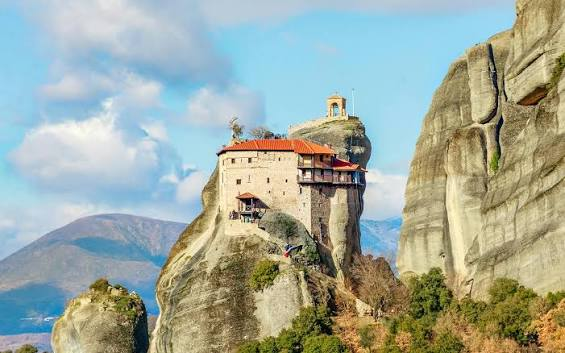
Rising abruptly from the flat mudstone basin of the Thessalian plain in central Greece, the towering sandstone pillars of Meteora present one of the most visually arresting and spiritually isolated landscapes in the world. The name itself, translating literally to "suspended in the air," perfectly captures the precarious nature of these massive rock formations. Long before the construction of the famous walled complexes, the sheer vertical cliffs and natural fissures of the rocks served as a magnet for Christian ascetics and hermits fleeing the chaos of the collapsing Byzantine Empire and the encroaching Ottoman advance during the 11th and 12th centuries.
For generations, the early history of these cliff dwellings remained shrouded in monastic folklore, with tales of monks scaling 1,300-foot vertical rock faces using nothing but basic finger-holds and wooden pegs driven into the stone. Modern multi-disciplinary investigations, combining architectural archaeology, structural engineering scans, and bioarchaeological analyses of the remains preserved in monastic ossuaries, have begun to unlock the physical reality of life, labor, and survival in these sky-high fortresses.
Vertical Architecture and the Bioarchaeology of Seclusion
The physical feat of transforming these bare, wind-swept stone pinnacles into fully functioning, self-sustaining monastic communities required an extraordinary adaptation of architectural engineering. Lacking any natural paths to the summits, the early Byzantine builders engineered sophisticated wood-and-rope scaffolding networks, utilizing counterweighted windlasses and large nets to haul up every single block of stone, timber, mortar, and drop of water. This absolute vertical isolation served a dual purpose: it brought the monks closer to the heavens in their pursuit of silent contemplation while providing an absolute, impenetrable defense against regional bandits and invading armies.
To reconstruct the daily lives and demographic origins of these cliff-dwelling communities, bioarchaeologists analyzed human skeletal remains preserved within the crypts and ossuaries of the oldest active monasteries, such as Great Meteoron and Varlaam. The osteological data revealed an intense, highly repetitive pattern of physical stress.
The bones of the monks displayed severe osteoarthritis in the knees, ankles, and lumbar vertebrae, accompanied by profound muscular hyper-development at the insertion points of the shoulders and forearms. This bone pathology provides clear evidence of a lifetime spent hauling heavy loads up vertical faces via ropes and navigating steep, uneven stone steps.
Furthermore, paleodietary stable isotope analysis of bone collagen showed a highly disciplined, remarkably uniform diet heavily reliant on wild plants, legumes, and grain, with almost zero marine or land-animal protein consumption. Genetically, the sequenced individuals demonstrate a tight cluster with the local, continuous Byzantine-era Greek population of Thessaly and Epirus, proving that the monasteries were populated and built by regional refugees who pooled their engineering skills and religious devotion to carve out an unassailable sanctuary in the sky.
Conclusion
The architectural and bioarchaeological unmasking of the Thessalian Meteora monasteries redefines our understanding of monastic resilience during the twilight of the Byzantine world. It proves that these cliff dwellings were not merely passive retreats from reality, but highly organized, masterfully engineered complexes that successfully adapted to one of the most challenging topographic environments on earth.
By leveraging the natural defense of the sandstone pillars, these communities preserved priceless Byzantine libraries, religious art, and cultural traditions that might otherwise have been obliterated during centuries of regional conflict. Today, the enduring stone walls of Meteora stand as a monument to human engineering and spiritual endurance, showing how an isolated population could transform bare rock faces into a lasting stronghold of cultural and religious heritage.