Introduction
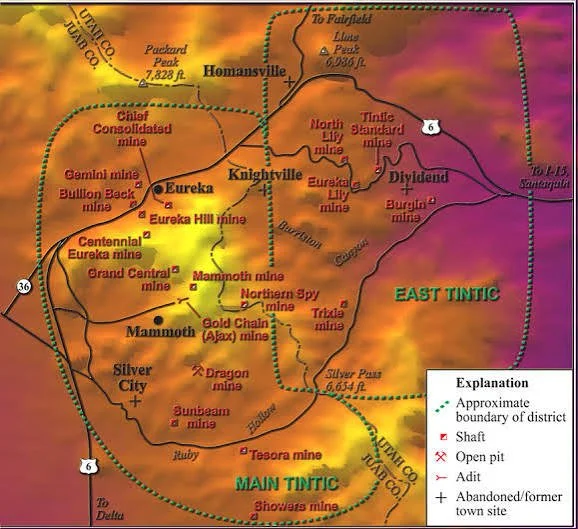
The Tintic Mining District is one of Utah's most important historic mining regions. Located in Juab and Utah counties, the district developed into a major nineteenth- and early twentieth-century center for the extraction of silver, lead, gold, copper, and other minerals.
The phrase "underground labyrinths" is especially appropriate for the physical complexity created by generations of mining.
Beneath the mountains, shafts, tunnels, stopes, drifts, raises, crosscuts, and other workings created an artificial subterranean landscape.
Geological Origins
The Tintic Mountains contain mineral deposits formed through complex geological processes.
Ore bodies occurred in different geological settings, requiring miners to adapt their extraction methods to local conditions.
This geological complexity influenced the shape of underground workings.
Mining was therefore an exercise in following mineralization through three-dimensional rock.
The Mining Boom
Tintic emerged as a major mining district during Utah's post-settlement mineral expansion.
Discoveries attracted prospectors and investors.
Settlements developed rapidly.
Eureka became the district's most famous community, while other camps developed around individual mines.
Railroads eventually transformed transportation and helped connect Tintic with national markets.
Underground Engineering
A nineteenth-century mine was effectively an underground city.
Shafts provided vertical access.
Drifts followed ore bodies horizontally.
Crosscuts connected workings.
Raises allowed miners to move upward.
Stopes were excavated where ore was removed.
Ventilation systems provided airflow.
Pumps removed groundwater.
Hoists transported people and materials.
The resulting network could extend for enormous distances.
Mining Technology
Early miners relied heavily on hand tools and black powder.
Later operations adopted increasingly powerful explosives, compressed-air drills, mechanical hoists, pumps, and improved ventilation systems.
Technological development changed the speed and scale of excavation.
However, deeper mining also introduced new dangers.
Rock pressure, flooding, poor ventilation, and structural failure became increasingly serious.
Labor and Risk
Mining was dangerous work.
Workers could be injured by explosions, rock falls, machinery, fires, and poisonous gases.
Long-term exposure to dust and metal-bearing materials could also produce serious health problems.
Despite these dangers, mining provided employment and wages that attracted workers from many backgrounds.
Eureka and the Tintic Economy
Eureka developed as one of Utah's major mining towns.
Its businesses, hotels, banks, newspapers, transportation infrastructure, and residential districts reflected the wealth generated by surrounding mines.
The town became a regional commercial center rather than merely a workers' camp.
Railroads
Rail transportation transformed Tintic mining.
Ore could be moved more efficiently to smelters and markets.
Coal, machinery, food, timber, and other supplies could enter the district more cheaply.
Rail access therefore changed the economics of mining.
Archaeology Beneath the Surface
Mining archaeology is unusual because much of the evidence is hidden underground.
Archaeologists and historians can study mine maps, engineering drawings, production records, machinery, surface structures, waste dumps, and underground features.
Mine maps are particularly valuable because they document how workers understood the subterranean environment.
They are historical maps of an artificial landscape.
Environmental Legacy
Tintic also demonstrates the environmental costs of extraction.
Mine waste can contain heavy metals.
Tailings can be transported by wind and water.
Smelters historically emitted pollutants.
Drainage from abandoned mines can alter water chemistry.
These impacts can continue long after mining ends.
Preservation
Historic mine openings can be extremely dangerous.
Unstable shafts and tunnels can collapse without warning.
Consequently, preservation does not necessarily mean allowing unrestricted public access underground.
Instead, historians and archaeologists can document sites through surveys, maps, photographs, engineering records, and carefully managed access.
Conclusion
The Tintic Mining District represents one of Utah's most complex industrial landscapes.
Its underground workings preserve evidence of generations of technological development and human labor.
Above ground, communities such as Eureka reveal how mining transformed Utah's economy and society.
Together, the surface settlements and subterranean workings demonstrate that nineteenth-century mining was a sophisticated industrial system whose physical footprint extended deep beneath the landscape.