Tsodilo Hills in northwestern Botswana is one of southern Africa's most extraordinary archaeological and sacred landscapes.
The hills contain:
rock paintings;
engravings;
archaeological sites;
shelters;
and evidence of long-term human occupation.
The area has been described as a major sacred landscape for local communities.
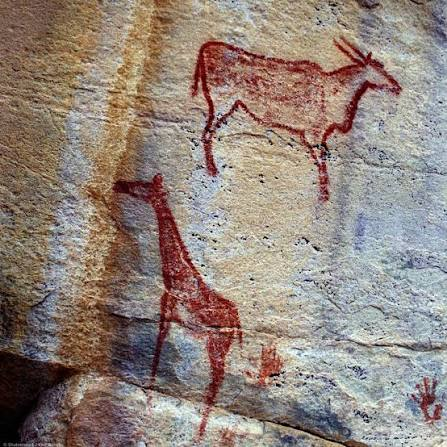
Its rock art includes representations of animals, humans, and abstract designs.
The title “Zoo Rock” captures the remarkable diversity of animals represented across the rock-art landscape, although the site's chronology extends well beyond a simple 2,000-year period.
The Hills
Tsodilo consists of several prominent rocky elevations rising dramatically from the surrounding landscape.
These include:
the Male Hill;
Female Hill;
Child Hill;
and other formations.
The landscape is visually distinctive and easily recognizable from a distance.
A Sacred Place
Tsodilo is deeply significant to local San communities.
Traditional beliefs associate the hills with spiritual beings and ancestral traditions.
The landscape therefore has both archaeological and living cultural significance.
Rock Art
The hills contain thousands of painted and engraved images.
Artists represented:
giraffes;
eland;
antelope;
rhinoceros;
cattle;
humans;
and other animals.
The Animal “Zoo”
The diversity of animal imagery is one of Tsodilo's most striking characteristics.
Wild animals could provide information about:
hunting;
ecology;
ritual;
and symbolic beliefs.
The presence of animals that are rare or absent in the modern region may also provide clues about past environments.
Hunter-Gatherers
Some of the earliest artistic traditions are associated with hunter-gatherer communities.
These societies relied on:
wild game;
plants;
water;
and detailed knowledge of seasonal resources.
Rock art may have formed part of their symbolic and ritual world.
Later Pastoral Communities
Later images include domesticated animals.
Cattle representations demonstrate that the landscape was eventually incorporated into pastoral economies.
This makes Tsodilo valuable for studying economic change.
Engraving Techniques
Artists created engravings by:
pecking;
scraping;
incising;
and polishing rock surfaces.
Some images are deeply carved.
Others are faint and difficult to see.
Paint Pigments
Paintings used mineral pigments, especially:
red ochre;
yellow;
white;
and black.
Some colors have survived remarkably well because of the dry environment.
Archaeological Occupation
Excavations around the hills have produced:
stone tools;
pottery;
beads;
metal objects;
and other artifacts.
These materials demonstrate that people repeatedly returned to Tsodilo over thousands of years.
Climate and Landscape
Tsodilo's history is connected to changing environmental conditions.
The surrounding region has experienced fluctuations in:
rainfall;
vegetation;
wildlife;
and water availability.
People adapted their subsistence strategies accordingly.
UNESCO World Heritage Status
Tsodilo Hills was designated a UNESCO World Heritage Site because of its exceptional archaeological, cultural, and spiritual importance.
The designation recognizes the hills as one of the most significant cultural landscapes in southern Africa.
Why Tsodilo Matters
Tsodilo is important because it combines:
archaeology;
rock art;
living Indigenous traditions;
environmental history;
and long-term human occupation.
Conclusion
Tsodilo Hills is far more than a collection of prehistoric paintings.
It is a cultural landscape in which archaeology and living tradition overlap.
Its thousands of animal and human images preserve evidence of changing societies, while the hills themselves remain spiritually significant to local communities.
The result is one of Africa's most extraordinary examples of a landscape that has retained cultural meaning across thousands of years.