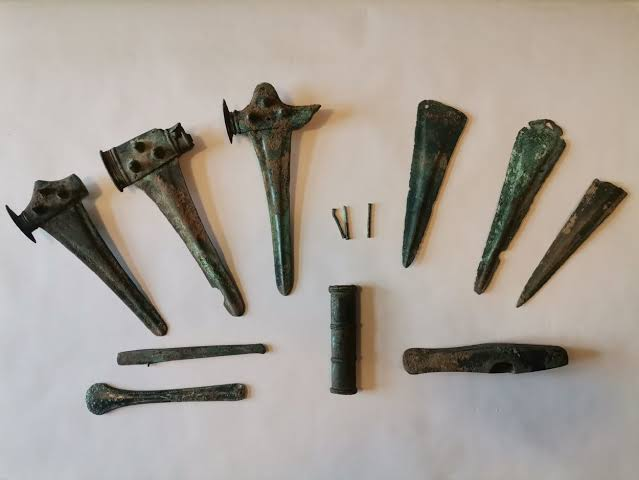
The Metallurgy Elite: Únětician artisans are famous for their massive metal hoards, which often contain hundreds of uniform bronze objects like axe heads, heavy neck rings (Ösenringe), and beautifully crafted daggers. These hoards were long debated: were they merchant warehouses, currency reserves, or religious offerings? Modern spatial analysis points heavily to ritualized landscape deposition, meant to mark territories or appease chthonic deities.
The Genetic Revolution: Recent paleogenomic sequencing of individuals from elite Únětice burials—including those from massive princely barrows like Leubingen—has provided profound insights into Bronze Age population dynamics. The data shows a massive genetic shift heavily dominated by Y-haplogroup I2 and various subclades of R1b-M269, linking them directly to the earlier Corded Ware and Bell Beaker expansions.
Social Inequality Inherited: What makes the Únětice genetic data groundbreaking is the evidence of strict social stratification. Kinship mapping reveals that wealth, status, and nutrition (measured via stable isotope analysis) were passed down strictly through patrilineal lines. Elite males enjoyed highly varied diets rich in animal proteins, while lower-class individuals buried in simple flat graves shows high rates of physiological stress and nutritional deficiencies.