One Temple, Two Religions: The 1,000-Year Mystery of Triloknath in the Himalayas
High in the mountainous Lahaul region of Himachal Pradesh stands one of the most remarkable religious monuments in the western Himalayas: Triloknath Temple. The site is extraordinary not simply because of its age or dramatic mountain setting, but because it occupies a cultural space where religious traditions that are often treated separately in modern discussions have historically overlapped.
For Hindu devotees, the temple is associated with Trilokinath, “Lord of the Three Worlds,” a form of Shiva. For Buddhist communities, the sacred image is associated with Avalokiteshvara, the bodhisattva of compassion.
This dual identity makes Triloknath one of the most important examples of religious interaction in the Himalayas.
The temple demonstrates that religious history is often more complicated than neat modern categories suggest. Communities did not always construct rigid boundaries between traditions. Sacred places could be shared, reinterpreted, and understood through multiple religious frameworks.
Lahaul: A Meeting Place Between Cultural Worlds
Lahaul occupies a geographically challenging but historically important region of the western Himalayas. High mountain passes and river valleys connected communities from the Indian subcontinent with Tibetan cultural regions.
For centuries, the region experienced overlapping influences.
These included:
Hindu religious traditions.
Tibetan Buddhism.
Indian Buddhist artistic traditions.
Local Himalayan beliefs.
Trade networks crossing mountain passes.
Political influences from neighboring Himalayan territories.
Triloknath emerged from this complex environment.
Its architecture and religious identity cannot be fully understood by placing it exclusively within either “Hindu” or “Buddhist” history.
The Sacred Image and Its Double Identity
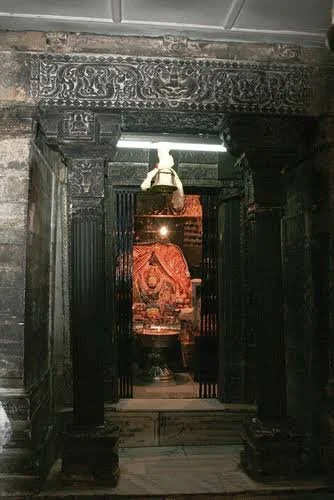
At the center of the temple's religious importance is the principal sacred image.
Different communities interpret the deity according to their own religious traditions.
For Hindu worshippers, the site is associated with Shiva as Trilokinath.
For Buddhist devotees, the central figure is identified with Avalokiteshvara, known in Tibetan traditions as Chenrezig.
This overlap is particularly significant because Avalokiteshvara is one of the most important bodhisattvas in Mahayana Buddhism.
He represents compassion.
In Buddhist belief, the bodhisattva postpones complete entry into final enlightenment in order to assist other beings.
The coexistence of these interpretations demonstrates a long history of cultural adaptation.
The object itself became part of multiple religious worlds.
A Temple Approximately a Millennium Old
Triloknath is generally regarded as an ancient Himalayan religious center with architectural elements and traditions extending back roughly a thousand years, although individual components and later renovations reflect the long life of the monument.
This distinction is important.
Historic temples are rarely frozen in time.
A sanctuary may be founded during one period.
Later communities repair walls.
Images may be replaced or restored.
Roofs can be reconstructed.
New ritual spaces can be added.
Therefore, describing a temple as “1,000 years old” usually refers to the antiquity of its religious and architectural tradition rather than suggesting that every beam and stone has survived unchanged for a millennium.
The Architecture of Cultural Exchange
The architecture of Triloknath reflects the complex cultural environment of the western Himalayas.
Himalayan temples frequently incorporated local building materials and techniques while also reflecting artistic influences from broader regions.
Architectural features could include:
Stone construction.
Timber structural elements.
Carved decorative components.
Enclosed sanctuaries.
Small courtyards or surrounding religious spaces.
Sculptural imagery.
The temple is therefore not merely a place of worship. It is physical evidence of artistic exchange.
Why Religious Boundaries Were Not Always Fixed
Modern observers often imagine that a temple must belong exclusively to one religion.
The historical reality can be very different.
In frontier regions and cultural contact zones, religious communities frequently borrowed ideas, shared sacred landscapes, and adapted preexisting monuments.
A deity could be interpreted differently by different communities.
A sacred mountain could possess importance across multiple traditions.
A pilgrimage route could be used by people with different religious identities.
Triloknath is one of the strongest examples of this phenomenon in the Himalayas.
Pilgrimage and Sacred Geography
The location of Triloknath contributes to its importance.
Pilgrimage involves movement.
The journey itself can become part of religious experience.
Traveling through difficult mountain landscapes reinforces the separation between ordinary life and sacred space.
Historically, reaching a Himalayan temple could require days or weeks of travel.
Pilgrims crossed rivers, valleys, and mountain routes.
The physical effort became intertwined with devotion.
The Importance of Avalokiteshvara
For Buddhist communities, Avalokiteshvara occupies an especially important position.
He is associated with compassion and the desire to assist suffering beings.
The spread of Avalokiteshvara worship across the Himalayan world demonstrates the movement of Buddhist religious traditions between India, Tibet, Nepal, and surrounding regions.
The identification of the sacred image at Triloknath with this bodhisattva places the temple within a much larger Buddhist cultural network.
Shiva and the Three Worlds
The Hindu identification of the site with Trilokinath introduces another layer of meaning.
The name refers to the “Lord of the Three Worlds,” an expression associated with cosmic authority.
Within Hindu traditions, Shiva occupies multiple roles as an ascetic, destroyer, protector, and cosmic figure.
The mountain environment itself is deeply compatible with Shaivite religious symbolism. Shiva is famously associated with Mount Kailash and Himalayan landscapes.
For Hindu pilgrims, therefore, the mountainous setting reinforces the deity's sacred identity.
A Living Monument
Triloknath is not important only because of its historical age.
It remains a living religious site.
This distinction is crucial in heritage studies.
An abandoned ruin can be studied primarily as an archaeological object.
A living temple must be understood through both past and present.
Communities continue to:
Visit the site.
Worship.
Perform rituals.
Participate in festivals.
Maintain religious traditions.
Conservation must therefore respect both physical heritage and living cultural practice.
Why Triloknath Matters Today
The temple provides an important lesson about the history of religion.
Religious traditions are not always isolated systems separated by impenetrable boundaries.
Human communities interact.
Ideas move.
Images are reinterpreted.
Sacred spaces accumulate new meanings.
For roughly a millennium, Triloknath has stood in one of the world's most challenging landscapes as evidence of this interaction.
It is a temple.
A pilgrimage center.
An architectural monument.
And a reminder that the history of the Himalayas cannot be understood through a single religious story.