The Lost City Built by a Caliph: Inside Medina Azahara's Spectacular Rise and Sudden Destruction
In the tenth century, near Córdoba, one of the most powerful rulers in the Islamic world ordered the construction of an entirely new palace city.
Its name was Madinat al-Zahra.
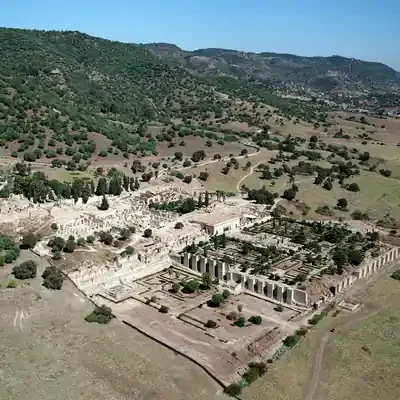
Today, the ruins of Medina Azahara reveal the remains of an ambitious political project designed to demonstrate the power of the Umayyad Caliphate of Córdoba.
The city was more than a residence.
It was a statement.
The Rise of the Caliphate of Córdoba
In 929 CE, Abd al-Rahman III declared himself caliph.
This was a major political act.
A caliph claimed leadership of the Islamic community.
The declaration placed the Umayyad ruler of al-Andalus in direct ideological competition with other major Islamic powers.
Madinat al-Zahra became an architectural expression of this new authority.
Why Build a New City?
A palace could have been expanded within Córdoba.
Instead, a new complex was constructed outside the city.
This allowed the caliph to create a carefully organized environment.
The city included:
Palaces.
Administrative buildings.
Gardens.
Reception halls.
Residential areas.
Infrastructure.
Military elements.
Its location and design demonstrated hierarchy.
Architecture as Political Propaganda
Every major empire communicates power.
Some do it through monuments.
Others through ceremonies.
Madinat al-Zahra did both.
Foreign envoys arriving at the palace would encounter controlled sequences of architecture and ceremony.
The physical journey through the complex reinforced the ruler's authority.
The Terraced City
The palace complex was organized across terraces on the hillside.
This created visual hierarchy.
Higher levels were associated with elite and administrative functions.
Architecture shaped movement and visibility.
The landscape itself became part of political design.
The Reception Hall
One of the most spectacular elements of the site is the richly decorated ceremonial architecture associated with royal reception.
Carved stone, arches, decorative panels, and carefully arranged spaces created an environment intended to impress visitors.
Diplomacy became theater.
The visitor did not simply meet the ruler.
The visitor experienced the power of the caliphate.
The Myth of Zahra
Popular tradition sometimes claims that the city was named after a beloved woman named Zahra.
While the story is famous, the historical certainty surrounding such romantic explanations is limited.
The name may instead have broader symbolic or linguistic significance.
This illustrates a common problem in historical interpretation: beautiful stories are not automatically historical facts.
A Short Life
Despite its extraordinary scale, Medina Azahara did not survive for centuries as a functioning capital.
Political instability and civil conflict during the early eleventh century led to its destruction and abandonment.
The great palace city became a ruin.
How an Entire City Was Forgotten
Over time, stone from the abandoned complex could be reused elsewhere.
Sediment covered surviving structures.
The location gradually disappeared from ordinary public memory.
For centuries, the magnificent caliphal city existed largely beneath the landscape.
Archaeology eventually began revealing it again.
Why Medina Azahara Is Extraordinary
The site demonstrates both the power and fragility of political architecture.
A ruler could command enormous resources.
A city could be built to symbolize a new caliphate.
But political collapse could destroy that achievement within a relatively short period.
Today, the ruins reveal a paradox.
The city failed as a permanent political capital.
Yet its archaeological survival allows the modern world to understand the ambitions of one of medieval Europe's most powerful Islamic states.