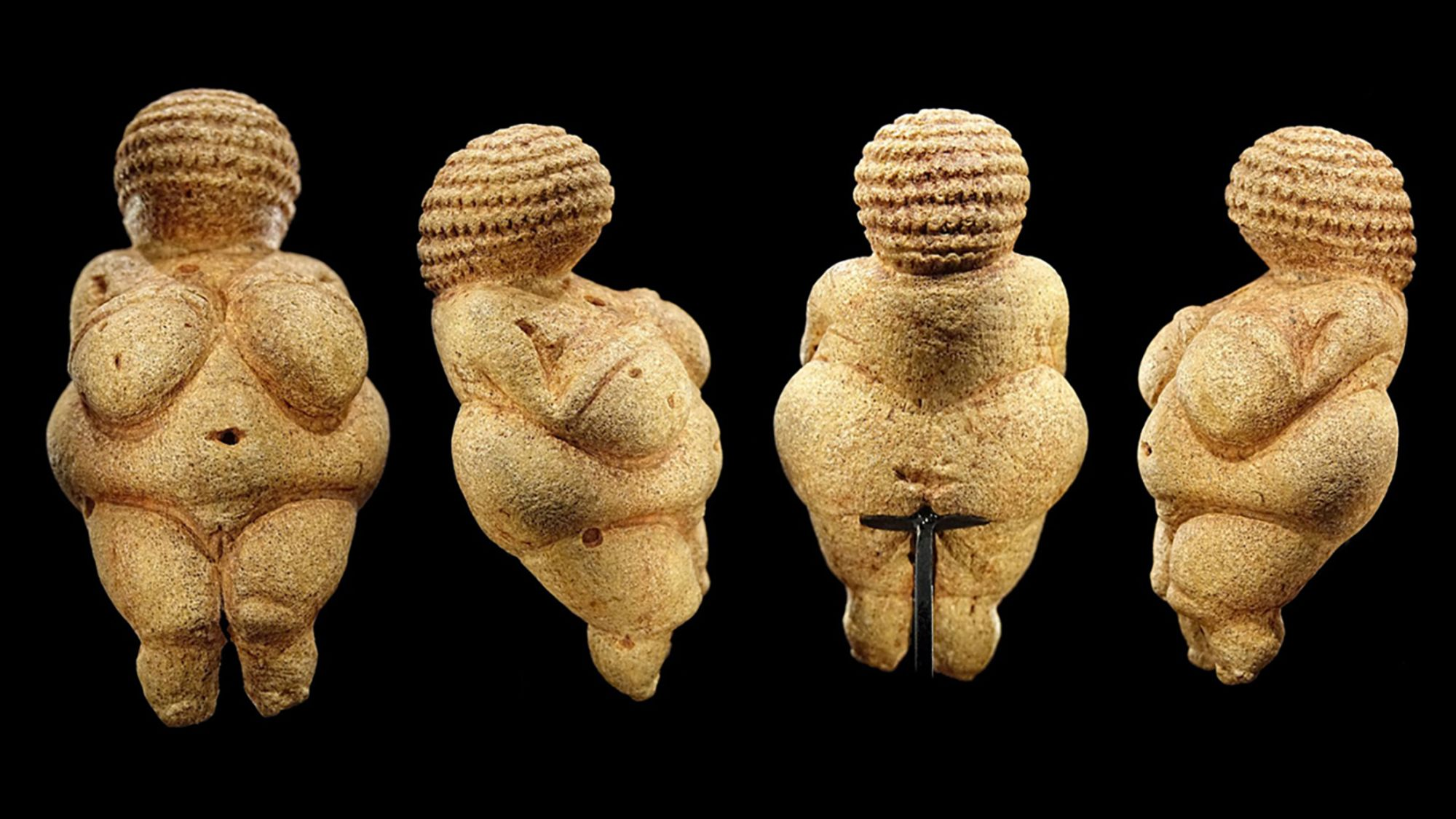
The Venus figurines are among the most captivating and debated objects in human history. These small, portable sculptures of the female form date primarily to the Gravettian period (c. 26,000–21,000 years ago) of the Upper Paleolithic.
Found across a vast geographic range—from France to the Ural Mountains in Russia—they share a striking "shorthand" for the female body: exaggerated breasts, bellies, and thighs, often with minimal attention paid to faces, hands, or feet.
1. The "Big Three": Iconic Examples
While hundreds of fragments exist, three specific figurines have defined our understanding of Paleolithic art:
Venus of Hohle Fels (c. 35,000 BCE): Found in Germany, this is the oldest known depiction of a human female. It was carved from a mammoth tusk and features a small loop instead of a head, suggesting it was worn as a pendant.
Venus of Willendorf (c. 25,000 BCE): Discovered in Austria, she is the "superstar" of the genre. Carved from oolitic limestone and originally tinted with red ochre, her detailed braided hairstyle (or cap) is one of the few features beyond her physique.
Venus of Brassempouy (c. 25,000 BCE): Found in France, this ivory fragment is unique because it focuses on the face. It is one of the earliest realistic representations of human facial features, complete with hair and eyes.
2. Theory 1: Symbols of Fertility and Survival
For decades, the dominant theory was that these were "Mother Goddesses" or fertility fetuses.
The Survival Mechanism: In a world of extreme ice-age scarcity, fat was a sign of health and the ability to survive a pregnancy. Exaggerated sexual characteristics may have been "sympathetic magic"—objects designed to ensure a successful birth.
The Steatopygia Debate: Some early researchers argued they were realistic portraits of women with steatopygia (a natural accumulation of fat in the hips and buttocks), though most modern scholars see the forms as highly stylized rather than literal.
3. Theory 2: Self-Portraits and the "Female Gaze"
In recent years, archaeologists like Catherine McCoid and LeRoy McDermott have proposed a revolutionary idea: these were made by women, for women.
The Perspective Argument: If a woman looks down at her own body, her breasts and belly appear larger and her feet seem small and distant. This perspective matches the proportions of the figurines perfectly.
Obstetrical Records: Some scholars suggest the figurines were used as educational tools for women to track the changes in their own bodies during different stages of pregnancy, acting as a "Paleolithic gynecological manual."
4. Theory 3: Social Glue and Diplomatic Tokens
Archaeologist Clive Gamble suggested that the figurines weren't about religion or sex, but about communication.
The Shared Language: Despite being thousands of miles apart, groups across Europe made figurines that looked nearly identical. This suggests they were "social signatures."
Climate Stress: During the coldest parts of the Ice Age, human groups needed to stay connected to survive. Carrying or trading these figurines might have been a way to signal "I am part of your culture" when encountering strangers in distant lands.
5. Artistic Expression: Aesthetics Beyond Function
We often try to find a "reason" for ancient art, but it’s possible the Paleolithic people simply valued artistic virtuosity.
Material Mastery: Carving mammoth ivory or hard stone required immense skill and hours of labor. The fine details on the "Venus of Dolní Věstonice"—the oldest known ceramic piece in the world—prove that Ice Age humans were experimenting with chemistry and kilns to achieve an aesthetic result.
Diverse Representations: Not all figurines are "voluptuous." Some are thin, some appear elderly, and some are highly abstract. This diversity suggests they weren't a "one-size-fits-all" religious icon.
6. The Naming Controversy
The term "Venus" was coined in the 19th century by the Marquis de Vibraye, who found a figurine and mockingly called it Vénus impudique (immodest Venus).
The Irony: By naming them after the Roman goddess of beauty, Victorian archaeologists imposed their own sexualized views on a culture that existed 20,000 years before Rome. Today, many archaeologists prefer the term "Anthropomorphic Figurines" to avoid these modern biases.
The Venus figurines remind us that the "human condition"—the desire to create, to understand the body, and to connect with others—has remained remarkably consistent for over 30,000 years.