Introduction
Wendover Airfield is one of the most significant World War II aviation sites in Utah.
Located in the remote western part of the state, the airfield began as a training facility for heavy bomber crews. It later became the secret training base of the 509th Composite Group, the unit associated with the atomic bombing missions against Japan in August 1945.
The National Park Service describes Wendover as an important training site for heavy bombardment crews and as the base where the 509th Composite Group trained before moving to Tinian.
Construction of the Airfield
The military began developing Wendover in the late 1930s.
The location offered extensive open space suitable for bombing and gunnery training.
The desert environment also reduced the risk of accidental damage to densely populated areas.
By 1942, training operations were well established.
Heavy Bomber Training
Wendover trained crews for some of the largest aircraft used by the United States during World War II.
Heavy bombers required specialized crews.
Pilots, navigators, bombardiers, engineers, radio operators, and gunners had to coordinate their activities.
Training emphasized precision.
The 509th Composite Group
In late 1944, Wendover became the home of the newly organized 509th Composite Group.
The unit had a highly specialized mission.
Its aircraft had to be modified to carry the enormous atomic bombs being developed through the Manhattan Project.
The group's training was conducted under extraordinary secrecy.
The Enola Gay
The B-29 known as the Enola Gay was associated with the 509th Composite Group.
The aircraft later carried the atomic bomb used against Hiroshima on August 6, 1945.
The crew had trained at Wendover before the group moved to Tinian in the Pacific.
It is therefore historically accurate to describe Wendover as the training base associated with the Enola Gay, while recognizing that the Hiroshima mission itself departed from Tinian, not Utah.
Secrecy
Security at Wendover became extremely strict.
The 509th operated as a specialized and relatively self-contained unit.
Personnel were not necessarily informed about the full purpose of their activities.
The secrecy reflected the military importance of the Manhattan Project.
Infrastructure
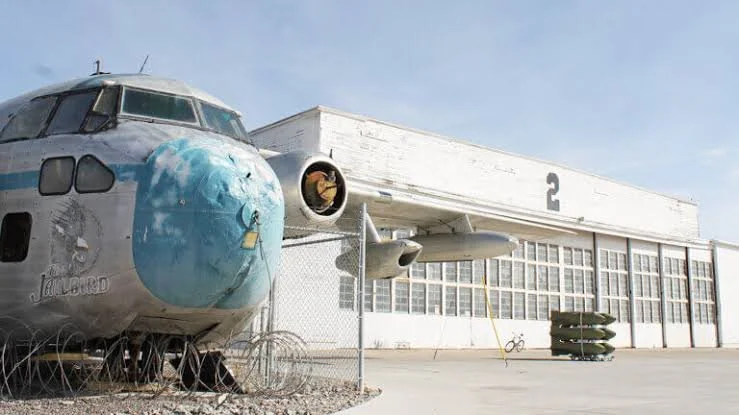
Wendover became a substantial military installation.
At its height, the base included hundreds of buildings, long runways, hangars, barracks, administrative facilities, maintenance areas, and specialized training infrastructure.
The scale of the installation illustrates how much physical infrastructure was required to operate heavy bomber forces.
Atomic-Bomb Training
The crews practiced specialized bombing techniques.
The B-29 had to be modified.
Bomb-loading procedures had to be developed.
Crews practiced flight patterns and release techniques.
The objective was to make an unprecedented weapon compatible with an operational aircraft.
Tinian
The 509th left Wendover for Tinian in 1945.
The Pacific base became the operational location for the atomic bombing missions.
The transition from Utah to Tinian demonstrates how Wendover functioned primarily as a training and preparation site.
Preservation
Wendover's historic buildings are valuable because they preserve the physical setting of World War II aviation.
Unlike a conventional museum display, the landscape allows visitors to understand the spatial scale of military aviation.
The National Park Service has described the surviving installation as exceptionally well preserved for a World War II Army Air Forces training base.
Historical Debate
Wendover's history cannot be separated from the broader history of nuclear warfare.
The atomic bombings of Hiroshima and Nagasaki remain major subjects of historical debate.
The airfield itself, however, can be studied without reducing its history to a single argument.
Its importance includes aviation technology, military training, secrecy, logistics, engineering, and the development of nuclear warfare.
Conclusion
Wendover Airfield preserves one of the most consequential military landscapes in Utah.
Its connection to the Enola Gay and the 509th Composite Group gives the site global historical significance.
At the same time, the airfield preserves the broader story of World War II aviation and the thousands of personnel who operated the vast infrastructure necessary to prepare for the final stages of the war.