Introduction
Around 3000 BCE, Western Europe was home to deeply rooted, peaceful Neolithic farming communities that had spent millennia building stone monuments, cultivating local valleys, and establishing complex agricultural networks. Within a few centuries, this ancient socio-economic landscape was shattered. The catalyst was a massive, unprecedented migration wave originating from the Pontic-Caspian steppe—the vast grassland spanning modern-day Ukraine and southwest Russia.
These nomadic pastoralists, known to archaeology as the Yamnaya culture, altered the course of human history. For decades, linguists and traditional archaeologists argued over the "Kurgan hypothesis"—the theory that nomadic steppe horsemen spread Indo-European languages into Europe through physical conquest. This intense historical debate was finally settled by a revolution in paleogenomics, which uncovered absolute, unmistakable molecular proof of a sweeping demographic invasion.
The Metallurgical and Genetic Tsunami
The Yamnaya were uniquely adapted for rapid, aggressive territorial expansion. They possessed a revolutionary technological triad: the domestication of the horse, the invention of heavy, wheeled ox-drawn wagons that served as mobile homes, and advanced copper metallurgy. These developments allowed them to abandon permanent river valleys and exploit the deep, arid interiors of the Eurasian steppe, driving immense herds of cattle and sheep before them. When a shifting climate or population pressure forced them westward, they did not arrive as peaceful traders; they descended upon Europe as a highly mobile, stratified warrior society.
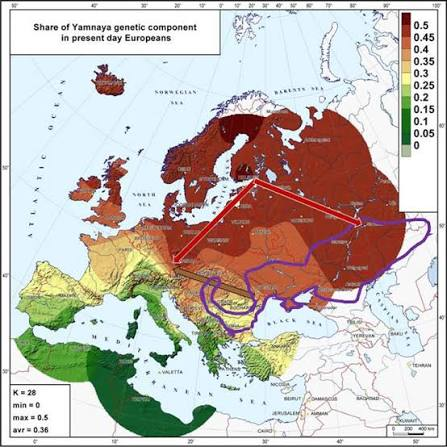
The true scale of their impact was revealed when international geneticists successfully sequenced genome-wide DNA from hundreds of prehistoric European skeletons. The results revealed a sudden genetic shift. Beginning around 2800 BCE, the centuries-old ancestry of native European Neolithic farmers was systematically overwritten by a massive influx of "Steppe Ancestry." In Central Europe, populations associated with the Corded Ware culture suddenly inherited up to 75% of their entire genome directly from Yamnaya migrants.
Crucially, archaeogeneticists uncovered an extreme sex bias in this migration pattern. By analyzing the Y-chromosome (passed exclusively from father to son) alongside mitochondrial DNA (passed from mothers), scientists discovered that the incoming steppe ancestry was overwhelmingly driven by male migrants. In many parts of Europe, native Neolithic paternal lineages (such as haplogroup G2a) completely vanished within a few generations, replaced by Yamnaya paternal haplogroups R1a and R1b.
This stark genetic asymmetry suggests a highly disruptive, violent male-driven conquest. Incoming Yamnaya warriors leveraged their mobility and metal weapons to eliminate local male populations and intermarry with native women, establishing a new, highly stratified social hierarchy that permanently transformed the European gene pool.
Conclusion
The paleogenomic mapping of the Yamnaya migration provides the definitive link between prehistoric genes and modern languages. This demographic upheaval acts as the primary vehicle that carried early Indo-European dialects into the heart of Europe, giving rise to the Celtic, Germanic, Italic, and Slavic language families spoken today.
By replacing the male lineages of Western Europe, the steppe herders did not merely change the genetic landscape; they introduced an entirely new worldview characterized by patriarchal social structures, pastoral wealth accumulation, and warrior mythologies. Ultimately, the ancient DNA proves that modern Europeans are the direct biological and linguistic heirs of this nomadic steppe expansion, showing that the foundational substrate of Western civilization was forged in the fire of a prehistoric bronze invasion.