1. Philistine DNA: Ashkelon's 3,000-Year European Roots
Introduction
For millennia, the Philistines were understood almost exclusively through the biased lens of their historical adversaries. In the Hebrew Bible, they are depicted as uncircumcised, culturally crude, and fiercely aggressive interlopers who occupied the southern coastal plains of the Levant. Classical and biblical texts suggested they were foreign invaders who arrived via maritime migration, a group frequently lumped together with the mysterious "Sea Peoples" coalition that destabilized the Eastern Mediterranean during the chaotic Late Bronze Age collapse around 1200 BCE.
Despite decades of traditional archaeological excavations unearthing distinct Aegean-style painted pottery, hearth-centered architecture, and pig-heavy dietary remains, historians remained deadlocked over whether this represented a true migration of flesh-and-blood people or simply the local adoption of fashionable foreign styles. The impasse was finally broken through a landmark paleogenomic study that successfully sequenced DNA from the ancient port city of Ashkelon.
The Archaeogenetic Extraction and Demographic Shift
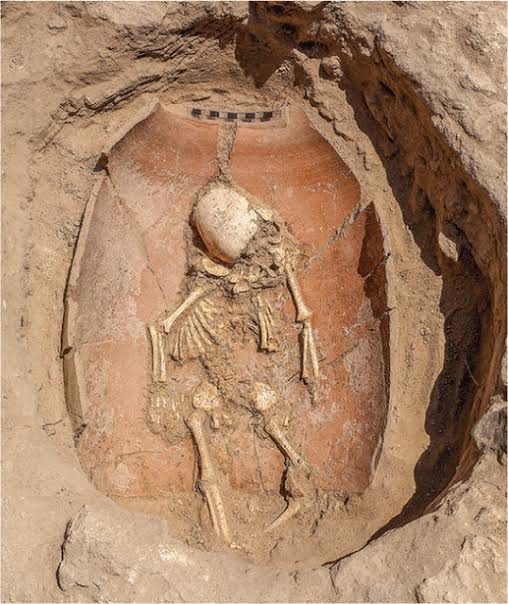
The scientific breakthrough came when an international research team extracted and analyzed genome-wide data from 10 individuals buried at Ashkelon, spanning the Middle Bronze Age, the early Iron Age, and the later Iron Age. The most critical data came from infants buried beneath the floors of early Philistine homes dating to the 12th century BCE, the precise historical moment the Philistines appear in the written record.
The genomic sequencing revealed a sudden, unmistakable genetic shift that completely distinguished these early Iron Age infants from the preceding Canaanite population of the Bronze Age. The early Philistines carried a substantial, statistically profound spike of Southern European ancestry, tracing their genetic roots directly to the Aegean, Greece, Crete, or the Iberian Peninsula.
This data provides the first immutable, molecular proof that a real, physical mass migration event took place across the Mediterranean Sea. The Philistines did not merely export pottery designs; they arrived as families, bringing their infants, their domestic culinary habits, and their distinct European genomes to the Levantine coast.
However, the paleogenomic timeline revealed an equally fascinating twist: when the researchers analyzed samples from Philistines buried in a large cemetery just a few centuries later (around the 10th and 9th centuries BCE), the European genetic signature had almost entirely vanished. Within a few generations of their arrival, the incoming European migrants had intermarried extensively with the local Semitic-speaking Levantine populations.
Genetically, they became indistinguishable from the surrounding Canaanite and Israelite populations, even while they fiercely maintained their distinct Philistine cultural identity, language, and military rivalries for centuries to come.
Conclusion
The paleogenomic mapping of Ashkelon fundamentally revises how modern historians conceptualize ancient ethnicity and cultural preservation. It demonstrates that an immigrant population can experience rapid, near-total genetic assimilation while successfully maintaining a distinct, high-prestige cultural and geopolitical footprint.
The European ancestry of the Philistines diluted into the broader Levantine gene pool within two centuries, but their political structures, unique ceramic styles, and historical memory survived long enough to give their name to the entire geographic region—Palestine. Ultimately, ancient DNA transforms the Philistines from abstract biblical caricatures into a tangible, highly resilient population of maritime migrants who successfully charted a new destiny on foreign shores.