• MAIN PAGE
  • LATEST NEWS
    • Lost Cities
    • Archaeology's Greatest Finds
    • Underwater Discoveries
    • Greatest Inventions
    • Studies
    • Blog
  • PHILOSOPHY
  • HISTORY
  • RELIGIONS
    • Africa
    • Anatolia
    • Arabian Peninsula
    • Balkan Region
    • China - East Asia
    • Europe
    • Eurasian Steppe
    • Levant
    • Mesopotamia
    • Oceania - SE Asia
    • Pre-Columbian Civilizations of America
    • Iranian Plateau - Central Asia
    • Indus Valley - South Asia
    • Japan
    • The Archaeologist Editor Group
    • Scientific Studies
    • Aegean Prehistory
    • Historical Period
    • Byzantine Middle Ages
    • Predynastic Period
    • Dynastic Period
    • Greco-Roman Egypt
  • Rome
  • PALEONTOLOGY
  • About us
Menu

The Archaeologist

  • MAIN PAGE
  • LATEST NEWS
  • DISCOVERIES
    • Lost Cities
    • Archaeology's Greatest Finds
    • Underwater Discoveries
    • Greatest Inventions
    • Studies
    • Blog
  • PHILOSOPHY
  • HISTORY
  • RELIGIONS
  • World Civilizations
    • Africa
    • Anatolia
    • Arabian Peninsula
    • Balkan Region
    • China - East Asia
    • Europe
    • Eurasian Steppe
    • Levant
    • Mesopotamia
    • Oceania - SE Asia
    • Pre-Columbian Civilizations of America
    • Iranian Plateau - Central Asia
    • Indus Valley - South Asia
    • Japan
    • The Archaeologist Editor Group
    • Scientific Studies
  • GREECE
    • Aegean Prehistory
    • Historical Period
    • Byzantine Middle Ages
  • Egypt
    • Predynastic Period
    • Dynastic Period
    • Greco-Roman Egypt
  • Rome
  • PALEONTOLOGY
  • About us
No results found

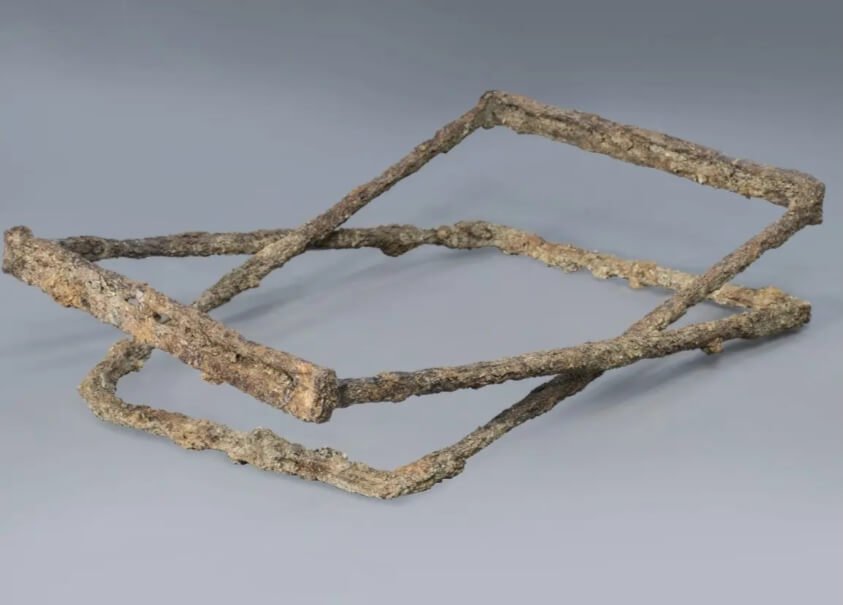
Image Credit : Bayerisches Landesamt für Denkmalpflege

Iron-Framed Marvel: The Remarkable Early Medieval Folding Chair

October 13, 2023

In the quiet village of Endsee, nestled within the heart of Middle Franconia, Germany, archaeologists recently unearthed an extraordinary artifact that has unveiled a fascinating glimpse into the past. The remarkable discovery, made during excavations in 2022, is none other than an early medieval folding chair, crafted from iron, dating back to the 7th century AD. This precious find was deposited as a funerary offering in a burial site, shedding light on the intriguing customs and lifestyles of the era.

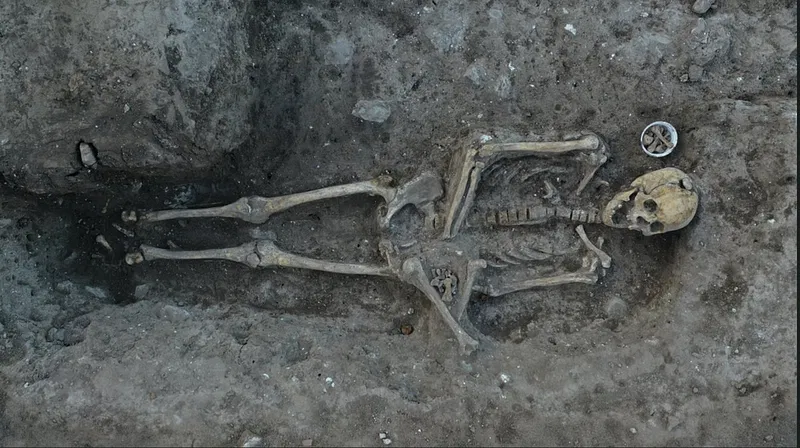
The chair's resting place was a grave that cradled the remains of a woman estimated to be between 40 and 50 years old. Alongside her skeletal remains, a treasure trove of relics was found. Among these were a delicate necklace adorned with small, multi-colored glass beads, two intricately designed brooches, an almandine disc brooch, a large millefiori bead, and a whorl—a testament to the craftsmanship and artistry of the time.

Notably, this woman was not alone in her journey to the afterlife. In proximity, another grave was discovered, this one belonging to a man. His final resting place was adorned with a lavish collection of weaponry, including a lance, shield, and spathe. These findings suggest a connection to the Franconian influence in the Main and Tauber regions during the 6th and 7th centuries, shedding light on the socio-cultural dynamics of the time.

After a meticulous restoration process, this ancient folding chair has now been unveiled to the public at the "Archaeology in Bavaria" conference. The chair itself is a testament to early medieval craftsmanship. It consists of two frames intricately connected with an axle pin and is embellished with brass non-ferrous metal inlays. Notably, narrow slots are present on the horizontal struts, which likely served as attachment points for a seat, presumably made from animal fur—a conclusion drawn from mineralized organic remains found on the chair.

Image Credit : Bayerisches Landesamt für Denkmalpflege

What makes this discovery truly exceptional is the rarity of folding chairs as grave goods in early medieval contexts. Such items were not common in burials, and their presence suggests that the individuals interred in these graves held a prominent position or occupied a higher social status within their communities. Astonishingly, this particular folding chair made from iron is among only six such examples discovered in Europe, out of a total of 29 early medieval graves containing folding chairs.

Professor Mathias Pfeil, the head of the Bavarian State Office for Monument Preservation, expressed his astonishment at the find. He stated, "The extremely rare discovery of an early medieval iron folding chair in 2022 was already a sensation, but the fact that such details have been preserved after remaining in the ground for over 1,400 years was a surprise." The chair's preservation is a testament to the meticulous care and reverence with which it was placed in the burial.

This remarkable artifact, which at first glance appears remarkably modern, holds immense cultural and historical significance. It provides a unique window into the burial practices and material culture of the early medieval period, offering invaluable insights into the lives and status of individuals who lived more than a millennium ago. As archaeologists continue to explore and excavate the past, discoveries like this folding chair continue to enrich our understanding of history, reminding us that even the seemingly mundane objects can tell extraordinary stories of our ancestors.

Relics from the Assyrian Era Discovered in Northern Iraq

October 12, 2023

In a remarkable archaeological discovery, Italian archaeologists, working in collaboration with Iraqi authorities, have unearthed a treasure trove of ancient Assyrian relics in the northern province of Nineveh, Iraq. This groundbreaking find offers a unique window into the rich history and culture of this ancient civilization.

The General Authority for Antiquities and Heritage in Iraq made the announcement on October 8, 2023. The discovery, made under the supervision of the Director-General of Investigations and Excavations, Ali Shalgham, is a testament to the dedication of the archaeological community and the tireless efforts to preserve and uncover the region's historical treasures.

The excavation site, located in the eastern part of Tell Qoyunjıq in Nineveh province, yielded a remarkable section of an administrative building constructed with mud bricks. This structure dates back to the modern Assyrian era, an important period in the history of Mesopotamia. The modern Assyrian era is generally considered to have extended from the 20th century BC to the 7th century BC. This era saw significant developments in the region, including the rise of the Assyrian Empire.

However, what makes this discovery even more fascinating is the diverse array of artifacts found at the site. The standout find was a collection of over 120 clay tablets, each containing literary texts. These tablets promise to shed light on various aspects of the Assyrian civilization, including their language, literature, and administrative practices. They provide invaluable insights into daily life, communication, and record-keeping during the modern Assyrian era.

During their examination of the excavation site, a committee from the General Authority for Antiquities and Heritage revealed the presence of two distinct cultural layers. These layers belong to different time periods: one hailing from the modern Assyrian era and the other from the Middle Assyrian period. The Middle Assyrian period, which occurred approximately from the 14th to the 11th century BC, represents a critical phase in the development of the Assyrian Empire. The presence of these layers hints at the potential for further discoveries that could span across the broader history of the Assyrian civilization.

Intriguingly, the committee recommended that excavation efforts continue at the site to explore layers from the ancient Assyrian era, should they be present. This potential holds the promise of uncovering even more secrets and relics from a civilization that once thrived in the region.

In addition to the excavation, the committee also inspected the restoration work being carried out on the Add gate. This historic site had suffered damage due to excavation work by the ISIS terrorist organization. The restoration work aims to repair and preserve the gate, which is an important piece of the Assyrian cultural heritage. It is essential to adhere to the guidelines set forth by the General Authority for Antiquities and Heritage in Iraq to ensure the gate's long-term protection.

This discovery is not only a testament to the dedication and collaboration of the international archaeological community but also a reminder of the importance of preserving and protecting our shared human heritage. The relics unearthed in Nineveh provide us with a remarkable glimpse into the ancient Assyrian civilization, offering a deeper understanding of its culture, language, and history.

As excavations continue and more artifacts come to light, the world can look forward to unraveling the secrets of this ancient civilization, piece by piece. The past holds a treasure trove of knowledge and wisdom, and discoveries like this one in northern Iraq ensure that it remains accessible to future generations, providing a bridge between our modern world and the distant echoes of the past.

However, what makes this discovery even more fascinating is the diverse array of artifacts found at the site. The standout find was a collection of over 120 clay tablets, each containing literary texts. These tablets promise to shed light on various aspects of the Assyrian civilization, including their language, literature, and administrative practices. They provide invaluable insights into daily life, communication, and record-keeping during the modern Assyrian era.

During their examination of the excavation site, a committee from the General Authority for Antiquities and Heritage revealed the presence of two distinct cultural layers. These layers belong to different time periods: one hailing from the modern Assyrian era and the other from the Middle Assyrian period. The Middle Assyrian period, which occurred approximately from the 14th to the 11th century BC, represents a critical phase in the development of the Assyrian Empire. The presence of these layers hints at the potential for further discoveries that could span across the broader history of the Assyrian civilization.

Intriguingly, the committee recommended that excavation efforts continue at the site to explore layers from the ancient Assyrian era, should they be present. This potential holds the promise of uncovering even more secrets and relics from a civilization that once thrived in the region.

In addition to the excavation, the committee also inspected the restoration work being carried out on the Add gate. This historic site had suffered damage due to excavation work by the ISIS terrorist organization. The restoration work aims to repair and preserve the gate, which is an important piece of the Assyrian cultural heritage. It is essential to adhere to the guidelines set forth by the General Authority for Antiquities and Heritage in Iraq to ensure the gate's long-term protection.

This discovery is not only a testament to the dedication and collaboration of the international archaeological community but also a reminder of the importance of preserving and protecting our shared human heritage. The relics unearthed in Nineveh provide us with a remarkable glimpse into the ancient Assyrian civilization, offering a deeper understanding of its culture, language, and history.

As excavations continue and more artifacts come to light, the world can look forward to unraveling the secrets of this ancient civilization, piece by piece. The past holds a treasure trove of knowledge and wisdom, and discoveries like this one in northern Iraq ensure that it remains accessible to future generations, providing a bridge between our modern world and the distant echoes of the past.

Archaeologists Unearth Site Believed to Be the Deathplace of Otto the Great

October 12, 2023

Archaeologists from the State Office for Monument Preservation and Archeology Saxony-Anhalt have been tirelessly excavating the former imperial palace and the Benedictine monastery in Memleben, a central German town, since 2017. Their efforts this year yielded remarkable findings – offering a significant breakthrough in our understanding of history. For the first time, tangible archaeological evidence of the Palatinate of Memleben, the as-yet unlocated place of death of Emperor Otto the Great and his father Henry the Fowler (919-936), has been uncovered.

The site was subsequently transformed into a monastery church by Otto the Great's son, Otto II. A mysterious foundation discovered in the cloister of the monastery church has ignited speculation about its potential link to the burial of Otto the Great's heart and internal organs.

Memleben monastery. In the right part of the picture, the monastery garden, under whose border the predecessor building of the monumental church continues. Photo by Thomas Jäger / Landesamt für Denkmalpflege und Archäologie Sachsen-Anhalt

The Memleben monastery itself stands as a pivotal historical site in the region, with its ruins of the 13th-century monastery church showcasing the transition from late Romanesque to early Gothic architecture. This church underscores the historical significance of the place: Emperor Otto I, famously known as "The Great," passed away in Memleben in 973, as did his father in 936. Otto II and his wife Theophanu went on to establish a Benedictine monastery at the site in honor of the emperor, which was first documented in 979 and remained one of the most important monastic institutions in the Ottonian Empire. Despite its loss of independence in 1015, when Henry II placed it under the control of the East Hesse Benedictine monastery of Hersfeld, Memleben remained a vital place of remembrance for the ruling family.

Recent research focused on three specific areas near the church built by Otto II: the northeast side apse, which partly served as a cemetery, the cloister area at the northern aisle, and the connection between the side aisle and the cloister on the western transept.

In 2022, the remains of a stone structure that predated the church were discovered directly adjacent to the northern side apse of Otto II's monumental church. This marks the first architectural evidence predating the construction of the basilica, dating back to the times of Henry the Fowler and Otto the Great. The building was approximately east-west oriented and measured around 9.20 meters in width. The extent to the east has yet to be determined, as it is concealed beneath today's monastery garden. The western side of the building features an opening over five meters wide, which appears to have had two portals originally. The building, dating back to the 10th/11th century, is notably older than the church it was found near.

Excavation section in the area of the cloister on the north side of the monumental church. On the right side of the picture, the remains of the foundation of the hitherto unknown, enigmatic building in the cloister. Photo by Holger Grönwald / Landesamt für Denkmalpflege und Archäologie Sachsen-Anhalt

The interior of this earlier building reveals a robust rubble pavement that served as a substructure for a lime plaster floor, remnants of which are still preserved in small sections. The exceptional quality of the 10th-century building suggests that it may have been a sacred or representative structure of the Palatinate of Memleben. Regardless of its precise function, this discovery marks the first time that archaeological evidence confirming the residence and death site of Henry and Otto has been uncovered.

A written source from the 16th century associates the mysterious building in the cloister area with the reburial of Otto the Great's heart. According to Thietmar von Merseburg's chronicle, Otto the Great's viscera were buried in Memleben's St. Mary's Church the night after his death, while his embalmed body was transported to Magdeburg. This newly discovered building might have been a sanctuary for the temporary storage and veneration of this relic, or it could have served as the tomb of a high-ranking person from the medieval period.

Further investigations of the densely occupied cemetery at the northeast apse of Otto II's church also unearthed numerous burials, shedding light on the historical significance of this site.

To better understand the floor plan and building history of Otto II's church, researchers examined the area outside the northern aisle, providing insights into the western transept, the foundation of which is interlocked with the nave to the east. This information complements earlier findings about the construction sequence, with the eastern apse and eastern transept being the first components built. Subsequently, the two eastern side apses and the nave and western transept were constructed simultaneously.

This year numerous burials were examined in the densely occupied cemetery at the northeast apse of Otto II’s church. Photo by Thomas Jager / Landesamt für Denkmalpflege und Archäologie Sachsen-Anhalt

Severe fire traces were also evident on the foundation during the excavation, indicating a targeted uncovering and burning during the building's demolition. This suggests that the laborious dismantling of individual stones was avoided in favor of a more efficient method of collapsing large sections of the masonry with fire. This demolition process can be dated to the 14th century, offering valuable insights into the church's history.

In summary, this year's archaeological excavations in Memleben have yielded crucial findings, most notably the discovery of a stone-built predecessor to Otto II's church. This 10th-century building's exceptional quality is of significant historical importance, as it provides tangible evidence of the authentic location of the Palatinate, a site of immense historical significance for the founding of the Holy Roman Empire and the deaths of the rulers Henry I and Otto I. The collaboration of various institutions and scholars has been instrumental in uncovering this vital piece of history, further enriching our understanding of the past.

This year's research excavation took place from August 21st to September 29th and was a collaborative effort between the State Office for Monument Preservation and Archeology Saxony-Anhalt, the Martin Luther University of Halle-Wittenberg (MLU), the Anhalt University of Applied Sciences (HA), and the Kloster und Kaiserpfalz Memleben Stiftung, with the participation of students from the Albert Ludwig University of Freiburg im Breisgau. The focus of the investigations was on the church from the time of the monastery's founding in the 10th century and its immediate surroundings.

A long section of the Upper Aqueduct to Jerusalem was uncovered in archaeological excavations at Giv‘at HaMatos

Ancient Aqueduct from Time of Roman Occupation Discovered in Jerusalem

October 12, 2023

In a remarkable archaeological discovery, an ancient aqueduct that once supplied water to Jerusalem's upper city during the Roman occupation has been unearthed in the Giv'at Hamatos neighborhood of Jerusalem. This significant find, announced by the Israel Antiquities Authority on October 2, sheds new light on the sophisticated engineering and water management systems of the time.

Water Supply in Ancient Jerusalem

Dr. Ofer Sion and Ruth Cohen, the excavation directors on behalf of the Israel Antiquities Authority, provided crucial historical context for this discovery. They explained that during the Second Temple period, as Jerusalem experienced significant expansion and Herod's Temple was constructed, the existing water sources, including springs and cisterns, were no longer sufficient to meet the growing needs of the city's residents and pilgrims. To address this issue, the Hasmoneans and King Herod initiated the construction of two elaborate aqueducts to transport water to Jerusalem, a monumental feat of engineering that was one of the most sophisticated water projects in the ancient world. The aqueducts harnessed water from springs in the Bethlehem region, utilizing large pools and hydraulic principles based on the siphon principle of communicating vessels and the force of gravity to transport water over long distances. This engineering marvel allowed the continued flow of water into the city, a lifeline for the population's daily needs despite the tumultuous events of the time.

A long section of the Upper Aqueduct to Jerusalem was uncovered in archaeological excavations at Giv‘at HaMatos.

The Roman Coin Mystery

The excavation efforts were not limited to uncovering the aqueduct's structure but also led to the discovery of a coin dating back to 67/68 CE, a relic from the first Jewish revolt against the Romans. This revolt occurred before the Second Temple's destruction and was a pivotal moment in the city's history. The intriguing aspect of this find is that the coin was discovered within the aqueduct. It is believed that the Roman occupiers deliberately placed the coin in the duct, possibly as an offering for good fortune. About 25 coins were found in the aqueduct's foundations, distributed at roughly equal distances, suggesting that this practice was not coincidental. The discovery of these coins could provide researchers with a unique opportunity for absolute dating of the various stages of Jerusalem's aqueduct construction. This newfound insight may help answer the long-standing question of whether it was the Hasmoneans or King Herod who initiated the construction of the first aqueduct.

The Upper Aqueduct's route and structure are testament to the advanced engineering skills of the time. Its ability to deliver water to Jerusalem's upper city even during times of political upheaval and conflict demonstrates the resilience of the water supply system. This find not only sheds light on the technology and water management practices of the Roman era but also provides a vivid historical context for the daily life and needs of ancient Jerusalem's residents. The discovery of the aqueduct and the enigmatic placement of coins within it create a more comprehensive picture of the city's history and the interplay between engineering, politics, and daily life in ancient Jerusalem.

The false door to Ptahshepses’s tomb was removed by a French archaeologist in the 19th century. Now, 160 years later, researchers have rediscovered it and found the mummy of its occupant.

Image courtesy of © Archive of the Czech Institute of Egyptology, Faculty of Arts, Charles University

Czech Archaeologists Rediscover Lost Tomb of Ancient Egyptian Official Ptahshepses

October 12, 2023

In a remarkable archaeological find, a team of Czech archaeologists has unearthed the long-lost tomb of an ancient Egyptian official named Ptahshepses. This discovery offers a fascinating glimpse into a pivotal period of ancient Egyptian history, shedding light on the life and significance of Ptahshepses, who lived around 4,400 years ago during the 24th and 25th centuries BCE.

The rediscovery of Ptahshepses' tomb occurred in the zone between the pyramid fields of Abusir and Saqqara, Egypt. Miroslav Barta, head of research at Abusir, described the challenging search that spanned several years. He explained that meticulous examination of old maps and detailed satellite imagery of the area played a pivotal role in the tomb's rediscovery in 2022.

Ptahshepses' Historical Significance

The story of this ancient tomb began approximately 160 years ago when French scholar Auguste Mariette partially excavated the site. He extracted Ptahshepses' false door and a lintel that was originally placed above the cult chapel. These artifacts, which offer valuable insights into Ptahshepses' life, are currently on display at the British Museum. The false door, in particular, provides a unique account of Ptahshepses' career, documenting how he received an education at the court of the last Giza ruler, Menkaure, and later married the daughter of pharaoh Userkaf. Userkaf was a prominent figure in Egyptian history, as he founded the Fifth Dynasty of Sun Kings. What makes this marriage especially significant is that it is the first known instance of an official of non-royal descent in Egyptian history marrying a royal daughter.

The chapel after cleaning.

Image courtesy of © Archive of the Czech Institute of Egyptology, Faculty of Arts, Charles University

Ptahshepses' Contribution to Egyptian Mythology

Furthermore, the lintel in Ptahshepses' tomb contains one of the earliest attestations of the god Osiris, a pivotal figure in Egyptian mythology associated with the afterlife. This discovery underscores Ptahshepses' historical significance, as he can be credited with introducing Osiris into the Egyptian pantheon.

The tomb has been dated to the reign of Nyuserra Ini, the sixth ruler of the Fifth Dynasty during the Old Kingdom period. Ptahshepses' tomb not only provides a window into his political and historical significance but also serves as a crucial missing link between smaller mastabas with a single cult chapel and extensive family tombs, such as the neighboring tomb of Ty, constructed around the same time.

Architectural Marvel and Burial Chamber

The extensive excavation work carried out in 2022 revealed a well-preserved chapel with painted decorations at the entrance, two serdabs (spaces used for statues of the owner), and a long access corridor within the 42-meter-long and 22-meter-wide superstructure of the mastaba. It was an architectural marvel of its time. In 2023, the archaeologists gained access to the burial chamber, which had a massive limestone blocking stone still in place. Although the chamber had been robbed in antiquity, it retained some original burial equipment, including votive offerings and pottery.

The burial chamber, complete with sarcophagus.

Image courtesy of © Archive of the Czech Institute of Egyptology, Faculty of Arts, Charles University

One intriguing find in Ptahshepses' tomb was a mummified fish, a unique discovery and the first of its kind. The most significant revelation came when the archaeologists opened the partially accessible sarcophagus, finding the mummified remains of Ptahshepses himself. Examination of these remains has offered new insights into the mummification techniques used during the Old Kingdom period, contributing to our understanding of ancient Egyptian burial practices.

Continuing Research

Miroslav Barta, who led the expedition, expressed the importance of this discovery, stating, "The tomb of a man who changed the course of Egyptian history has thus been rediscovered, representing one of the expedition's greatest recent discoveries. The research is still ongoing, and further discoveries will likely be made to shed new light on his family and times."

The rediscovery of Ptahshepses' tomb is not only a testament to the dedication and persistence of the Czech archaeologists but also a significant milestone in understanding the history, culture, and religious beliefs of ancient Egypt. This discovery opens up new avenues for research, promising to unveil more secrets of Ptahshepses' life and the remarkable times in which he lived.

Life-Size Images of Extinct Camels Discovered in Saudi Arabian Desert

October 12, 2023

In a remarkable archaeological discovery, a team of international researchers has uncovered life-size images of an extinct camel species meticulously carved into rock formations in the arid heart of Saudi Arabia. The findings, recently published in the journal "Archaeological Research in Asia," provide a unique window into the lives of people who lived thousands of years ago in the harsh and unforgiving landscapes of the Arabian Peninsula.

The Neolithic era in Saudi Arabia has long remained shrouded in mystery due to the challenging environmental conditions that do not favor the preservation of historical artifacts. However, recent discoveries, like the one at the Camel Site in northern Saudi Arabia, have begun to shed light on this ancient history. Here, large rocks bear life-size images of camels, offering tantalizing glimpses into the past.

Parade of Life-Size Camels

This newfound fascination with ancient camel carvings is not limited to the Camel Site alone. In the Al-Jouf province, a similar "parade of life-size camels" was uncovered five years ago, adding to the growing list of archaeological sites in Saudi Arabia with such remarkable features. But the most recent discovery pushes the boundaries of historical knowledge even further.

The research team's attention was drawn to the Sahout outcrop, located near the southern edge of the Nefud desert. While the outcrop was already known to researchers, it required a closer examination to reveal the artistry etched into its rugged surface. Here, the team unearthed several dozen images of a camel species that has been extinct for millennia but once roamed the entire Arabian Peninsula.

One of the most intriguing aspects of the Sahout outcrop discovery is the realization that the images were not the work of a single group of people. Instead, they were created in layers over time, with different groups contributing to the carvings and often etching over the work of those who came before. This technique provided valuable insights into the evolving styles and artistic methods of the ancient inhabitants of the region.

Preserving the Legacy

The researchers noted that the majority of the images were made in crevices—apparently a deliberate choice to ensure their preservation. This strategy seems to have been highly effective, as the images have endured for thousands of years in the harsh desert environment. Furthermore, the presence of other materials dated back to approximately 8,000 years in the same area offers valuable context for these incredible findings.

A detailed analysis of the artwork revealed that the ancient artists likely used stone tools made from chert to carve the images into the rock. This painstaking process would have required considerable time and effort, with some carvings taking up to two weeks to complete. The evidence also suggests that the creation of these images might have been a communal endeavor, underscoring the significance of camels in the lives of these ancient people.

The discovery of life-size images of extinct camel species carved into the Sahout outcrop in Saudi Arabia is a testament to the enduring curiosity and tenacity of archaeologists. These findings open up new avenues for understanding the ancient inhabitants of the Arabian Peninsula and their deep connection with these majestic creatures. With each new revelation, the rich history of Saudi Arabia continues to come to life, promising further insights into the distant past and the people who once called this unforgiving land their home.

The Israel-Palestine conflict: a brief, simple history

October 12, 2023

The Israel-Palestine conflict is a centuries-long conflict between the Jewish people and the Palestinian people over the land that is now known as Israel, the West Bank, and Gaza.

The conflict started with the expulsion of the Palestinian people from their homes in Lebanon in the 1920s and 1930s, and has continued to this day with the construction of settlements by Israelis in the occupied Palestinian territories, which Palestinians view as illegitimate.

The Oslo Accords of 1993 were meant to be the beginning of the end of the conflict, but they failed due to the resistance of Israeli hard-liners and the violence of Palestinian extremists. The current situation is characterized by Israeli occupation of the Palestinian territories, a crippling economic blockade of Gaza, and periodic violence between Israelis and Palestinians.

There is little political will for peace on either side, and the conflict is likely to continue for many years to come.

In this video, we'll be examining the Israel-Palestinian conflict.

Hidden in Plain Sight: Ghostly Images of King Khufu in the Pyramid of Unas

October 12, 2023

In this video we explore the Pyramid of Unas in Egypt and its association with Pharaohs Khufu and Unas. Despite its small size, the pyramid holds great historical importance due to its well-preserved pyramid texts and intricate decorations.

Pyramid of Unas

The video also discusses the challenges faced during its construction and the deterioration of its exterior. Additionally, the video explores the theory of hidden images of King Khufu within the pyramid walls, challenging traditional narratives and raising questions about his architectural legacy.

The Full History of the Peloponnesian War - Athens vs Sparta

October 12, 2023

Discover the epic tale of the Peloponnesian War in the video below! Dive into the clash of ancient titans, Athens and Sparta, as they battled for supremacy in ancient Greece.

Explore the intriguing role of the Achaemenid Empire in this historic conflict and its impact on the Peloponnesian League and Delian League. Unearth the dramatic events and consequences that shaped the destiny of a civilization.

Join us as we unravel the secrets of this monumental chapter in history.

The Knights Templar - Explained in 4 Minutes

October 12, 2023

The Knights Templar was a Catholic military order founded in 1119 in Jerusalem with the aim of protecting holy sites and pilgrims in Levant and Europe. The order was founded by Hugh of Payens and six other knights who eventually took monastic vows and followed strict discipline and rules.

In 1120, the Christian king of Jerusalem gave the order his palace, the Temple of Mount Jerusalem, to use as their headquarters. In 1129, the Knights Templar became an officially recognized organization under Pope Horus II. They were granted permission to wear their white cloaks with the red cross on a white background in 1145.

The Knights Templar grew in size and power as they received donations in the form of money, land, horses, and weapons. They purchased revenue-producing properties, increasing their power and impact.

In the following brief video we will cover some of the significant areas that the Knights Templars grew, and how their growing power and influence eventually led to their downfall. Watch the video to find out more!

Lao Tzu's Ancient Life Lessons Men Learn Too Late In Life

October 12, 2023

Chinese philosopher and author Lao Tzu is also referred to as Laozi or Lao-Tze. For thousands of years, this "Old Master" has been a major figure in Chinese culture.

The Tao Te Ching, an old Chinese literature that identifies the Tao (or Dao) as the root of all things, has historically been attributed to Lao Tzu. Lao Tzu Quotes have been collected here to provide insight into this learned man and his beliefs.

The Origins of War (500,000 BC–3,000 BC)

October 12, 2023

In a part of the Nile Valley that was soon going to be flooded by the construction of the Aswan Dam, the archaeologist Fred Wendorf made a groundbreaking discovery.

In 1964 he found a prehistoric burial site which contained 61 skeletons near the border between Egypt and Sudan. This burial site, called Jebel Sahaba, was constructed by members of the Qadan culture about 14,000 years ago.

Because almost all these skeletons showed clear signs of physical trauma, Wendorf and his colleagues thought they had found the oldest battlefield in history. But were these skeletons really the victims of the first battle? And did organized warfare even exist at all at that time? If so, what did it look like?

In this video we address these questions and search for the origins of war.

Top 10 Greatest Magic Tricks Of All Time Revealed

October 12, 2023

Magic has played an important role in our childhood and not many will disagree! Rabbits popping from hats, card tricks and cutting a lady into two parts, it was all amazing and we waited for the magic show eagerly!

We believed it all to be true and as we grew up, we moved towards more complex magic tricks to satisfy our skeptical minds. It pains us to shatter the illusion but people, the magicians have been fooling us all this while! You can’t have the Statue of Liberty disappearing; you know it was a lie. Know the secrets behind many such tricks and burn in agony!

The researchers uncovered 2,000-year-old shops that sold cosmetic products such as perfumes, jewellry and makeup materials (Picture: Anadolu)

Roman Beauty Secrets: 2,000-Year-Old Makeup Shop Reveals Love for Pink Eyeshadow

October 11, 2023

In a remarkable archaeological discovery, the ancient city of Aizanoi in western Turkey has once again shared its secrets with the modern world. Archaeologists have unearthed a trove of remnants from Roman cosmetic and makeup shops, shedding light on the beauty practices of Roman women over 2,000 years ago. The findings include captivating details about the makeup materials used by Roman women, particularly the revelation that they loved hot pink eyeshadow. This remarkable insight into ancient beauty rituals has opened a colorful window into the past.

The city of Aizanoi, renowned for its well-preserved Temple of Zeus in Anatolia, is where this historical treasure was discovered. The excavations led by Gokhan Coskun, an archaeologist at Dumlupinar University, unveiled the remains of shops that sold a variety of cosmetic products, such as perfumes, jewelry, and makeup materials. Among the discoveries were beads used for hairpins and necklaces, providing a glimpse into the Roman women's fashion choices of the time.

Cosmetic Pigments Resembling Modern Makeup

One of the most striking findings was the unearthing of makeup pigments that closely resembled the blush and eyeshadow used in contemporary cosmetics. These pigments were found in various shades of pink and red, remarkably similar to the colors still popular today. The samples recovered by the researchers were mostly tiny pieces, approximately 1 to 2 millimeters in size.

Archaeologist Gokhan Coskun stated, "One of the most surprising findings we came across were makeup pigments similar to blush and eyeshadow used today." This discovery emphasizes the timeless appeal of certain beauty practices, transcending the ages.

Archaeologists have discovered remnants of ancient cosmetic and makeup products, used by Roman women more than 2,000 years ago (Picture: Anadolu)

Oyster Shells as Makeup Containers

What makes these ancient makeup pigments even more fascinating is that they were often stored within oyster shells. The excavation team found a considerable number of oyster shells in the shop they were working on. This practice was common in the Roman Empire, where makeup materials were neatly tucked inside these natural containers.

The Roman city of Aizanoi, located 35 miles from the Kutahya city center, thrived during the second and third centuries AD, and later became a significant episcopal center during the Byzantine era. Recent excavations have revealed multiple layers of settlement dating as far back as 3000 BCE, with the city falling under Roman rule in 133 BCE.

A Treasure Trove of Ancient History

The discovery in Aizanoi is not the first glimpse into its rich historical past. The city, once forgotten by the world, was rediscovered by European travelers in 1824. Subsequent excavations by the German Archaeology Institute between 1970 and 2011 unearthed a multitude of significant artifacts, including a theater, a stadium, public baths, a gymnasium, bridges, trading buildings, necropolises, and even the sacred cave of Metre Steune, a site associated with ancient cult practices.

In the Roman Empire, makeup materials such as blush and eyeshadow were often placed inside oyster shells and used (Picture: Anadolu)

Since 2011, Turkish archaeologists have continued their work at this ancient site, gradually revealing more about its history and its connections to the Roman Empire.

The recent excavation of ancient cosmetic remnants in Aizanoi, Turkey, offers a captivating glimpse into the beauty practices of Roman women over two millennia ago. The discovery of makeup pigments similar to blush and eyeshadow used today, stored within oyster shells, underscores the timeless appeal of certain beauty rituals. This archaeological find not only adds to our understanding of ancient history but also highlights the enduring traditions of beauty and self-expression that continue to captivate us today. The past, it seems, can be as colorful as the present.

Senior Researcher at the National Museum of Denmark Mads Dengso Jessen holding a window glass fragment from the Viking Age, in Copenhagen, Denmark, Sept. 8, 2023.

Viking Discovery: Shedding Light on the Sophistication of Norsemen

October 11, 2023

Vikings, often depicted as fearsome and unsophisticated warriors, are taking a surprising step into a more refined light. Recent discoveries by Danish researchers have revealed that these Norsemen had something previously associated primarily with medieval churches and castles – windows with glass. This revelation challenges the traditional image of Vikings, showcasing their more cultured side.

According to findings by a team of archaeologists and historians, the notion of Vikings with windows adorned by glass panes dates back centuries before the emergence of the church and castle windows often associated with the Middle Ages. This fascinating revelation came to light after a comprehensive analysis of glass fragments from multiple excavations across southern Sweden, Denmark, and northern Germany.

The National Museum in Copenhagen led the charge in this archaeological investigation, meticulously examining 61 glass fragments. Researchers were able to date these pieces to a timeframe spanning from 800 to 1100, firmly placing these unique windows within the Viking Age, typically considered to run from 793 to 1066.

Mads Dengsø Jessen, a senior researcher at the National Museum in Copenhagen, emphasized the significance of this discovery, stating, "This is yet another shift away from the image of unsophisticated barbaric Vikings swinging their swords around." It suggests that Vikings were more than just ruthless warriors, possessing an appreciation for aesthetics and culture.

Intriguingly, the glass windows in the Viking Age were not the large, transparent windows we are accustomed to today. Instead, they likely consisted of smaller panes, possibly in different shades of green and brown. The primary purpose was not to offer panoramic views but rather to create a vivid and colorful interplay of light within the buildings. This revelation challenges our perception of Viking society, showcasing their interest in art and light manipulation.

The National Museum proposed that these glazed windows were reserved for the upper echelons of Viking society and for religious purposes, mirroring practices elsewhere in Europe. Despite their reputation as fierce raiders, Vikings were also extensive traders and had a profound influence across continents, even reaching North America.

The acquisition of such glass, an exquisite and valuable material during that time, likely occurred through trade networks. The Norsemen had developed an elite society with power akin to Charlemagne, the King of the Franks, challenging the Hollywood portrayal of Vikings as mere warriors.

This discovery underscores the need for more in-depth exploration of Viking history and the importance of questioning traditional stereotypes. It illustrates that the Viking Age was an era of sophistication and cultural exchange, where even the gleam of glass windows adorned their noble dwellings.

In the midst of these significant revelations, it becomes clear that Vikings were more than the marauders of legend. They were cultured, elite warriors who enjoyed the beauty of light and the intricacies of art, fostering a newfound appreciation for their rich history and legacy. This historical shift encourages us to dig deeper into our understanding of these seafaring people, opening doors to further fascinating discoveries.

Dr Jonathan Clark, left, and Tim FitzHigham inspect the oak boards found in the Guildhall of St George (Image: BNPS)

Shakespeare's stage has been discovered in an old guildhall in King's Lynn

October 11, 2023

In a remarkable archaeological discovery, oak floorboards dating back 600 years have been unearthed during restoration work at St George's Guildhall in King's Lynn, revealing a potential connection to one of the world's greatest playwrights, William Shakespeare. This revelation not only sheds light on the history of this historic venue but also adds a layer of enchantment to the Bard's legacy.

St George's Guildhall, the UK's oldest working theatre, stands as a witness to centuries of performances and cultural exchange. Records indicate that the guildhall was graced by Shakespeare's troupe of actors in the late 16th century, suggesting that the playwright himself may have trodden upon these very boards. The building's significance is, therefore, twofold, as it encompasses not only architectural history but also the theatrical history of a literary giant.

The Guildhall of St George in King's Lynn (Image: Denise Bradley)

The recent discovery came about as a result of meticulous restoration work carried out by a team of archaeologists. The oak beams, estimated to date back to the years 1417-1430 when the complex was initially constructed, had been concealed beneath layers of flooring from the 1950s and 1960s. Dr. Jonathan Clark, the archaeologist leading the project, expressed the extraordinary rarity of this find. He noted, "As archaeological finds go, this is extraordinarily rare, especially on this scale. This is the largest timber 15th-century floor in the country, and that's before you add the Shakespeare connection."

The Guildhall of St George in King's Lynn (Image: Matthew Usher)

Scientific analysis and a careful study of the structure confirmed the age of the floor, providing substantial evidence that these timbers were present when Shakespeare performed at the Guildhall in 1592-1593. Dr. Clark believes that the floor has endured through the centuries because it is integral to the building, and removing it would irreparably damage the structure itself.

Tim FitzHigham, creative director at West Norfolk Council, which leases the building from the National Trust, expressed his excitement over the find. "Shakespeare is known across the globe, so to be able to make this claim is pretty magical," he said. This historic revelation not only rekindles the memory of Shakespearean performances in King's Lynn but also reaffirms the town's place in the broader tapestry of English theater history.

An engraving of William Shakespeare, who is said to have performed at the Guildhall of St George in King's Lynn (Image: Public Domain)

The Guildhall's history is further enriched by the fact that Shakespeare and his company of actors visited King's Lynn on tour in 1592-1593, during a time when London's theaters were closed due to an outbreak of the plague. Historical records even show that Shakespeare's company was paid by the corporation of King's Lynn to perform there. This unique connection highlights how the performing arts have transcended boundaries and time periods.

The Queen Mother attends the reopening of the Guildhall of St George in 1957 (Image: Eastern Daily Press)

St George's Guildhall initially began as a religious guild meeting house, established by Royal Charter in 1406. It later transformed into a theater, and over the centuries, it faced periods of neglect and the looming threat of demolition. Fortunately, in 1945, a local landowner purchased the building and generously gave it to the National Trust. The Queen Mother reopened the Grade I Listed building in 1957, marking its revival and return to cultural prominence.

In recent years, the Guildhall had served as an arts center before closing in 2015. However, with funding from King's Lynn's £25 million town deal, the venue is currently undergoing extensive restoration. This initiative not only aims to preserve the historical integrity of the Guildhall but also provide a space for future generations to appreciate its cultural and architectural significance.

Dr Jonathan Clark, left, and Tim FitzHigham, Creative Director at the Borough Council of King’s Lynn & West Norfolk inspect the oak boards (Image: BNPS)

The discovery of these ancient oak floorboards at St George's Guildhall in King's Lynn is a testament to the enduring power of the arts and their capacity to bridge the gaps between centuries. It not only connects the town to Shakespeare's legacy but also serves as a reminder of the rich cultural heritage that resides within the heart of England.

Remarkable Discovery: 1,700-Year-Old Trident Unearthed in Assos Ancient City of Turkey

October 11, 2023

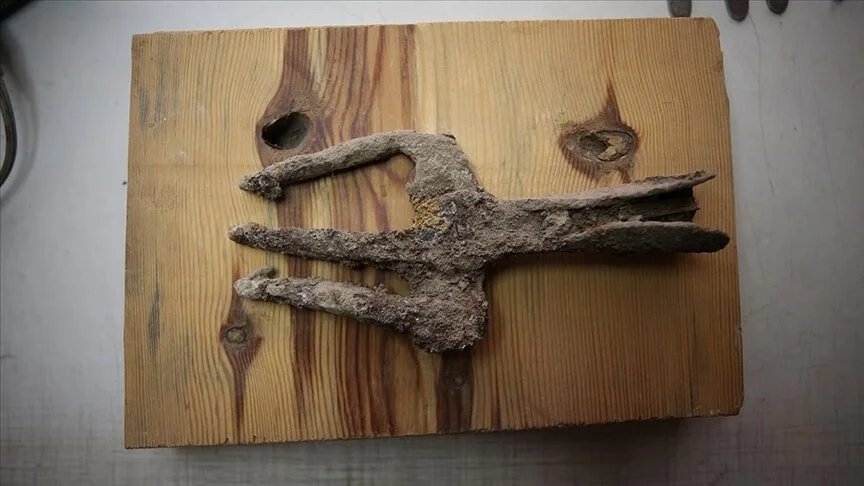
Archaeologists in the northwestern region of Turkey have recently made a captivating discovery in the ancient city of Assos, shedding new light on the historical significance of this remarkable site. The find in question is an ancient iron trident, believed to have been used for fishing, that dates back an astonishing 1,700 years. This trident's unearthing is not only a testament to the city's rich history but also a rare glimpse into the tools and practices of ancient fishermen.
Assos, situated in the Ayvacik district of Canakkale, is renowned for its well-preserved ancient ruins and artifacts from both the Roman and Byzantine eras. The ongoing excavations in this ancient city are being carried out under the guidance of Nurettin Arslan, a professor specializing in humanities and social sciences at Canakkale Onsekiz Mart University. The Turkish Ministry of Culture and Tourism and the Turkish Historical Society have provided essential support for this archaeological endeavor.
The team of dedicated archaeologists stumbled upon this extraordinary artifact during their excavations in the eastern part of the city, specifically in an area known as the Nymphaion, or eastern fountain. The trident was concealed beneath layers of soil and subjected to oxidization over the centuries. To unveil its historical significance, an expert restorer meticulously worked on cleaning and preserving this remarkable piece.

Professor Arslan explained that while iron tridents are frequently depicted in murals and other ancient depictions, this was the first time such a tool had been discovered in Assos. Iron, being susceptible to rapid decay, is typically scarce in ancient city excavations. This rarity makes the Assos trident a significant find, as it provides valuable insights into the fishing techniques of the time.

Arslan went on to describe how these tridents were likely employed by ancient fishermen, who would venture out to sea in small boats illuminated by torchlight at night to catch large fish. The tridents would have been essential tools in this daring and skillful pursuit.

Determining the precise origin of the trident remains challenging due to its iron composition. Iron was widely available and produced across various regions, making it difficult to pinpoint its place of production. However, Assos has yielded numerous discoveries of iron slag and iron forging, suggesting that this particular trident might have been crafted within the city itself.

This remarkable discovery further cements Assos's status as a treasure trove of historical and archaeological wonders. The ongoing excavations promise to reveal more about this ancient city's past, offering a glimpse into the lives and practices of those who once called Assos home.

As archaeologists continue to unearth and study these fascinating artifacts, Assos remains a captivating destination for history enthusiasts and curious travelers eager to explore Turkey's rich cultural heritage. The ancient trident serves as a tangible link to the past, allowing us to connect with the experiences and tools of our ancestors in this beautiful and historically significant part of the world.

Key aspects of the ancient city of Assos

The ancient city of Assos, also known as Behramkale in modern-day Turkey, is a historically and archaeologically significant site located in the northwestern part of the country. Assos is situated in the Ayvacik district of Canakkale Province, near the Aegean Sea. This ancient city is renowned for its well-preserved ruins and the insights it provides into the history and culture of the ancient world.

Assos has a rich and diverse history that spans several millennia. It was originally founded by Aeolian settlers from the island of Lesbos in the 8th century BCE. Over the centuries, Assos was ruled by various powers, including the Persians, Athenians, and Macedonians.

One of the most famous aspects of Assos's history is its association with the ancient Greek philosopher Aristotle. He spent some time in Assos and established a philosophical school there. The Temple of Athena in Assos is believed to have been the location of Aristotle's school, where he taught his disciples.

Assos is known for its impressive architectural remains. The Temple of Athena, which dates back to the 6th century BCE, is one of the most iconic structures. It features doric columns and offers breathtaking views of the surrounding landscape. Additionally, there are well-preserved city walls, a theater, and other ancient structures.

The city's strategic location overlooking the Aegean Sea made it an important center for trade and commerce in antiquity. Its position on a hill provided natural defenses against potential invaders and offered stunning vistas of the sea.

Roman and Byzantine Influence: Assos continued to thrive during the Roman and Byzantine periods, with various monuments and buildings added during these eras. The city served as a regional center and played a role in the Byzantine Empire's history.

Modern archaeological excavations have been conducted in Assos since the late 19th century, uncovering numerous artifacts and providing valuable insights into the city's history. These excavations continue to this day, revealing new details about Assos's past.

Today, Assos is a popular tourist destination, attracting visitors from around the world who are interested in its historical and cultural heritage. The well-preserved ruins, picturesque landscapes, and serene atmosphere make it an ideal place for exploration and reflection.

Assos's historical significance has led to efforts to preserve and protect its archaeological remains. Conservation projects and initiatives aim to safeguard the city's heritage for future generations.

Visiting the ancient city of Assos allows travelers to step back in time and experience the grandeur of ancient Greek and Roman civilizations. The combination of its historical significance, architectural marvels, and scenic beauty makes Assos a must-visit destination for history enthusiasts and tourists exploring the rich history of Turkey.

Mysteries of a 1900-Year-Old Judean Desert Child's Nightgown

October 11, 2023

In the heart of the Judean Desert, nestled near the Dead Sea, lies the enigmatic Cave of Letters. This ancient cavern, which can only be reached by ascending a daunting 50-foot climb, has long been a treasure trove of historical artifacts. Discovered in the early 1960s CE and meticulously excavated by the renowned Israeli archaeologist Yigael Yadin from 1960 to 1961, the Cave of Letters has yielded a fascinating array of papyrus letters and documents, some dating back to the Roman Empire era and even connected to the Bar Kokhba revolt.

However, among the wealth of discoveries in this remarkable cave, one stands out as particularly poignant: a 1900-year-old child's nightgown. This piece of clothing, with its intriguing knots, carries with it a story that tugs at the heartstrings of history enthusiasts and archaeologists alike.

The Cave of Letters, perched above the picturesque Nahal Hever canyon, boasts a unique collection of historical artifacts. While countless scraps of textiles from the Roman period have been found in various sites across Israel, it's in the Cave of Letters that textiles adorned with mysterious "knots" have emerged. These knots are like small pendants situated at the bottom of the garment, created by meticulously tying parts of the fabric around various substances known for their protective qualities. Among the materials used are resin, salt, iron sulfate, asphalt, henna, seeds, and several unidentified substances. This intricate binding was achieved by winding a flax thread around the material multiple times, a technique that speaks to the care and intention behind the garment's creation.

Photo: Israel Antiquities Authority

The nightgown, with its knots adorning the hem, is indicative of a child's size and was likely used as an undergarment beneath a colorful wool upper garment, possibly for decorative purposes. This precious relic consists of two equal-sized panels expertly sewn together along their upper edges, with an opening in the middle designed for the neck. Adding to its charm, the gown features flax threads that dangle gracefully from both sides of the neck.

Upon closer examination of the fabric itself, textile specialist Dr. Orit Shamir of the Israel Antiquities Authority noted that the thickness and density of the threads are not uniform. The weaving employed a simple twining technique, occasionally marked by subtle mistakes. Furthermore, the sewing of the garment exhibits a degree of imperfection, with several noticeable holes, some resulting from the inevitable wear and tear over time.

While the intricate craftsmanship of the nightgown speaks to the skills of its maker, it's the significance of the knots that adds a layer of depth to this historical find. Given that the nightgown is unquestionably designed for a child, it raises the intriguing possibility that these knots served a protective function. It's not difficult to imagine a caring mother, concealed in the depths of the Judean Desert, hiding substances like salt, iron sulfate, and resin within the knots while reciting prayers and offering hopeful wishes for the well-being of her son or daughter.

This child's nightgown from the depths of the Cave of Letters serves as a poignant reminder of the universal human desire to protect and nurture the ones we hold dear. As we unravel the mysteries of this ancient textile, we gain a glimpse into the daily lives and heartfelt sentiments of those who inhabited this remote desert region nearly two millennia ago. The Cave of Letters continues to be a testament to the enduring power of archaeology to connect us with our shared human history, one knot at a time.

Israel Antiquities Authority

Understanding the Geo-technical Parameters and Degradation of Historical Buildings in Najran City, Saudi Arabia

October 11, 2023

Najran City, nestled in the southwestern realm of Saudi Arabia, beholds a rich tapestry of historical structures that tell a tale of its vibrant past. However, the longevity and stability of these architectural treasures are under threat due to various geoenvironmental risks and weathering processes. A new study aims to delve into the heart of the matter, exploring the deterioration drivers in ancient buildings in Najran City and employing numerical simulations to understand the geo-technical parameters and their role in the degradation process.

Historical Significance and Geographical Context

The geographical expanse of Najran is not only a testament to Saudi Arabia’s booming population and burgeoning mining sector but also stands as a gatekeeper to a wealth of archeological sites that chronicle its rich history. With natural stone being a pivotal building material, the interplay between the geological characteristics of the area, such as the prevalence of Najran granite and red sandstone, and historical building preservation becomes critical.

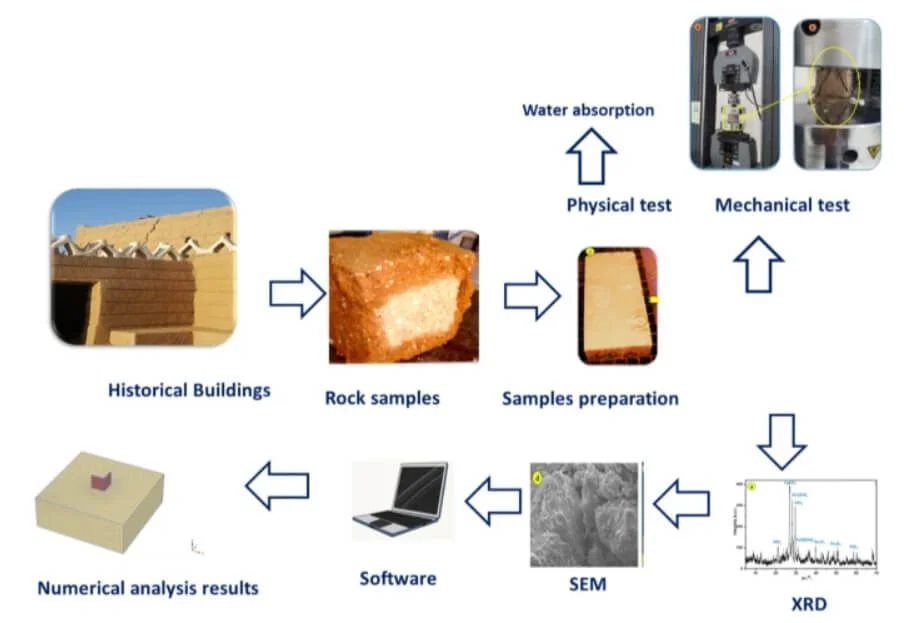
A detailed flowchart to explain the methodology and experimental tests of the present work.

Degradation Drivers of the Historical Buildings

The primary culprits contributing to the decline and fracturing of Najran City's historical buildings are recognized as the dissolution of clay minerals and salt crystallization, wind erosion, and intermittent wetting–drying cycles triggered by climate variables such as temperature and humidity. The area's mining expansion, according to Saudi Arabia's 2030 vision, further introduces man-made challenges and impacts on these ancient structures, which, coupled with natural weathering processes, create a complex deterioration network.

Methodological Approach Towards Preservation

To decipher the underlying degradation mechanisms and strive towards preservation, a meticulous approach embracing both field and lab observations, alongside numerical simulations, was adopted.

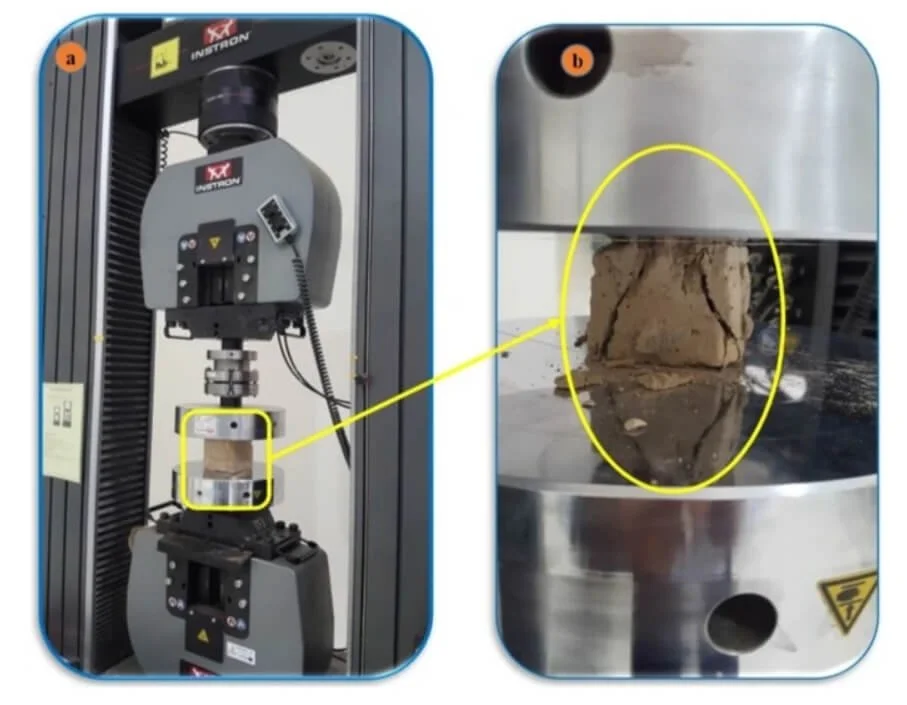
Field and Lab Observations: Techniques such as SEM, EDX, and XRD analyses were deployed, revealing kaolinite as a predominant mineral, with certain samples revealing traces of halite and goethite minerals. Other crucial data like unconfined compressive strength (average of 2 MPa) and water absorption (within the upper limit of 15%) of the earthen wall samples were also observed through experimental data.

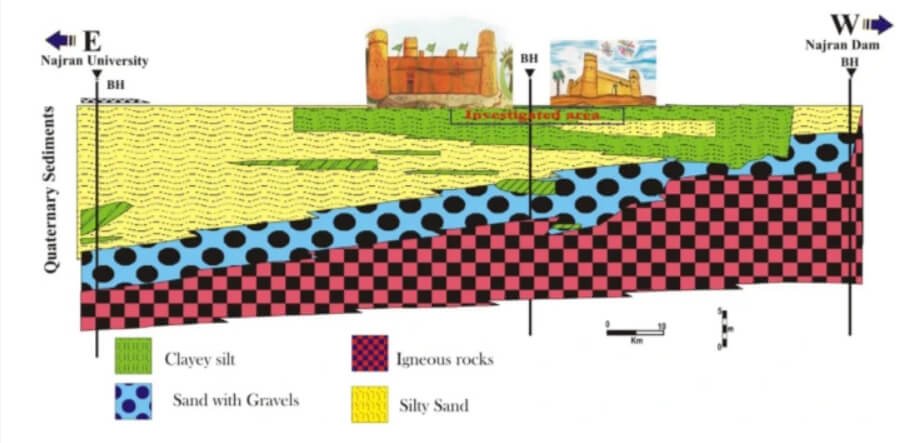
Numerical Simulations: Utilizing the PLAXIS 3D software, a finite element model of a typical earthen historical building was developed. This model, simulating the behavior of the silty sand soil layer beneath the building and evaluating the non-linear response of the earthen structures, confirmed that excessive settlement and environmental conditions were the primary culprits behind structural failure.

Compressive strength test of prepared cubed from historical buildings (a) test setup, (b) sample after failure and loading rate.

Role of Environmental Variables

The intricate web of environmental variables, such as fluctuating temperatures, contrasting day and night humidity, and wind erosion, plays a pivotal role in expediting the degradation of historical buildings. The absorption test results, which calculated the percentage of moisture absorbed by the blocks, showed adherence to acceptable standards, albeit closely bordering the upper allowed limit. However, the resultant continuous wetting and drying cycles pose significant threats to the stability and longevity of the structures.

Insights from Human-induced Damage

Man-induced damages, including spray paint graffiti, scrape marks from sharp tools, and intentional structural perforations, further aggravate the deteriorative cycle. This underscores the significance of integrating preventative and restorative measures into the conservation strategy to safeguard historical edifices against such detrimental human activities.

Concluding Observations

Through a systematic integration of field observations, laboratory analyses, and numerical simulations, the research highlights the imperative to recognize the interplay between geotechnical, environmental, and anthropogenic factors in the degradation of historical structures. Understanding these interactions will facilitate the development of targeted restoration and preservation strategies, thereby safeguarding the architectural heritage of Najran City and ensuring the tales of its antiquity continue to echo through future generations.

E–W profile along the area of study area showing the subsurface layers of foundation beds of the historical building.

Future Perspectives

Preservation Techniques: Employing innovative and sustainable preservation techniques that counteract the effects of identified degradation drivers

Policy-making: formulating policies that safeguard the architectural heritage from both environmental and human-induced damages, ensuring that they continue to stand tall as symbols of Najran's vibrant history and culture.

Community Engagement: Fostering a community-oriented approach that cultivates an appreciation for architectural heritage and encourages active participation in its conservation

23,000 Years Ago: New Research Sheds Light on Early Human Presence in America

October 11, 2023

For decades, the question of when and how humans first settled in the Americas has been a contentious topic in the field of archaeology. The conventional wisdom, until recently, was that humans arrived in the North American interior around 14,000 years ago, coinciding with the formation of an ice-free corridor between massive ice sheets in Canada and the northern United States. However, groundbreaking research has challenged this narrative, pushing the timeline back by several millennia.

In a significant departure from the previously accepted timeline, a study published in September 2021 asserted that humans had set foot in the Americas approximately 23,000 years ago, a time when the last Ice Age was at its peak. This revelation added a substantial 7,000 years to the known history of human presence on the continent, effectively rewriting the prehistory of the Americas.

Critics of this extraordinary claim pointed to concerns about the accuracy of the radiocarbon dating method used in the 2021 study. They raised the issue of the "hard water" effect, which occurs when groundwater, isolated from the atmosphere for an extended period, contains carbon-14 that has already undergone radioactive decay, potentially skewing radiocarbon dates.

Image courtesy of USGS.

Acknowledging these concerns as an essential part of the scientific process, researchers embarked on a mission to retest and confirm their findings. Their efforts included innovative techniques and methodologies that shed new light on the ancient past of the Americas.

One of the key aspects of the new research involved dating fossilized pollen grains found in sediment layers both above and below the footprints discovered near White Sands, New Mexico. These common ditch grass seeds were subjected to radiocarbon dating, a well-established and reliable technique for dating organic materials. However, dating pollen grains presented a unique challenge due to their minuscule size, typically around 0.005 millimeters in diameter. To obtain a sufficient amount of carbon for dating, thousands of pollen grains were required.

To overcome this challenge, the researchers turned to medical science and employed a technique called flow cytometry. Normally used to count and sample individual human cells, this method uses the fluorescence of cells stimulated by a laser to identify and isolate them from a liquid stream. In this case, it was adapted to count and concentrate fossilized pollen grains for radiocarbon dating.

The footprints come from a group of people of different ages. National Park Service

After extensive and painstaking laboratory work spanning over a year, the researchers successfully dated the pollen, with a focus on pine pollen that was unaffected by the "hard water" effect. These new dates validated the original chronology of the footprints and conclusively demonstrated that old water effects were not at play at the White Sands site.

Beyond confirming the timeline of the footprints, the pollen analysis also provided insights into the vegetation that thrived when the people left their marks in the area. The plant species identified were consistent with what one would expect to find in Ice Age New Mexico.

As an additional layer of verification, the research team employed optically stimulated luminescence (OSL) dating. This method relies on the accumulation of energy within buried quartz grains over time, originating from background radiation. By measuring the light emitted by these grains when exposed to light in a controlled laboratory setting, scientists can determine the last time the grains saw sunlight, thus providing an age estimate. Remarkably, the OSL dates aligned with those obtained through other dating techniques.

In summary, the combination of radiocarbon dating, pollen analysis using flow cytometry, and OSL dating has provided a robust and convincing argument for the presence of humans in the Americas approximately 23,000 years ago. This research challenges long-held beliefs about the timing of human migration to the continent and underscores the importance of continued scientific exploration and inquiry.

The journey to understanding the history of human settlement in the Americas is far from over, but with each breakthrough, we inch closer to unraveling the mysteries of our past. This remarkable research not only advances our knowledge of ancient human migration but also highlights the power of interdisciplinary collaboration in unraveling the tapestry of our shared history.

In Paleontology
← Newer Posts Older Posts →
Featured
image_2026-08-21_231115959.png
August 23, 2026
Mudejar Sintra: Portugal's Islamic Palace Remains
August 23, 2026
Read more →
August 23, 2026
image_2026-08-21_231446774.png
August 23, 2026
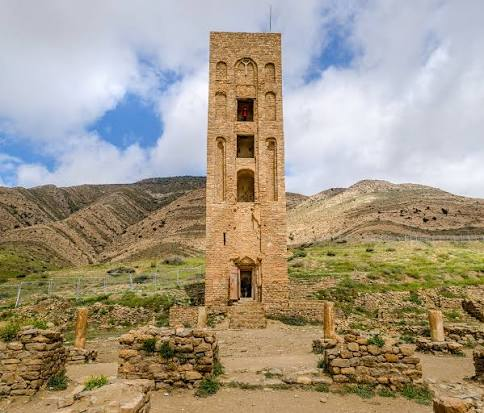
Qal'at Bani Hammad: Algeria's 11th-Century Aghlabid City
August 23, 2026
Read more →
August 23, 2026
image_2026-08-23_221330300.png
August 23, 2026
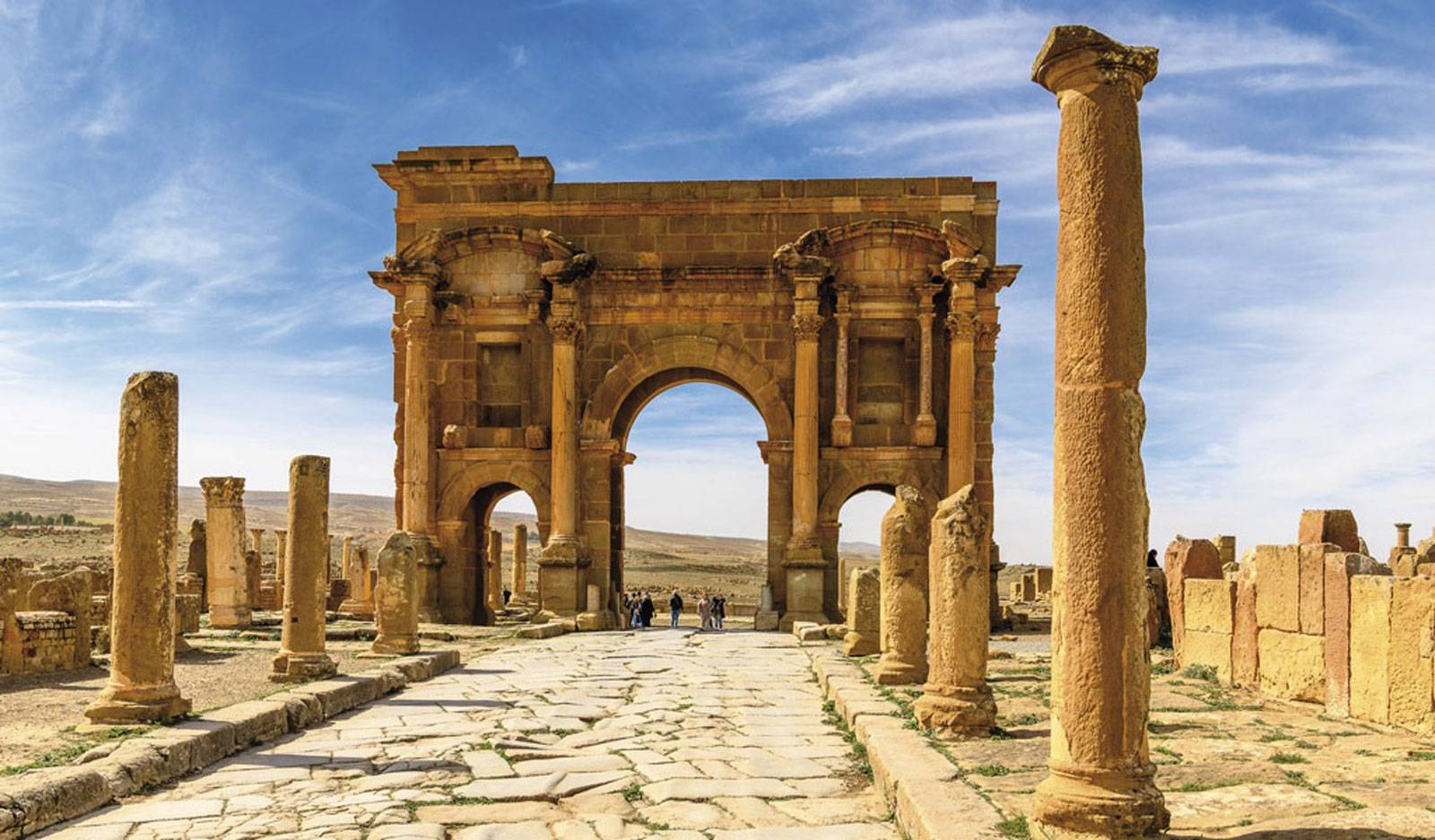
Timgad: Algeria's Roman North African Colony
August 23, 2026
Read more →
August 23, 2026
libya-tadrart-acacus-cave-art--e1508918107880.jpg
August 23, 2026
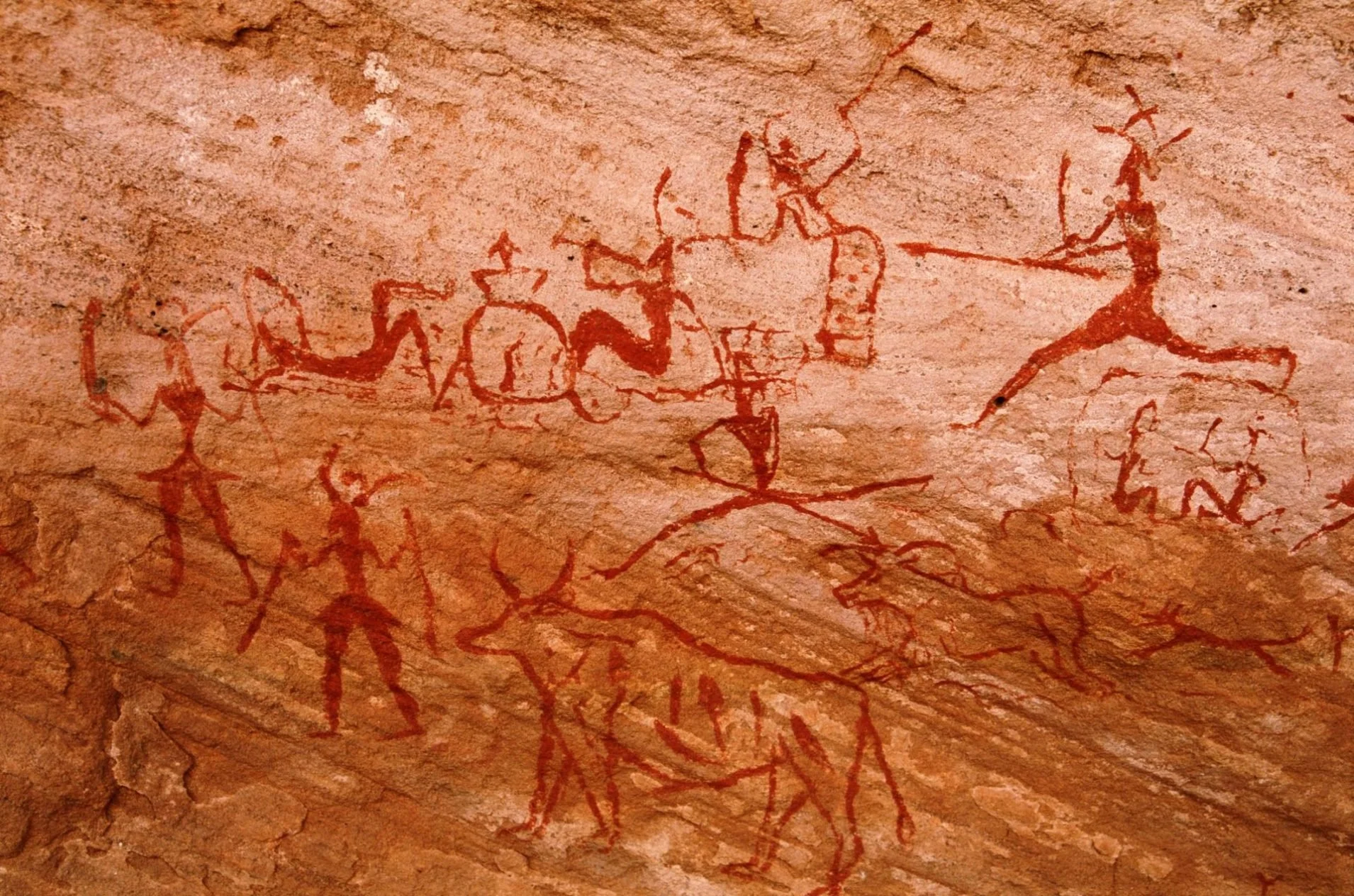
Acacus Mountains: Libya's 14,000-Year Rock Art
August 23, 2026
Read more →
August 23, 2026
Fondazione_Passaré_V1_056.jpg
August 23, 2026
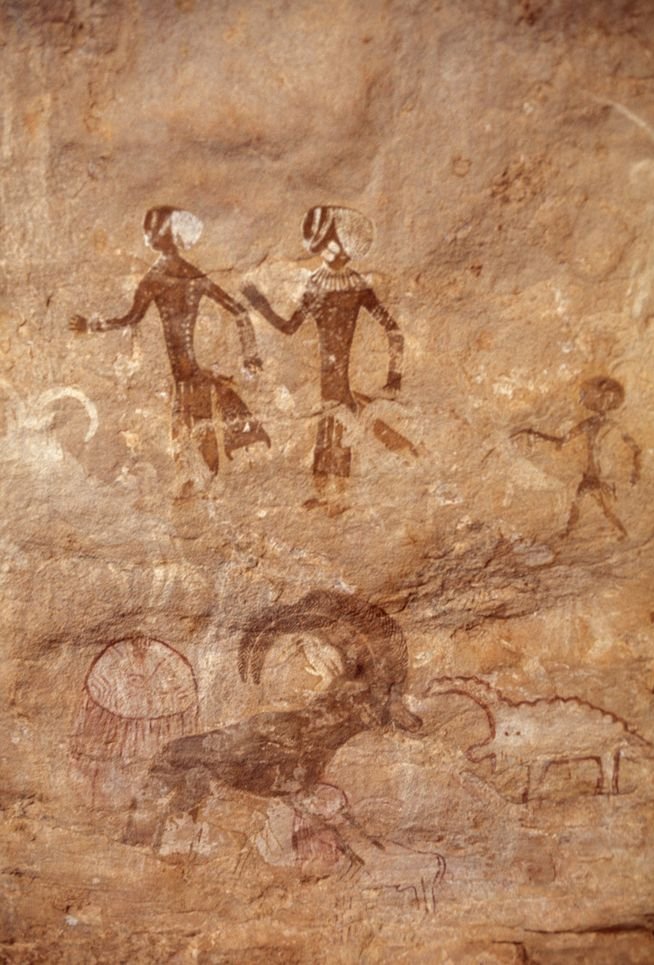
Ti-n-Torha: Libya's Round Head Paintings
August 23, 2026
Read more →
August 23, 2026
images.jpeg
August 23, 2026
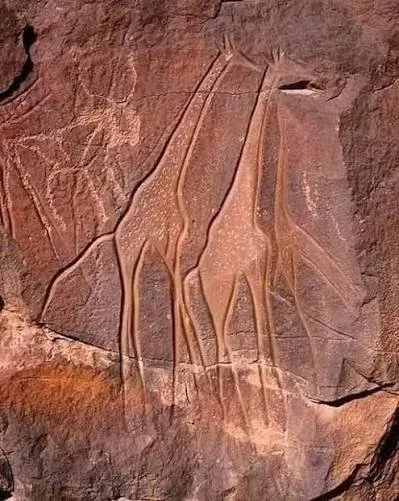
Messak Settafet: Libya's 10,000-Year Engravings
August 23, 2026
Read more →
August 23, 2026
read more

Powered by The archaeologist