Learn about a 500,000-year old hammer made from elephant bone, used by early humans in England to sharpen stone tools.
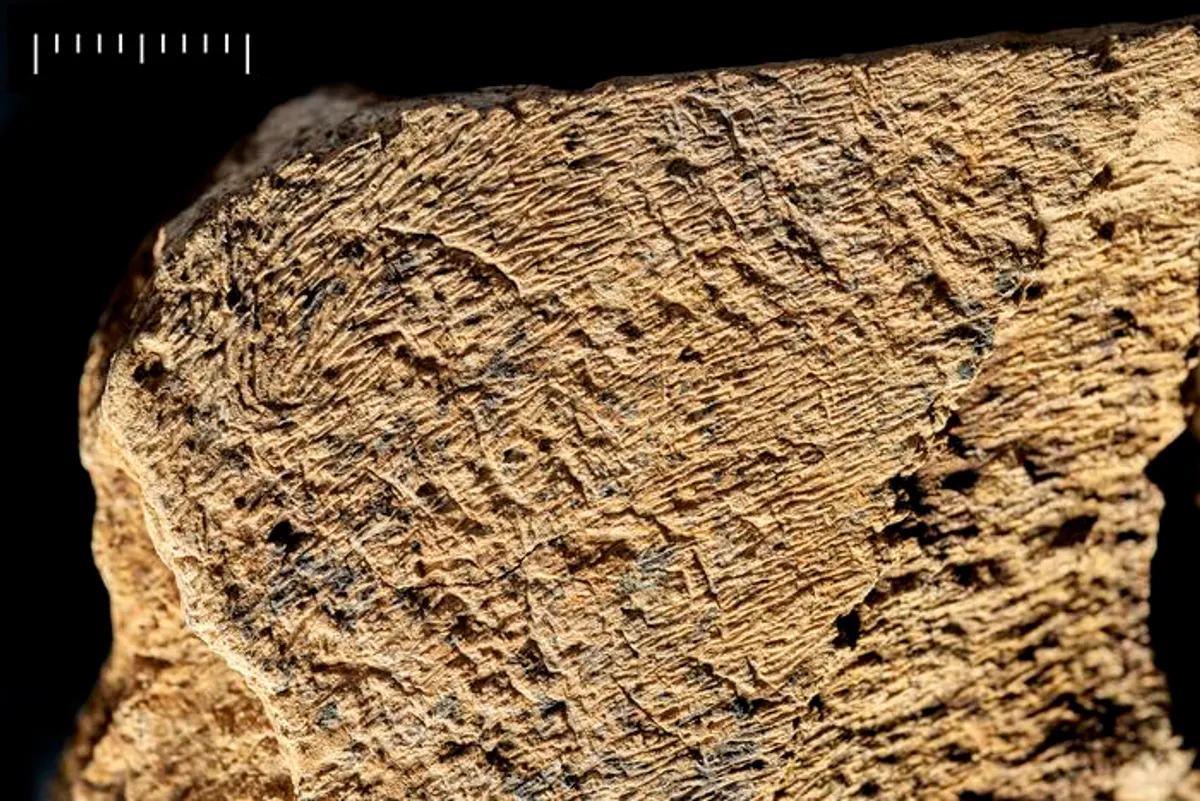
The elephant bone tool’s surface shows marks of it being struck against flint tools.
Early humans were remarkably inventive, crafting tools not only from stone but also from animal bones. One striking example is a primitive hammer made from elephant bone that dates back nearly 500,000 years and was recently identified in southern England.
A new study published in Science Advances highlights the ingenuity of the early human species that used this bone hammer to refine stone tools. Elephant bone, a rare material in prehistoric Britain, proved ideal for tool maintenance because of its thickness and durability. The surface of the hammer bears clear impact marks, showing it was repeatedly struck against stone and revealing a high level of technical skill.
“This extraordinary find demonstrates the creativity and adaptability of our ancient ancestors,” said lead author Simon Parfitt, a research fellow at University College London. “They had an in-depth understanding of local materials and knew how to use them to produce finely crafted stone tools.”
Bone tools and early humans
In Europe, the earliest clear evidence for deliberately made bone tools dates to around 500,000 years ago. Archaeological sites in central and southern Europe have yielded shaped bone implements, some of which were used to resharpen stone tools. Across Eurasia, such bone technologies were likely first developed by Homo heidelbergensis and later adopted and expanded by Neanderthals, reflecting growing technological complexity.
The use of bone tools, however, extends even further back in time. A study published in March 2025 reported the discovery of 1.5-million-year-old tools from Olduvai Gorge in Tanzania, made from the limb bones of large mammals. Early hominins in East Africa mainly used hippopotamus and elephant bones to create elongated, pointed, and notched tools.
The 500,000-year-old hammer discussed in the new study is the oldest elephant bone tool ever identified in Europe. Although the bone fragment was excavated in the early 1990s at the Boxgrove site in the UK, it was only recently recognized as a tool following renewed analysis.
“Elephant bone would have been a rare yet highly valuable resource, and this object was likely an important and well-used tool,” Parfitt said.
Researchers examined the artifact using 3D scanning and electron microscopy, which revealed notches and impact marks consistent with hammering. Tiny fragments of flint embedded in these notches further confirmed that the bone had been repeatedly used to strike stone.
Sharpening stone tools
The team suggests that either early Neanderthals or Homo heidelbergensis made the tool, although the fragment is too incomplete to identify the exact elephant species. The markings indicate the bone was relatively fresh when it was used, but it remains unclear whether it came from a hunted elephant or a scavenged carcass.
The triangular hammer likely functioned as a “retoucher,” used to resharpen dulled stone handaxes and other tools by carefully chipping away flakes. Elephant bone was particularly well suited to this task: softer than stone for precise work, yet strengthened by a dense outer layer of cortical bone that made it more durable than most other animal bones.
“Our ancestors showed a sophisticated understanding of tool use,” said co-author Silvia Bello of the Natural History Museum in London. “Selecting and shaping an elephant bone fragment, then repeatedly using it to maintain stone tools, reflects advanced planning, abstract thinking, and an impressive ability to make the most of available resources.”