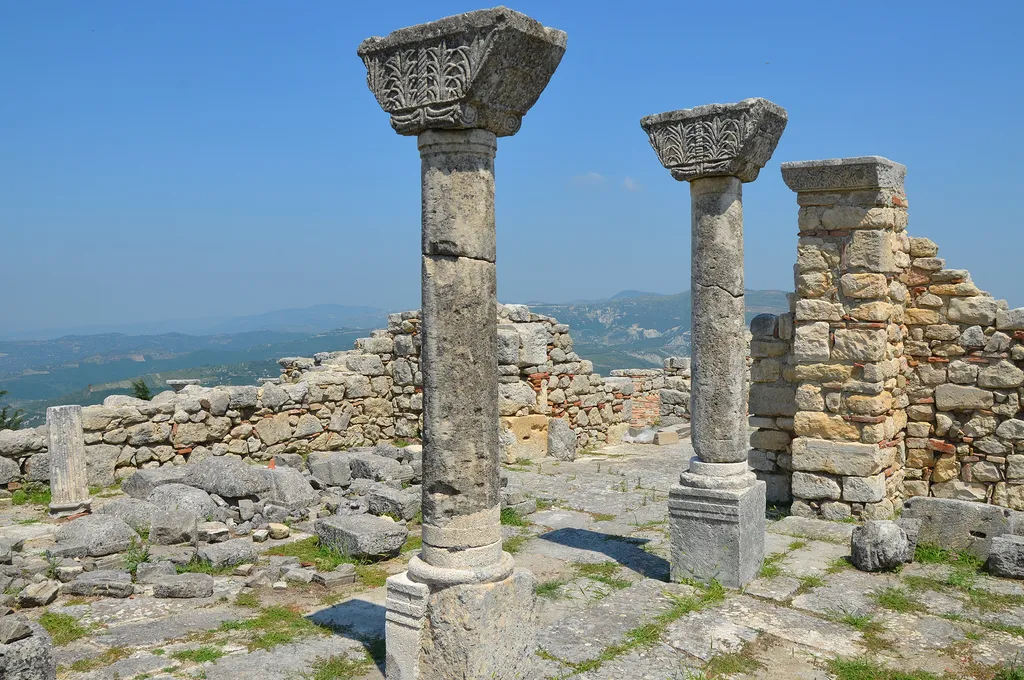
For centuries, the classical city of Byllis—perched on a dramatic, 1,700-foot-high triangular plateau overlooking the Vjosa River valley in southern Albania—was viewed by Western scholars through a strictly Greco-Roman lens. It was long cataloged as a secondary colonial outpost established by Greek settlers expanding into the Adriatic. However, extensive, multi-year international excavation campaigns culminating in comprehensive reports between 2025 and 2026 have completely shattered this Eurocentric historical model.
   [ THE HISTORICAL MYTH ] ──► Greek Colonial Foundation Theory (Passive Periphery)
                                              │
                                  (The 2025 Excavations)
                                              │
                                              ▼
   [ THE EXCAVATED REALITY ] ◄── Indigenous Illyrian Urban Capital (Active Engine)
The newest archaeological layers prove that Byllis was a monumental, indigenous Illyrian urban capital planned, engineered, and inhabited by the Bylliones tribe. The ongoing European Union-funded conservation and excavation projects exposed the earliest foundations of the city’s massive, two-mile-long defensive wall circuit. These fortifications, which enclose an area of over 30 hectares, utilize a distinct trapezoidal and polygonal masonry style that pre-dates Hellenistic architectural adjustments. The Illyrians carved these massive limestone blocks directly from the living rock of the plateau, fitting them together without mortar to create an impenetrable barrier against Macedonian expansion.
The Civic and Democratic Matrix
The recent rediscoveries went far beyond military architecture, exposing a highly organized society. Excavators uncovered a sprawling administrative and civic heart that rivals the famous poleis of the Aegean:
The Stoa Complex: A massive, 140-meter-long double-storied promenade that served as the economic and legal spine of the city.
The Prytaneion: The official seat of the indigenous government, where archaeologists found administrative bronze tablets and weights stamped with the explicit ethnic name of the tribe: BYLLIONON.
The Great Theater: A 7,500-seat theater carved directly into the natural slope of the hill, utilizing an acoustic design optimized for public tribal assemblies rather than just dramatic performances.
The presence of these structures proves that the Illyrians were not "barbarians" living on the fringes of the classical world, but masters of independent, sophisticated urbanization. They operated a highly organized democratic state system, minted their own distinct currency, and managed a complex network of public works long before Roman legions marched across the Balkans.
Social Freedom and Economic Mastery
What has truly shocked historians is the evidence regarding the social fabric of Byllis. Excavations at the city's South Gate revealed clusters of ancient musical instruments—including cymbals, gongs, and bells—scattered across a localized performance area. This highlights a rich public performance culture where artistic talent flourished.
Furthermore, epigraphic evidence recovered from ivory and stone tablets within the region indicates a highly progressive legal standing for women. In stark contrast to classical Athens or Rome, where women were effectively disenfranchised property, wealthy Illyrian women at Byllis acted as independent moneylenders and high-level financial transactors.
The economic muscle of the city was tied directly to its geography. The Bylliones controlled Europe's largest natural bitumen mine, which is active to this day. They leveraged this highly prized material, used for waterproofing ships and sealing structures across the Mediterranean, to establish a vast trade monopoly.
By the late antiquity and Byzantine periods, Byllis evolved into a massive Christian powerhouse. A network of five sprawling basilicas was erected, featuring over one hectare of brilliant mosaic flooring. Unlike contemporary Byzantine churches that focused exclusively on austere biblical scenes, the Byllis mosaics depict vibrant, secular everyday life: shepherds tending flocks, fishermen hauling nets bursting with crabs and lobsters, and detailed renderings of native flora, mushrooms, and fruit trees.
One prominent inscription reads, "In fulfillment of the vow of those whose names God knows," demonstrating a collective civic humility where elite donors chose divine recognition over personal vanity. Strikingly, these religious complexes were also commercial engines; excavations within the episcopal palace uncovered large-scale wine and oil production facilities directly integrated into the architecture. The Bishops of Byllis were running lucrative trade networks alongside their spiritual duties, cementing the city's status as an enduring center of wealth, production, and cultural autonomy until its eventual abandonment.