The island of Sardinia is home to one of the most sprawling, sophisticated, and deeply enigmatic architectural phenomena of the ancient Mediterranean: the Nuraghe towers.
Scattered across the rugged Sardinian landscape are the stone ruins of more than 7,000 to 8,000 of these monumental Bronze Age megaliths. Built by a forgotten civilization that left behind no written records, these towers represent a staggering feat of prehistoric engineering that continues to spark intense archaeological debate.
1. The Nuragic Civilization: Masters of Bronze and Stone
The architects of these structures are known simply as the Nuragic civilization, a highly organized, martial society that flourished on Sardinia from roughly 1800 BCE down to the Roman conquest in the 2nd century BCE.
While contemporary civilizations in Egypt, Mycenaean Greece, and Mesopotamia were developing writing systems, the Nuragic people channeled their collective energy into two massive cultural outputs: exceptional bronze metallurgy (producing thousands of detailed bronze statuettes, or bronzetti) and megalithic stone architecture. They transformed the entirety of Sardinia into a fortified, stone-clad landscape long before the founding of Rome.
2. Megalithic Engineering: Built Without Mortar
The sheer scale of a standard nuraghe is an engineering marvel. A typical tower is shaped like a truncated cone, resembling a modern industrial cooling tower, often standing between 30 to 65 feet (10 to 20 meters) tall.
What makes their preservation across three millennia so astonishing is their construction technique:
Cyclopean Masonry: The towers were built using giant, roughly hewn blocks of local volcanic rock, such as basalt, granite, or trachyte.
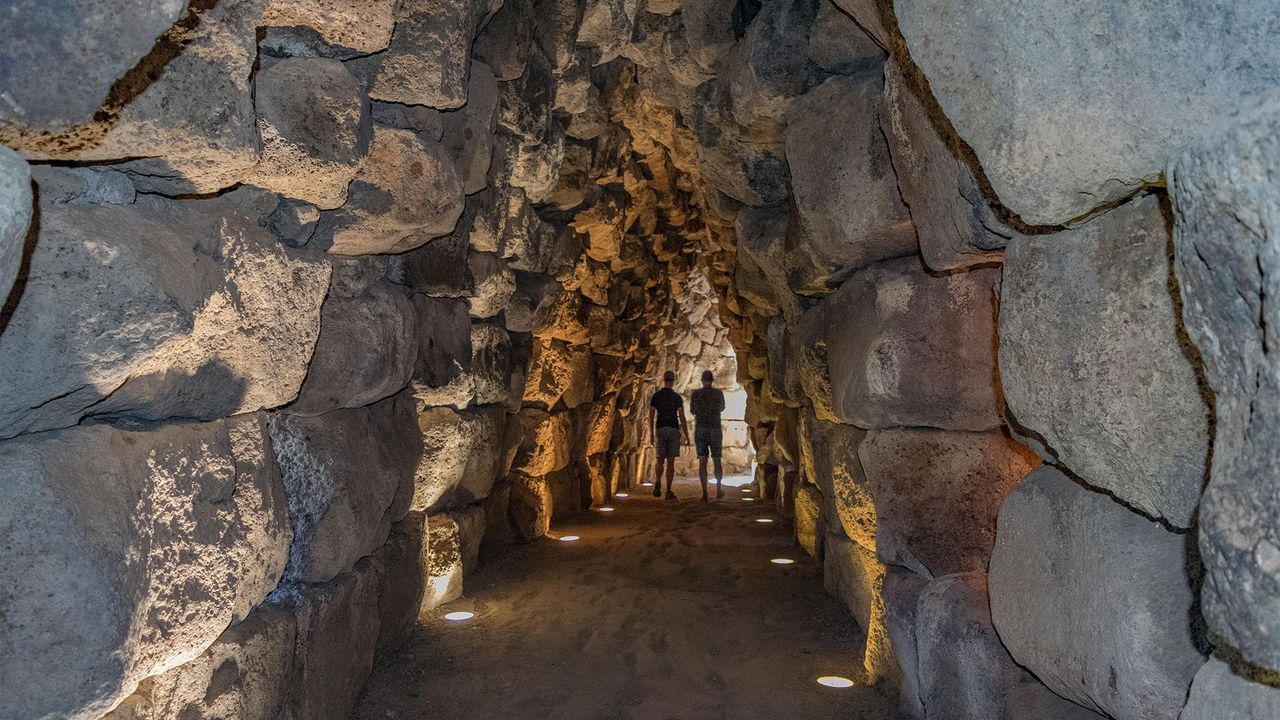
Dry-Stone Construction: The Nuragic builders used absolutely no mortar or cement. The immense structures are held together solely by the laws of gravity, the immense weight of the stones, and the precise, geometric interlocking of the blocks.
The Tholos Dome: Inside the towers, the builders utilized the tholos technique—corbelling rows of stones inward, layer by layer, until they met at the top to form a perfect, self-supporting domed ceiling.
A central, spiral stone staircase was frequently built directly inside the thick cavity of the double walls, allowing defenders to climb safely to upper floors or a roof-deck platform without being exposed to the outside.
3. From Simple Towers to Royal Citadels
As the centuries progressed, Nuragic architecture evolved from isolated watchtowers into massive, sprawling royal fortresses that rivaled the contemporary palaces of Mycenae.
Su Nuraxi di Barumini
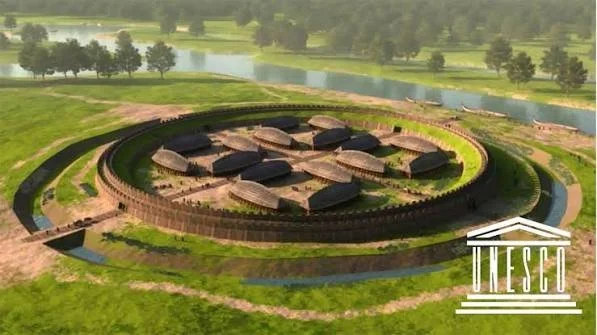
The absolute pinnacle of this architectural evolution is Su Nuraxi di Barumini, a UNESCO World Heritage site located in southern Sardinia.
Dating back to the 16th century BCE, Barumini evolved into a complex, multi-towered citadel containing several layers of defense:
The Central Keep (Mastio): A massive three-story central tower that originally stood over 60 feet tall, featuring three stacked tholos chambers connected by internal staircases.
The Quadrilateral Bastion: A defensive wall containing four secondary towers, oriented to the four cardinal directions, linked by a massive curtain wall.
The Outer Ring and Village: Surrounding the central fortress is a labyrinth of over a hundred circular stone huts, meeting rooms, and ritual sanctuaries where the broader community lived, creating a highly organized, fortified urban ecosystem.
4. The 8,000 Mysteries: What Were They For?
Because the Nuragic people left behind no written records, texts, or inscriptions, the true function of the nuraghe towers remains the greatest mystery of the ancient Mediterranean. Archaeologists are sharply divided, with several competing theories:
The Military Fortress Theory
The traditional, long-standing view is that the nuraghes were defensive military strongholds. Their strategic placement on high plateaus, commanding hilltops, and valley passes suggests an island-wide network of defensive watchtowers. The thick walls, internal staircases, arrow-slits, and complex bastions indicate they were designed to withstand prolonged sieges, either from rival local clans fighting over fertile pastureland or from sea-faring foreign invaders.
The Elite Royal Residence Theory
Other researchers view the nuraghes as symbols of political power and prestige—the prehistoric equivalents of medieval castles. In this model, the grandest multi-towered structures were the permanent palaces of local tribal chieftains or royal dynasties, serving as administrative centers to control agricultural wealth, store bulk food supplies, and house the elite warrior class.
The Sacred Astronomical Sanctuary Theory
A more modern, interdisciplinary school of thought focuses on archaeoastronomy. Many nuraghes feature entrance portals and inner chambers precisely aligned with specific celestial events, such as the winter solstice sunrise, the rising points of specific bright constellations, or maximum lunar cycles. Proponents argue that the towers were sacred temples or cosmic calendars managed by a priestly caste to track agricultural seasons.
5. Structural Evolution of the Towers
Simple Nuraghe
Architecture: Composed of a single, isolated conical tower.
Interior Space: Features one to three stacked tholos chambers built on top of each other.
Location Strategy: Positioned on isolated hills, borders, and high mountain passes to serve as tactical watchtowers or border posts.
Complex or Polylobed Nuraghe
Architecture: Built around a central keep (mastio) enveloped by multiple secondary towers linked by a heavy curtain wall.
Interior Space: Expands into a miniature citadel with internal courtyards, corridors, storage silos, and water cisterns.
Location Strategy: Erected in low valleys, fertile plateaus, and centers of large settlements to serve as royal palaces or regional administrative hubs.
Sardinia's nuraghe towers stand as an enduring monument to the ingenuity of a Bronze Age society that successfully shaped the geology of their island. Whether they were built as fortresses of war, palaces of kings, or temples to the stars, these thousands of silent stone sentinels remain one of the ancient world's most compelling architectural mysteries, serving as a powerful reminder of the sophisticated, forgotten empires that once navigated the Mediterranean.