In Ancient Egyptian society, linen was far more than a textile; it was a symbol of purity, light, and social status. Known as "woven air," the finest Egyptian linen was so translucent that the wearer’s skin could be seen through multiple layers. During the New Kingdom (c. 1550–1070 BC), weaving technology reached its zenith, transitioning from domestic craft to a sophisticated industrial enterprise.
1. From Field to Fiber: Flax Processing
The foundation of all Egyptian linen was the flax plant (Linum usitatissimum). Unlike cotton, which was not used in Egypt until much later, flax required labor-intensive preparation.
Pulling and Rippling: Flax was pulled from the ground by the roots to preserve the full length of the fibers. The seed heads were then removed using a large wooden comb called a ripple.
Retting and Breaking: The stalks were soaked in water (retting) to rot the woody outer stem. Once dried, the stems were beaten with wooden mallets to release the long, inner bast fibers.
Hackling: The fibers were combed through spikes to align them and remove any remaining straw, resulting in a bundle of soft, blonde "tow."
2. The Innovation of the Vertical Loom
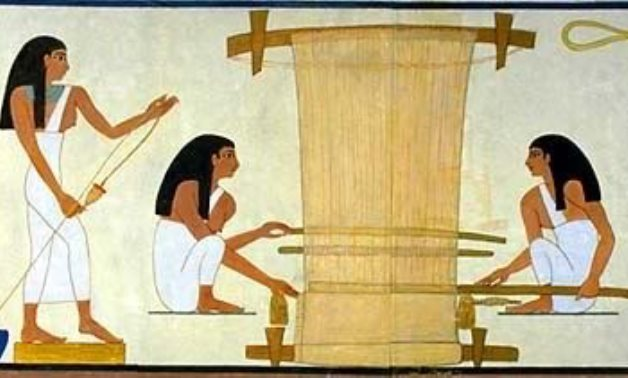
The most significant technological shift of the New Kingdom was the introduction of the Vertical Loom, likely brought to Egypt by the Hyksos.
The Old Style: Previously, Egyptians used horizontal ground looms, which forced weavers to crouch over their work and limited the length of the cloth to the reach of their arms.
The New Style: The vertical loom allowed weavers to stand or sit comfortably. It utilized a heavy wooden frame where the warp threads were weighted or tied to a bottom beam. This allowed for much larger pieces of fabric and more intricate patterns, as the weaver could see the entire "canvas" at eye level.
3. Spinning: The Drop Spindle
Before weaving could begin, the flax had to be spun into thread. Egyptian spinners were famous for their ability to produce incredibly thin, strong yarn.
The Spindle: They used a "drop spindle"—a wooden stick with a circular weight (whorl) at the top. By spinning the spindle like a top and letting it drop, the fibers were twisted together.
High Velocity: Professional spinners often worked in pairs or used a "spinning bowl" to keep the thread tension consistent. The resulting thread was often finer than the machine-spun thread used in high-end modern garments.
4. Dyeing and Sizing
While the "ideal" look for an Egyptian was bleached, brilliant white, the New Kingdom saw an explosion of color and texture.
Mordant Dyeing: Egyptians used minerals like alum to help vegetable dyes (such as woad for blue or madder for red) bond to the linen fibers.
Sizing: To make the fine threads easier to handle on the loom, they were often coated in a thin layer of starch or glue (sizing). This prevented the linen from fraying or snapping under the tension of the weights.
5. Pleating: The Fashion of the Elite
One of the most recognizable features of New Kingdom fashion—as seen on statues of Nefertiti or Ramesses II—is the intricate, razor-sharp pleating.
The Technique: Pleats were created by pressing the wet linen onto a heavy wooden board carved with parallel grooves. Once the fabric dried, the starch within the fibers held the shape.
The Vizier’s Wardrobe: High-ranking officials wore "Kalasiris" (long tunics) with thousands of these pleats, which shimmered and expanded as they moved, creating a liquid-like effect.
6. The Sacred Warp: Mummification and Ritual
Linen held a deep religious significance because it was a plant-based material, unlike wool which was considered "unclean" by priests.
The "House of Life": Large temples had their own weaving workshops dedicated to producing the linen used for cult statues and priests.
Mummification: A single mummy could require over 375 square meters of linen bandages. These were often recycled from high-quality household linens (old tunics or bedsheets), as the Egyptians believed that using familiar cloth helped the soul recognize its physical form in the afterlife.