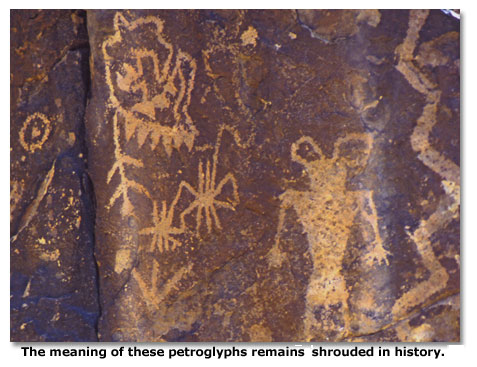
The American Southwest—spanning Utah, Arizona, New Mexico, and Colorado—is home to one of the world’s most dense concentrations of petroglyphs. Unlike pictographs, which are painted onto the stone, petroglyphs are pecked, carved, or abraded into the "desert varnish" (a dark patina of manganese and iron oxides) to reveal the lighter rock beneath.
These images were created by various cultures, including the Ancestral Puebloans, Fremont, and Hohokam, spanning thousands of years from the Archaic period to the arrival of the Spanish.
1. The Mechanics: How Stone Records Art
The longevity of petroglyphs is due to the chemical interaction between the artist and the cliff face.
Desert Varnish: Over millennia, bacteria and wind-blown dust create a dark, shiny coating on sandstone.
The Tools: Artists used "indirect percussion," where a hammerstone struck a stone chisel to chip away the varnish.
Patination: After a petroglyph is carved, it begins to "re-patinate." Archaeologists use the darkness of the carving relative to the surrounding rock to estimate age; the darker the image, the older it likely is.
2. Classifying the Styles
Petroglyphs are categorized by specific cultural "signatures" that reflect the worldview of the people who carved them.
Barrier Canyon Style: Characterized by tall, tapered, "ghost-like" figures that often lack arms or legs. These are some of the oldest (dating back 4,000+ years) and most haunting images in the Southwest.
Fremont Style: Known for "trapezoidal" human figures with elaborate headdresses, jewelry, and shields. They are often found in the Great Basin and northern Utah.
Ancestral Puebloan (Anasazi): These feature more recognizable animals (zoomorphs), flute players (Kokopelli), and intricate geometric spirals.
3. The Spiral: The "Calendar" Hypothesis
One of the most common symbols in the Southwest is the spiral. While it has many meanings, archaeology has proven that some were used as sophisticated solar observatories.
The Sun Dagger: At Fajada Butte in Chaco Canyon, a spiral was carved behind three stone slabs. On the summer solstice, a "dagger" of light pierces the exact center of the spiral.
Agriculture: These carvings weren't just art; they were agricultural tools that told farmers exactly when to plant maize based on the position of the sun during the equinoxes.
4. Iconography: Reading the Symbols
While we cannot "read" petroglyphs like a book, researchers and modern Indigenous descendants provide insight into the recurring motifs:
Bighorn Sheep: Often represent a successful hunt or perhaps a spiritual guide for rain-making.
Anthropomorphs: Figures with horns or feathers often represent shamans or deities (Kachinas).
Handprints: A universal sign of "I was here" or a symbol of a person’s connection to the earth and the sacred site.
Migration Lines: Long, undulating lines connecting different figures are often interpreted as "maps" of tribal migrations across the desert.
5. The "Rock Art" vs. "Writing" Debate
Archaeologists are careful to distinguish petroglyphs from a formal writing system like Cuneiform or Maya glyphs.
Ideograms: Most petroglyphs are ideograms—symbols that represent an idea or a story rather than a specific sound or word.
Cultural Context: To the Hopi, Zuni, and Diné (Navajo) people, these are not "dead" art. They are living records of ancestral history, clan migrations, and spiritual covenants that continue to hold power today.
6. Preservation and Ethics
Petroglyphs are incredibly fragile. The oils from human skin can damage the desert varnish and introduce bacteria that "eat" the image.
Vandalism: Tragically, many sites have been marred by graffiti or "chalking" (outlining images in chalk to make them pop for photos).
Tribal Sovereignty: Modern archaeology now works closely with Indigenous tribes to ensure that sites are managed with spiritual respect, often leaving some locations undisclosed to the public to prevent desecration.
The petroglyphs of the Southwest are a "library in the landscape." They remind us that for thousands of years, the desert was not an empty space, but a deeply mapped and storied home.